If you have forward head posture (FHP) you may well spend endless hours focusing on your sitting, working, cell phone or exercising posture. But what about the many hours you spend sleeping?
Your sleeping position can influence the position of your head and neck for several hours at a time. A pillow that is too high, too low, or simply not suited to your sleeping position may leave you with neck stiffness or discomfort when you wake up.
But here’s the thing: adjusting your sleeping posture isn’t going to fix your forward head posture on its own. The goal is to find a sleeping position that is comfortable and provides adequate support without placing unnecessary strain on your head and neck.
So if you’re wondering how to fix forward head posture while sleeping the real question should be: what sleeping posture and pillow combination will keep me the most comfortable while still supporting more comfortable head and neck positioning?
Table of Contents
- Can Your Sleeping Position Affect Forward Head Posture?
- What Is the Best Sleeping Position for Forward Head Posture?
- Sleeping on Your Back
- Side Sleeping With Proper Pillow Support
- What About Sleeping on Your Stomach?
- How to Choose the Right Pillow for Forward Head Posture
- Pillow Height
- Should You Use a Cervical Pillow?
- What About Adjustable Pillows?
- How to Set Up Your Sleeping Position for Better Neck Support
- Common Sleep Mistakes That May Increase Neck Discomfort
- Can Sleeping Position Actually Correct Forward Head Posture?
- What Else Can You Do During the Day?
- When Should You See a Healthcare Professional?
- Frequently Asked Questions
- Bottom Line
Quick Answer: What Is the Best Sleeping Position for Forward Head Posture?
There is no single ideal sleeping position for everyone with forward head posture.
Sleeping on your back can make it easier for some people to maintain a comfortable, relatively neutral head and neck position when the pillow height is appropriate.
Side sleeping can also be comfortable when the pillow provides enough support to fill the space between your head and the mattress without pushing your neck excessively upward or allowing it to drop downward. Stomach sleeping requires your head to remain rotated to one side so that you can breathe, which may be uncomfortable for some people with neck problems.
Therefore, the safest and most suitable sleep positions are those that do not force your body into an unnatural position. The practical goal is to find a comfortable position that supports your head and neck without placing them in an excessively flexed, extended, or rotated position.

What Is Forward Head Posture and How Does Sleep Relate to It?
Forward head posture refers to a head position where the head is further forward relative to the trunk and shoulders than in a more neutral posture.
FHP is often discussed with respect to neck discomfort, but the relationship between posture and pain is more nuanced than it might initially seem. A systematic review and meta-analysis found differences in forward head posture in adults with and without neck pain, but the authors also found that factors such as age play a role in the relationship.
Forward head posture can be associated with neck stiffness, discomfort, and changes in how the head and neck are positioned. If you want to learn more about the common signs to look for, see our guide to forward head posture symptoms.
Sleep is relevant because you remain in a particular position for a prolonged period while sleeping.
If your pillow or positioning while sleeping is putting you in a position where your head is too far forward, backward, or sideways repeatedly, you may wake up stiff or uncomfortable. On the other hand, a comfortable and supported sleeping position may help you avoid unnecessary strain while you sleep.
That does not mean that a sleeping position will permanently adjust your posture.
Think of sleep positioning as a component of a more comprehensive posture strategy rather than an isolated intervention.
If you are unsure whether you actually have forward head posture, you can learn more about how to check forward head posture using commonly described posture assessments.
What Is the Best Sleeping Position for Forward Head Posture?
The best position for sleeping depends partly on how you find most comfortable, your body shape, your pillow, your mattress, and whether you have any neck or shoulder problems.
Rather than trying to identify the one correct way to sleep, think about how to support your head and neck so that it is comfortable.
Sleeping on Your Back
Sleeping on your back can be a good position, as long as you are not pushing your head and neck unduly forward.
When you sleep on your back, use enough pillow support to keep your head and neck comfortable without pushing your head too far forward.
Do not automatically assume that more is better, and do not push your chin into your chest. Your goal is simply to allow your head and neck to rest comfortably rather than actively forcing them into a particular position.
What if your pillow pushes your head forward?
This is one of the first things worth checking.
If your pillow is too thick, it might leave your head in a more flexed position when you’re lying on your back.
Instead of immediately buying a “posture correction” pillow, try adjusting the height of your existing pillow and see how your neck feels.
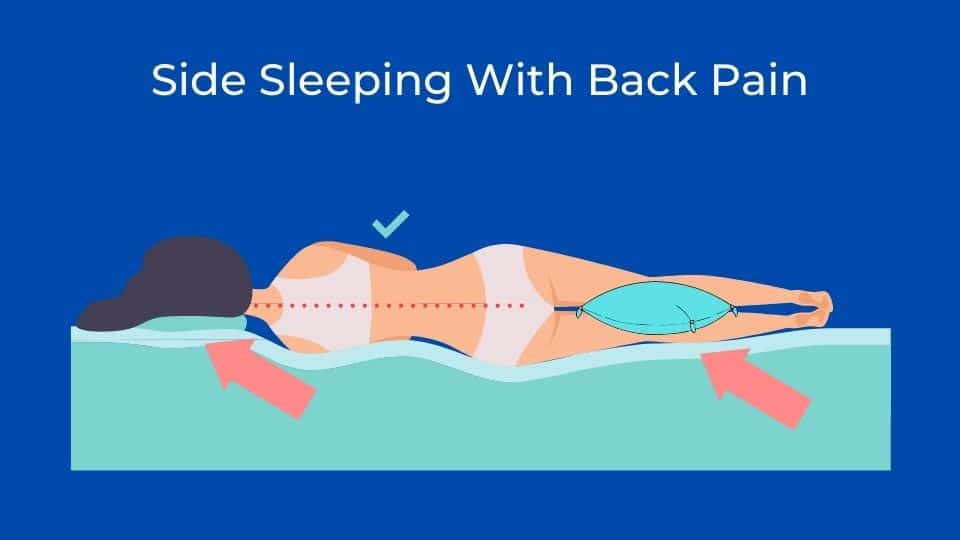
Side Sleeping With Proper Pillow Support
You don’t have to sleep on your back to work on your posture.
Side sleeping can be a comfortable option for many people, too.
The main difference is the height of the pillow.
When side sleeping, you want the pillow height to provide enough support to span the distance between your head and your side of the bed without pushing your neck noticeably upward or allowing your head to drop toward the mattress.
A good starting point is to find a position in which your head feels reasonably aligned with your torso rather than noticeably tilted toward or away from the mattress, instead of being tilted back toward the mattress or the ceiling.
You might also find it helpful to position a pillow between your knees or to use a body pillow, if you find it comfortable.
But you don’t need a body pillow to fix forward head posture, unless it happens to be comfortable for you.
What About Sleeping on Your Stomach?
Stomach sleeping can be a problem for people who have neck pain. You have to turn your head to one side to breathe when you sleep on your stomach.
This keeps your neck rotated for a prolonged period and may be uncomfortable for some people.
If you wake up with stiff neck muscles or pain after sleeping on your stomach, you might want to try sleeping on your side or back instead.
However, if changing positions makes it difficult for you to sleep, you do not need to force an immediate change. It may be easier to make gradual adjustments rather than trying to completely change your usual sleeping position overnight.
How to Choose the Right Pillow for Forward Head Posture
Your pillow matters, but there is no one perfect type that has been proven to fix forward head posture.
A 2025 systematic review that looked at pillows as an intervention for chronic neck pain found only 5 eligible studies with 239 participants, which was not enough to come to a conclusive answer.
The review concluded that pillow interventions may influence neck pain and other outcomes on waking, but the available evidence is limited and the effects appear to depend on the specific pillow characteristics.
So you should look for a pillow that fits your needs and sleeping position.
Pillow Height
Pillow height is often especially important.
A pillow that is too high may push your head forward or to one side, depending on your sleeping position.
A low pillow, meanwhile, might not give you enough support.
The appropriate height depends on factors such as:
- sleeping position
- shoulder width
- body size
- mattress firmness
- pillow material
- individual comfort
There’s no ideal height that applies to everyone.
Signs Your Pillow May Be Too High
You may notice:
- your chin tucked to your chest
- more stiffness in the neck when you wake up
- being unable to find a comfortable position
- tightness or pressure around the neck
Signs Your Pillow May Be Too Low
You may notice:
- your head dropping toward the mattress
- a feeling that your neck is unsupported
- discomfort that improves when you add a small amount of support
These observations do not diagnose a neck or posture problem. They simply suggest that your current sleeping setup may be worth adjusting.
Should You Use a Cervical Pillow?
Cervical or contoured pillows are those that have been specifically shaped to support the head and neck.
Some people find them comfortable, although the benefits can vary depending on the pillow design and the individual.
A cervical support pillow will not necessarily cure a forward head posture, however.
If you try them out, be sure to pay attention to whether or not they allow you to sleep comfortably without forcing your head into an overly extended or flexed position.
If a special cervical pillow isn’t comfortable for you to sleep on, there is no reason to feel like you should continue using one simply because it is marketed as an orthopedic or posture correcting pillow.
What About Adjustable Pillows?
Adjustable pillows can be beneficial because their fill or loft can be adjusted.
This allows you to experiment with different levels of support.
For example, a side sleeper may need a higher loft than a back sleeper due to the extra space needed for the shoulders.
What matters most is not what the pillow is called, but rather if the final product allows for relaxation without an uncomfortable degree of neck flexion or rotation.
How to Set Up Your Sleeping Position for Better Neck Support
If you want to start improving your sleeping environment today, here’s a process you can use.
Step 1: Start With Your Natural Sleeping Position
Avoid trying to become a back sleeper right away.
Instead, begin with your natural sleeping posture.
Step 2: Consider Your Pillow’s Height
Ask yourself if your pillow is pushing your head too far forward, backward, up, or down.
Make only minor adjustments rather than something dramatic.
Step 3: Practice Neck Relaxation
Your neck should be able to relax rather than actively holding your head in a particular position. Your pillow should provide comfortable external support without forcing your head into an awkward angle.
Step 4: Check How You Feel in the Morning
Pay attention to:
- neck stiffness
- shoulder discomfort
- headaches
- whether one side feels noticeably more strained than the other
- whether your symptoms improve or worsen after changing your setup
Morning discomfort can have many possible causes, so do not automatically assume that your pillow or forward head posture is responsible.
Step 5: Allow Your Body to Adjust
If you’ve just changed your sleeping position, give your body time to adapt to the new position.
You don’t need to hurt your body by lying in an unpleasant position for hours at a time in the name of correcting your posture.

Common Sleep Mistakes That May Increase Neck Discomfort
Mistake #1: Using Too Many Pillows
Placing multiple pillows under your head can push your neck into a more flexed position, depending on their combined height.
If you’re waking up sore, try sleeping with a lower stack of pillows instead of more pillows.
Mistake #2: Choosing a Pillow Based Only on Marketing
Terms like “posture correction,” “orthopedic,” or “cervical” do not necessarily mean that a particular pillow is right for you. Your sleeping position and preference are much better indicators of what you should be looking for.
Mistake #3: Forcing Yourself Into An Uncomfortable Position
You do not have to lie awake trying to hold your head in a certain position throughout the night.
The objective is to achieve comfort, not constant correction.
Mistake #4: Assuming Sleep Alone Will Correct FHP
Your sleeping position is only one part of your overall posture habits.
If you sit at a desk for long periods of time or stare down at your phone throughout the day, you may want to rethink your daily habits as well.
Can Sleeping Position Actually Correct Forward Head Posture?
Sleep positioning alone should not be considered a guaranteed way to correct forward head posture.
It may help you maintain a more comfortable and supported position while you sleep, but improving FHP generally involves looking at the bigger picture.
Depending on the individual, that may include:
- everyday movement
- improving your workstation
- strengthening and mobility exercises
- improving your head and neck control
- avoiding long periods in one position
- addressing factors which could be contributing to your discomfort
Research into the treatment of FHP indicates that exercise-based techniques can improve measurements of posture and, in some populations, pain and function. However, the evidence does not support the idea that one exercise, pillow, or sleeping position is a universal solution.
What Else Can You Do During the Day?
Regular physical activity is also beneficial. As opposed to attempting to sustain a single ‘perfect posture’ throughout the day, change positions frequently and do not remain in one posture for an extended time period.
Exercises can also be incorporated into a broader strategy. For example, chin-tuck exercises for forward head posture can be used to practice cervical control, while strengthening and mobility work for the upper back may address other areas involved in posture.
If you want to understand more about the relationship between the upper-back muscles and forward head posture, you can explore our detailed guide on the subject.
For individuals who have been experiencing these symptoms, a personal evaluation by a physical therapist or other medical professional may be more effective than attempting to self-correct their stance or posture based on information found online.
If you spend several hours working at a computer, adjusting your computer screen position and forward head posture may help you work comfortably without repeatedly leaning your head toward the screen.
Your workstation involves more than just the monitor. Chair height, keyboard and mouse placement, and the way you position your body throughout the workday can also influence how comfortably you maintain your posture. Our guide to forward head posture with ergonomics provides more practical tips for setting up your workspace.
When Should You See a Healthcare Professional?
Not every case of neck stiffness or forward head posture requires professional treatment.
But, get it checked by a medical professional if you have:
- constant or worsening neck pain
- pain that repeatedly interferes with sleep
- numbness or tingling
- arm or hand weakness
- severe or recurring headaches
- pain caused by an injury
- pain or other symptoms that cause you to not be able to carry out daily tasks
- symptoms that don’t go away even after making lifestyle changes
A physical therapist or doctor can help determine whether your symptoms are caused by a postural issue or something else.
Frequently Asked Questions
What is the best sleeping position for forward head posture?
There is not one best position for everyone, but back sleeping can help neutralize the head/neck position for some people, and sleeping on the side can also be a suitable position so long as it provides adequate support.
Choose a position that allows you to sleep comfortably without placing your neck in excessive flexion or rotation.
Is sleeping on the back recommended for forward head posture?
Back sleeping can be a suitable option for some people with forward head posture, provided the pillow does not push the head too far forward or backward.
Can sleeping on the side cause forward head posture?
Sleeping on the side itself does not necessarily cause forward head posture, but a pillow that is too high or too low can put the head/neck at an uncomfortable angle. In general, try to find a pillow that provides enough support to keep the head and neck at a neutral position, without tilting them too far in any direction.
Is a cervical pillow recommended for forward head posture?
A cervical or contoured pillow may be worth trying if you find it comfortable, but there is no universally recommended pillow type for forward head posture. A cervical pillow should not be viewed as a definitive treatment for FHP.
How high should my pillow be?
There is no single pillow height that is appropriate for everyone as it depends on your sleeping position, body size, how wide your shoulders are, what type of mattress you have, how comfortable you are with the height, and other factors.
A good rule of thumb is simply to avoid letting your head/neck be tilted too far forward/backward/sideways by the height/angle of your pillow.
Can a sleeping position cure forward head posture?
No specific sleeping position should be considered a definitive cure for forward head posture. Adjusting your sleeping position may help create a more comfortable and supportive environment for your neck, but improving FHP may also require attention to daytime habits, exercise, movement, and other individual factors.
Does forward head posture mean I should stop sleeping on my stomach?
Not necessarily.
If you are comfortable sleeping on your stomach with a suitable pillow and don’t experience any negative side effects, then you don’t necessarily need to avoid it solely because you have forward head posture. Stomach sleeping generally requires more rotation of the neck than other positions, which can make it uncomfortable for people with neck issues.
Why does my neck feel stiff or painful when I wake up?
Morning neck discomfort can have many possible causes, including sleeping position, pillow setup, existing neck problems, muscle tension, or factors unrelated to posture. If it happens regularly or is significant, consider discussing it with a healthcare professional rather than assuming your sleeping position is the cause.
How long does it take to improve forward head posture?
There is no set time frame for this, as it depends on what is causing your forward head posture, how severe it is, whether or not you consistently use a proper sleeping position and other treatments recommended for your condition, and other factors. Avoid programs that promise that a particular sleeping position will permanently correct FHP within a fixed number of days or weeks.
Bottom Line
Your sleeping position can affect your head and neck positions for several hours at a time, so it may be worth adjusting if you regularly wake up with neck stiffness or discomfort.
You do not need to find a “perfect” sleeping position or consciously control your posture throughout the night.
Focus on choosing a comfortable sleeping position and pillow setup that supports your head and neck without forcing them into an excessively bent or rotated position.
Back and side sleeping may be comfortable options for many people, while stomach sleeping can be less comfortable for people who experience neck problems because it requires prolonged neck rotation.
It is important, however, to note that sleep position is not the only contributor to one’s posture, and exercising regularly, sitting up straight at your workstation, and taking care to address the other potential causes can be just as important.
If your pains and discomfort persist, and you notice additional symptoms such as numbness or loss of mobility, do not hesitate to contact a medical professional to check whether something might be wrong.
References:
- Effect of Pillow on Pain, Disability and Sleep Quality in Patients With Chronic Neck Pain: A Systematic Review — PubMed
- The Effect of Pillow Designs on Neck Pain, Waking Symptoms and Cervical Alignment: A Systematic Review and Meta-Analysis — PubMed
- The Relationship Between Forward Head Posture and Neck Pain: A Systematic Review — PubMed
- Treatment of Chronic Neck Pain in Patients With Forward Head Posture: A Systematic Review — PubMed
- The Effect of Head Position on Cervical Spine Alignment and Neck Symptoms: A Systematic Review — PubMed
- Why trust us?
- For Educational Purpose Only