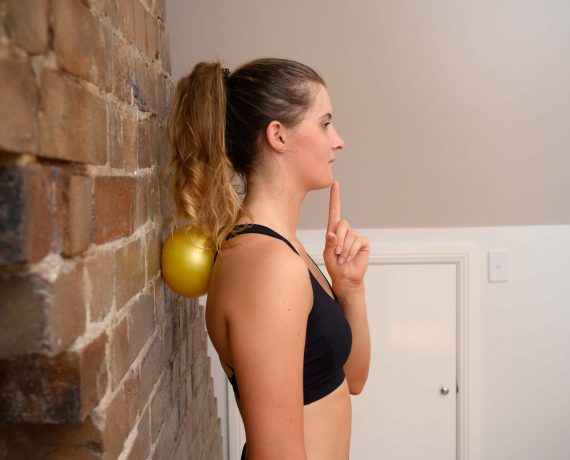
If you spend a lot of time at a computer, looking at your phone, or sitting in the same position for long periods, you may notice that your head tends to drift farther forward than you would like.
Anchored to neutral by weak muscles, it is a common problem with an equally common fix: the chin tuck.
But do chin tucks really do anything to help forward head posture?
It’s complicated.
Several studies on therapeutic exercise for forward head posture suggest that neck pain and function, as well as measurements of forward head posture itself, can improve through carefully designed exercise programs.
The issue is that none of these studies show that chin tucks are a cure-all for forward head posture, and that their effects are largely situational.
Chin tucks are best thought of as one tool in an expansive toolkit for correcting forward head posture, along with general neck mobility and stability exercises, upper back mobility and stability, activity modifications, and workplace adjustments if applicable.
Article Index
- Do Chin Tucks Help Forward Head Posture?
- What Is a Chin Tuck?
- How Do Chin Tucks Work?
- How to Do Chin Tucks Correctly
- What Should You Feel During a Chin Tuck?
- How Many Chin Tucks Should You Do?
- How Often Should You Do Chin Tucks?
- Common Chin Tuck Mistakes
- Can Chin Tucks Help Neck Pain?
- Can Chin Tucks Permanently Fix Forward Head Posture?
- What Other Exercises Can Complement Chin Tucks?
- When Should You Stop or Seek Professional Advice?
- Frequently Asked Questions
- Bottom Line
- References
- Why Trust Us
- Medical Disclaimer
Do Chin Tucks Help Forward Head Posture?
Chin tucks may help improve forward head posture when they are used as part of an appropriate exercise program.
Research into therapeutic exercises for the correction of the forward head posture has yielded positive results for the craniovertebral angle (CVA) and pain and function in the neck in particular populations.
However, these studies predominantly assess therapeutic exercise programs, not a single therapeutic exercise that could independently correct the forward head posture.
A 2018 systematic review and meta-analysis concluded that therapeutic exercises could improve the CVA and potentially the neck pain in patients presenting with forward head posture.
Systematic reviews published more recently also report improvements to postural deformities and the outcomes related to the neck after therapeutic exercises with varying levels of certainty of the evidence.
So the most accurate answer is:
Chin tucks can be a useful exercise for people working on forward head posture, but they should not be presented as a stand-alone cure.
What Is a Chin Tuck?
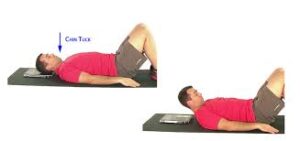
A chin tuck is a controlled movement in which you gently draw your chin backward while keeping your head relatively level.
It may feel as if you’re making a “double chin”
The important thing is that the motion is mainly backward, instead of pushing your chin in toward your chest.
Chin tucks are often used in rehab because they can help to train control of the musculature in the neck.
Exercises for the deep cervical flexor muscles have been studied in patients with neck pain and forward head posture. A systematic review found evidence that deep cervical flexor training may improve neuromuscular coordination and head and cervical posture, although the effects were not consistent across all outcomes.
How Do Chin Tucks Work?
The movement alters the position of your head and neck while requiring controlled activation of the muscles that move and stabilize the cervical region.
It is not that people who suffer from forward head posture do not have weak neck muscles. The muscle imbalances, dysfunctional movement patterns, restricted motion, pain, and compensations that are often present in forward head posture can take many forms.
This is why it is best to think of these movements as ways to practice motor control, instead of focusing on a specific muscle that needs to be fixed.
Research also suggests that therapeutic exercise can improve measures of head and neck posture, particularly when exercise is used as part of a broader program.

How to Do Chin Tucks Correctly
You can do chin tucks sitting or standing.
Step 1: Preparatory position
Sit or stand comfortably and allow your shoulders to relax.
Let your eyes gaze straight ahead.
Don’t feel as if you need to sit or stand up as if you are on a strict posture patrol.
Step 2: Bring your chin back
Move your chin back slowly as if you were attempting to create a double chin.
Imagine that you are not looking down but rather moving your head back.
Step 3: Maintain a forward gaze
Do not look down while you are doing this.
Your head should remain relatively level as you move your chin back.
Step 4: Hold
Hold for a second or two until you feel a stretch.
You should not feel as if you need to push your head back forcefully.
You should be able to take a normal breath.
Step 5: Release
Allow your head to return slowly to the starting position.
Repeat this movement in a controlled manner and do not rush.
What Should You Feel During a Chin Tuck?
You may feel a slight tightening or pulling sensation in your front neck muscles.
You may also feel some action in your rear neck muscles.
It is not required to feel immediate painful sensations to make the exercise effective.
Stop and reevaluate if you experience during the exercise:
- sharp or increasing neck pain
- pain radiating into the arm
- numbness or tingling
- dizziness or severe headaches
- unusual weakness
- other concerning symptoms
If any of these sensations begin to bother you frequently, consult with a healthcare professional to see if you should change or adjust your current exercise and its intensity.
How Many Chin Tucks Should You Do?
There’s no one-size-fits-all number of chin tucks that’s healthy for everyone.
The original article recommended a certain amount: 30-50 per day, and it claimed that doing more repetitions leads to quicker results, but those specifics aren’t reliable.
You may want to start slow and work your way up, rather than attempt a set number of chin tucks straight away.
If you are doing chin tucks with help from your physical therapist, or other medical professional, as a means of rehabilitating, they’ll be able to help you decide how many you should do.
A few careful, controlled chin tucks could be more effective and safer than working up to a large number right away, especially if you’re new to the exercise.
How Often Should You Do Chin Tucks?
The ideal frequency depends on the exercise program, your symptoms, your technique, and your individual needs.
Studies of forward head posture evaluate programs of multiple weeks, rather than a single, daily chin-tuck prescription. For instance, studies of therapeutic exercise have looked at programs lasting several weeks and have found improvements in posture and some neck-related outcomes.
This is why it would be misleading to promise that doing a particular number of chin tucks every day will correct forward head posture within a specific number of weeks.
Consistency is useful, but more repetitions are not necessarily better.
Common Chin Tuck Mistakes
Moving the chin downwards
One of the most common mistakes is to confuse a chin tuck with a bend in the neck forwards.
The direction of the chin is forward, but you want to gently draw it backward, not simply look down.
Using too much force
A chin tuck is controlled exercise.
Straining to move your head back as far as possible will not necessarily achieve that.
Lifting the chin
Some people compensate by looking up as they move their head back.
Keep your eyes level and do not extend your neck.
Clenching the jaw
Try to relax your jaw.
Your head and neck should move in a controlled way, not your teeth.
Holding your breath
Do not hold your breath while doing the exercise.
There is no need to hold your breath during a gentle chin tuck. Just continue breathing normally.
Straining to maintain one ‘perfect’ posture all day long
Exercise is only one part of improving your posture.
You do not have to lock your head backwards all day.
It is probably more realistic to change positions occasionally, take regular breaks from sitting if you can, adjust your working environment, and develop good movement habits rather than trying to hold a fixed posture all day long.
Can Chin Tucks Help Neck Pain?
They may be beneficial for some individuals, but this largely depends on the underlying cause of the condition.
Forward head posture and neck pain have been shown to be related in research, but the nature of this relationship is complex.
A systematic review and meta-analysis found that forward head posture differed between adults with and without neck pain, while also emphasizing that the relationship between posture and pain is complex.
Exercise can be beneficial for individuals with neck pain, but a chin tuck does not necessarily indicate the type of exercise that would be appropriate for someone with the condition.
If an individual notices that an exercise is aggravating their symptoms, it is best for them to stop doing it and ask for an individualized assessment.
Can Chin Tucks Permanently Fix Forward Head Posture?
There is insufficient evidence to support the claim that chin tucks can permanently correct forward head posture.
This distinction matters because studies of forward head posture generally examine broader exercise programs rather than chin tucks alone.
Studies do show efficacy for therapeutic exercise in the management of forward head posture, but these interventions are typically part of a broader exercise program, and the results are variable.
More recently, systematic reviews have highlighted the heterogeneity of exercise interventions and the limited quality of evidence.
Forward head posture can also be influenced by:
- neck and upper-back movement
- muscle endurance and coordination
- pain
- work habits
- prolonged static positions
- workstation setup
- general physical activity
- previous injury
- individual anatomy
For this reason, treating posture as a single problem with one exercise is usually too simplistic.
What Other Exercises Can Complement Chin Tucks?
Chin tucks may be more useful when they form part of a broader exercise program.
Depending on your requirements, you can design a program that will address:
- neck mobility and control
- upper-back range of motion
- scapular control
- upper-body strength
- general physical activity
- movement habits
A 2026 systematic review and meta-analysis of therapeutic exercises for forward head posture revealed improvements in the craniovertebral angle, levels of pain, and neck functionality, when compared to control groups.
The authors also highlight that combined regimens might have more therapeutic potential, albeit with a number of caveats due to the significant heterogeneity between included studies.
You can learn more about our broader guide to Forward Head Posture Exercises.
If you are interested in the muscles and movement around the shoulder blades, see our guide to scapular retraction exercises.
Your workstation can also influence how often you find yourself leaning forward. See our guide to computer screen positioning and forward head posture.
When Should You Stop or Seek Professional Advice?
A moderate amount of muscle soreness after an exercise is not unusual.
Consider seeking professional advice if you have persistent or worsening symptoms, particularly if you experience:
- loss of neck mobility
- pain extending into the arm
- numbness or tingling
- unusual weakness
- neck pain following an injury
- poor balance or coordination
- intense headaches
- loss of strength that affects routine activities
A physical therapist can evaluate your range of motion and any restrictions in your movement, as well as your posture, muscle strength, shoulder and back mobility, and other factors.
You can also read our guide explaining how a physical therapist evaluates forward head posture.
If you are primarily trying to understand whether your symptoms could be related to forward head posture, see Forward Head Posture Symptoms.
Frequently Asked Questions:
Do chin tucks fix forward head posture?
Chin tucks are often recommended as an important part of a rehabilitation program for head and neck posture concerns. However, they are unlikely to be a standalone permanent solution.
How to do a chin tuck?
Sit or stand comfortably with your eyes level, then gently draw your chin backward without looking down. Hold briefly, breathe normally, and return to the starting position.
Should a chin tuck hurt?
It is unlikely that a chin tuck should be painful. However, if the stretch produced causes recurring pain, numbness, tingling, dizziness, or other concerning symptoms then we recommend that you stop and seek professional advice.
How long to do chin tucks to improve posture?
There is no firm answer to this question. Most research into forward head posture and exercises to address it consider an exercise program over weeks rather than days.
Can I do chin tucks daily?
Forward head posture rehabilitation exercises can be carried out daily, but there is no one-size-fits-all recommendation. It depends on the person’s symptoms, the correct exercise form, and the whole program.
Are chin tucks good for neck pain?
Chin tucks can be beneficial for some people with neck pain. However, there are many possible causes of neck pain and the most appropriate treatment or exercises will vary depending on the underlying reason.
Are chin tucks and neck stretches the same thing?
No, stretching is not the same as a chin tuck. Stretches generally target specific tissues or areas of the body and aim to increase flexibility. A chin tuck is primarily a controlled movement designed to retrain the muscles and movement patterns of the head and neck.
Can chin tucks make forward head posture worse?
The wrong type of exercises or incorrect form can worsen symptoms in many cases. It is important to avoid excessive force, over-stretching or holding a stretch for too long. If you find that chin tucks are making your symptoms worse, stop and seek professional advice.
Bottom Line
Chin tucks are an exercise frequently recommended for improving control of the head and neck, and they appear to be generally effective at this task. However, it’s misleading to promote them as a cure for forward head posture.
Evidence for therapeutic exercise is more encouraging overall: exercise programs can improve measures of forward head posture and may improve pain and neck function. So, unless you’re looking for a single magic exercise, it is better to think of chin tucks as a part of a larger program of movement and exercise.
Focus on controlled movement, avoid forcing the exercise, and consider professional assessment if you have persistent pain, neurological symptoms, or other concerning symptoms.
References
- Sheikhhoseini R, et al. Effectiveness of Therapeutic Exercise on Forward Head Posture. PubMed
- Xing Y, et al. Therapeutic Exercise for Forward Head Posture in Neck Pain Patients. PubMed
- Carrasco-Uribarren A, et al. Impact of Therapeutic Exercise on Craniovertebral Angle in Forward Head Posture. PubMed
- Mahmoud NF, et al. The Relationship Between Forward Head Posture and Neck Pain. PubMed
- Blomgren J, et al. Effects of Deep Cervical Flexor Training on Chronic Neck Pain. PubMed