If you look after long periods of sitting at a computer, using your phone, or just generally slouching around, you may notice that your shoulders or upper back begin to stiffen or round inwards.
This can sometimes go hand in hand with a forwards head posture, whereby your head sits in a more forward position relative to your trunk.
One of the most commonly suggested stretches for this is a chest stretch.
But can stretching your chest actually correct forward head posture?
The short answer is: it may be useful, but chest stretching alone should not be considered a proven way to fix forward head posture.
A chest stretch might help with reduced range of motion in your chest or shoulders. Research into forward head posture, however, indicates that a more general approach to exercise, including stretching, neck-stabilizing exercises, scapular strengthening and mobility, and overall physical activity, may be more beneficial.
Article Index
- Quick Answer: Can Chest Stretch Help Forward Head Posture?
- What Is a Chest Stretch?
- How Can Tight Chest Muscles Affect Posture?
- Can Chest Stretching Correct Forward Head Posture?
- What Does the Research Say?
- How to Do a Doorway Chest Stretch
- How Long Should You Hold a Chest Stretch?
- How Often Should You Stretch Your Chest?
- Common Chest-Stretching Mistakes
- Can Chest Stretching Help Rounded Shoulders?
- What Exercises Can You Combine With Chest Stretching?
- When Should You Stop or Seek Professional Advice?
- Frequently Asked Questions
- Bottom Line
- References
- Why Trust Us
- Medical Disclaimer
Quick Answer: Can Chest Stretch Help Forward Head Posture?
Chest stretching has not been shown to be a standalone exercise that permanently corrects forward head posture.
Pectoral stretching has been included as part of exercise protocols that have shown improvements in forward head posture, but these protocols generally involved more than one type of exercise.
Studies comparing pectoral stretching with scapular strengthening suggest that strengthening the muscles involved in scapular control may improve certain aspects of forward shoulder posture more than stretching alone.
Therefore, if you’re looking to fix forward head posture, looking at a chest stretch as a component of multiple different types of exercises in your routine will be more helpful than trying to rely on a single corrective exercise.
What Is a Chest Stretch?
A chest stretch is an exercise that lengthens the muscles of the front of the chest and shoulder.
Common chest stretches include the following:
- doorway chest stretches
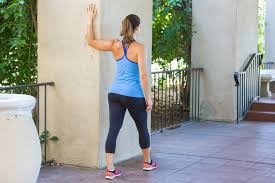
- corner stretches
- wall-assisted chest stretches
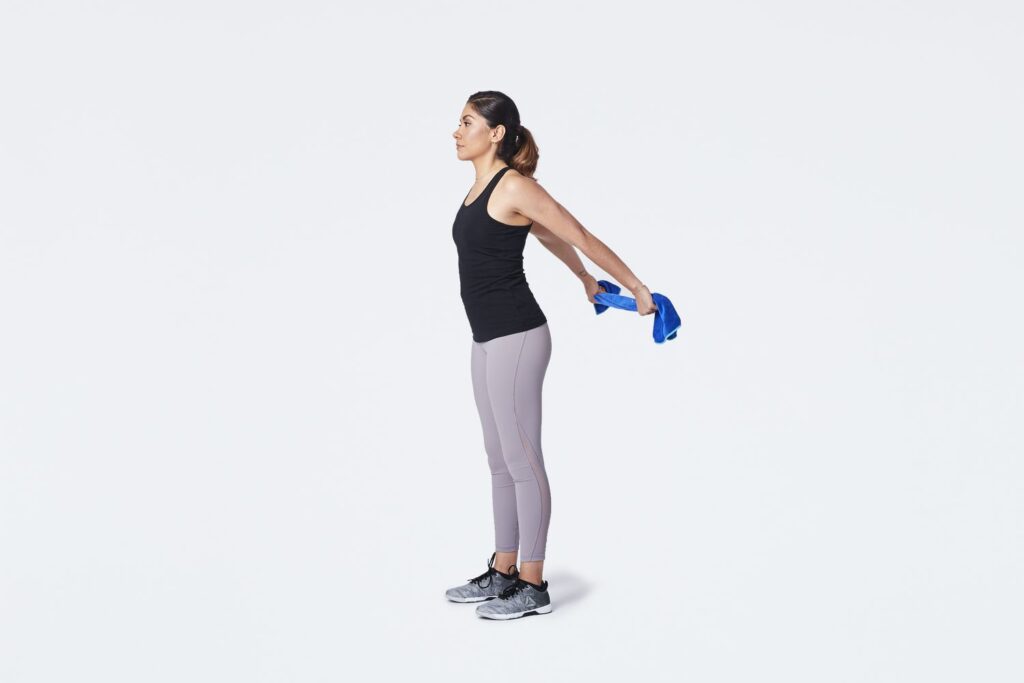
- standing chest stretches with arms behind the body
Depending on the position of your arms and shoulders, different muscles are stretched.
The pectoralis major and pectoralis minor are two of the major muscles involved with movement of the chest and shoulders.
A chest stretch should be comfortable and not cause pain or excessive pressure.
How Can Tight Chest Muscles Affect Posture?
The muscles of the chest, shoulder blades, upper back, and neck are all involved in a wide range of activities.
Limited flexibility or altered movement of the chest and shoulder region may influence your ability to maintain comfortable posture of the shoulders and upper body.
However, it would be an oversimplification to claim that the reason for your forward head posture is entirely due to tightness in the muscles of the chest.
Forward head posture can be affected by a number of factors, such as:
- movement of the neck and upper back
- muscle strength and endurance
- shoulder and scapular control
- prolonged sitting
- workstation set up
- exercise and activity levels
- pain
- previous injury
- individual anatomy
- habits and movement patterns
This is why stretching the chest is not as simple as ‘pulling your shoulders back’ and expecting the head to immediately follow.
Can Chest Stretching Correct Forward Head Posture?
Pectoral stretching has been included as one component of exercise programs designed to improve forward head posture, but the evidence does not show that stretching alone is sufficient.
It is also unclear if simply stretching the chest can resolve the condition on its own.
A useful distinction is:
Chest stretching may help with mobility.
A broader exercise program may address strength, movement control, and posture.
Neither should be presented as a guaranteed permanent correction.
Evidence on stretching as a treatment for postural changes is mixed. Recent research suggests that stretching alone may be less effective for some posture-related changes than strengthening or combined exercise programs.
Because of this, chest stretching is better viewed as a supplementary exercise within a broader program addressing forward head posture.
What Does the Research Say?
Research on forward head posture gives a more nuanced view than the popular message of “tight pecs cause nerd neck.”
A 2018 study comparing pectoralis stretching with scapular-retraction strengthening in people with forward shoulder posture found that both approaches were effective, but the strengthening group showed a greater reduction in forward shoulder posture.
So while stretching may help, it should not be viewed as a complete solution.
A 2022 evidence-based appraisal found that pectoralis stretching, along with scapular retraction and chin-tuck exercises, were among the interventions found to be incorporated into corrective-exercise programs for forward head posture in adolescents and young adults without musculoskeletal pathology.
And while recent systematic reviews of therapeutic exercise for forward head posture also suggest that broader exercise programs are beneficial, they do not identify any single intervention as universally most effective.
The practical takeaway is simple:
Chest stretching can have a place in a forward-head-posture exercise program, but it should not be treated as a standalone cure.
How to Do a Doorway Chest Stretch
The doorway chest stretch is an accessible variation that targets the front of the chest and shoulders.
Step 1: Find a stable doorway
Stand in an open doorway in which you have enough room to step forward comfortably.
Make sure that the doorway and surrounding surface are stable.
Step 2: Position your arms
Place your forearms against the sides of the doorway.
Your elbows should be at a comfortable height. You do not need to force your arms into a perfect 90-degree position.
Step 3: Relax your shoulders
Keep your shoulders relaxed rather than shrugging them toward your ears.
Keep your head and neck in a comfortable, neutral position.
Step 4: Step forward gently
Take a small step forward until you feel a gentle stretch across your chest and possibly the front of your shoulders.
You should not need to lean aggressively into the doorway.
Step 5: Hold the stretch
Hold the position while breathing normally.
The sensation should feel like a mild to moderate stretch rather than sharp pain.
Step 6: Return slowly
Step back from the doorway and allow your arms to return to a comfortable position.
Do not bounce into or out of the stretch.
How Long Should You Hold a Chest Stretch?
There is no universal holding time that has been proven effective for correcting forward head posture.
One simple way to start is to hold a comfortable chest stretch for 20-30 seconds before slowly releasing the stretch.
The objective is not to stretch as far or as long as possible.
Focus on the following:
- controlled movement
- comfortable breathing
- a tolerable stretch
- not causing pain
- gradually increasing range of motion
If you are on a rehab program, use the prescribed dosage your physical therapist recommends.
How Often Should You Stretch Your Chest?
There is no evidence-based rule for how many times every person with forward head posture should perform a chest stretch each day.
Therefore, the frequency can differ depending on:
- one’s mobility,
- symptoms,
- other exercises in a routine,
- how well the muscles stretch,
- or if it is being used as a rehabilitative or a mobility exercise.
A more effective approach would be to perform the exercise regularly instead of trying to overstretch the muscles at once.
A chest stretch can be added to a broader exercise routine rather than treated as a stand-alone daily exercise.
Common Chest-Stretching Mistakes
Avoiding Aggressive Stretching
More is not always better when it comes to stretching.
Forcing the shoulders backward or leaning too far into the doorway may irritate the muscles or joints.
Shoulders Shrug
Avoid raising your shoulders up toward your ears when stretching.
Keep them relaxed.
Low Back Arch
Avoid compensating for the restriction in your shoulder or your chest by over-arching your lower back.
Instead, keep your trunk comfortably upright without forcing the position.
Painful Range of Motion
A bit of a stretch is fine, but pulling or painful range of motion is not.
If an exercise provokes worrisome symptoms, stop.
Aggressive Neck Extension
You don’t have to violently twist your neck backward to open up your chest; in fact, you shouldn’t.
Rather, keep your neck comfortable and focused on opening your chest and your shoulders.
Holding Your Breath
Remember to breathe!
Holding your breath during a gentle mobility drill will not help you.
Can Chest Stretching Help Rounded Shoulders?
Chest stretches may be beneficial for improving comfort and mobility around the chest and shoulders if you have limited range of motion in this region.
However, rounded shoulders are not always the result of a single tight muscle.
Your posture also relies on:
- motion of your shoulder blades
- strength in the upper back
- shoulder range of motion
- endurance of the muscles
- patterns of movement
- and exercise.
Research comparing pectoral stretching with scapular strengthening suggests that improving scapular stability and motor control may be important when addressing rounded shoulders.
When rounded shoulders occur alongside forward head posture, a broader exercise program may be more appropriate than relying on isolated pectoral stretching.
What Exercises Can You Combine With Chest Stretching?
Consider combining chest mobility with additional exercises that target other areas of movement and strength, if you’re looking to fix forward head posture.
Chin Tucks
Chin tucks are focused on controlled head and neck positioning.
They are not the same as stretching your neck or pulling your head back.
Read our guide on Chin Tucks for Forward Head Posture.
Scapular Exercises
Scapular retractor and stabilizer exercises can help improve control and strength in the scapulas (shoulder blades).
See our guide to Scapular Retraction Exercises for Forward Head Posture.
Upper-Back Mobility
Thoracic mobility exercises can be helpful if you have stiffness in your upper back or if you find yourself spending a lot of time in the same position.
General Strengthening
A more general strengthening program can target more than one muscle group at a time and is often a more practical solution than a single posture exercise.
Movement Breaks
If you’re often at a computer for long stretches at a time, it can be more practical to break your posture up into smaller segments, instead of trying to hold a single posture throughout the day.
Workstation Adjustments
Your computer workstation can also play a role in holding your head and upper body in certain postures.
If you spend a lot of time at a computer, read our guide to computer screen positioning and forward head posture.
When Should You Stop or Seek Professional Advice?
Stop the exercise if you have any of these:
- sharp or severe pain
- numbness or tingling
- pain that shoots into your arm
- unexplained weakness
- significant or persistent dizziness
- symptoms that are still there after you’re done exercising
Your physical therapist or another health care provider can help check your neck, shoulders, upper back, or other areas to see if something is causing your symptoms.
You can also read our guide explaining how a physical therapist evaluates forward head posture.
If you are trying to understand symptoms associated with forward head posture, see our guide to Forward Head Posture Symptoms.
Frequently Asked Questions:
Can stretching the chest muscles treat forward head posture?
No. Not on their own.
Chest stretches can help improve mobility in the chest and shoulders, but there is not enough evidence to state that stretching the chest on its own can permanently correct forward head posture
A more varied routine may be more effective.
Is a stretch for the chest a good exercise for forward head posture?
It can be a useful accessory exercise, especially if you have limited mobility in the chest or shoulders, but it should not be relied on as the primary treatment when other exercises are appropriate.
What is the best stretch for forward head posture in the chest?
There is no one stretch that has been proven to be most effective, but a doorway stretch is a good option as it requires minimal equipment and can be controlled well.
Can I improve my posture by stretching tight pecs?
While it is possible to improve some aspects of posture by stretching the pectoral muscles, simply having more flexible pecs does not guarantee that forward head posture will be corrected.
Forward head posture is a postural pattern that can have multiple contributing factors. How your posture responds to stretching will depend on many factors.
How long should I hold a stretch for the chest?
A reasonable starting point is 20–30 seconds, provided the stretch feels comfortable.
There is no proven correct amount of time to hold a stretch to cure forward head posture.
Should I do stretches for the chest every day?
It depends on you, your daily activity, and your mobility. There is no strict requirement for how often you should stretch your chest.
Can stretching the chest help with rounded shoulders?
It may help to improve mobility, but if your rounded shoulders are being caused by something else besides tight pecs, it will not necessarily cure them.
Should I stretch or strengthen my muscles if I have forward head posture?
A better question might be: Should I do both?
Studies on forward head posture have shown that a combination of stretches and strengthening, along with neck and scapular control exercises can be effective, so a varied routine may be better than either stretching or strengthening alone.
Bottom Line
A chest stretch might be helpful for forward head posture, but we shouldn’t oversell it.
Chest mobility can be a good accessory for working on forward head posture, but there are multiple variables that play a role in FHP and there is no research that stretching the chest will do anything to actually pull the head into a neutral position.
So if you are looking to work on forward head posture, you need to focus on more than just stretching your chest. You also need to think about chest mobility, neck control, upper-back strength and mobility, scapular control, physical activity, and your everyday movement patterns.
Instead of trying to fit yourself into a mold of what proper posture is supposed to be, we should be focusing on being comfortable, mobile, strong, and able to move and change positions throughout the day as needed.
References:
- Yoo WG. Pectoralis Muscle Stretching vs. Scapular Retraction Exercise for Forward Shoulder.
PubMed - Titcomb DA, et al. Evidence-Based Corrective Exercise for Forward Head Posture.
PubMed - Warneke K, Lohmann LH, Wilke J. Stretching or Strengthening Exercise and Posture: Systematic Review and Meta-Analysis.
PubMed - Xing Y, Wang R, Zhao X, Xu A. Therapeutic Exercise for Forward Head Posture: Systematic Review and Meta-Analysis.
PubMed - Carrasco-Uribarren A, et al. Therapeutic Exercise and Forward Head Posture: Systematic Review and Meta-Analysis.
PubMed
Why Trust Us
Our content is developed using peer-reviewed research and systematic reviews when available.
We aim to differentiate research supported information from assertions, common claims, and lack of evidence.
For more information about how health content on this site is reviewed, please visit our Why Trust Us page.
Medical Disclaimer
This article is for educational and informational purposes only and is not a substitute for individual medical or physical therapy advice.
Exercises suggested may not be appropriate for all individuals.
If you are experiencing significant pain, neurological symptoms, injury or other medical conditions, please consult a qualified medical professional prior to undertaking any new exercises.
For information on our health-related content review process, please see our Medical Review process page.