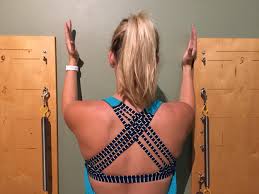
If you spend long periods sitting at a computer or using your phone, you may notice that your shoulders and upper back round forward.
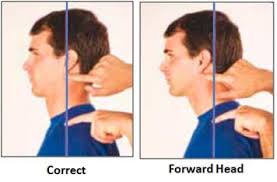
In some cases, this is accompanied by forward head posture, where your head is out in front of your torso.
A great way to counter this is by working on your scapular control and middle back muscles.
Exercises targeting the scapulae are often used to improve shoulder-blade control, upper-back strength, and movement.
Studies have shown that exercises targeting your scapulae can improve measurements of forward head posture and relieve pain in the neck region, but they shouldn’t be viewed as a standalone solution for forward head posture.
Rather, they should be seen as a part of a bigger exercise and mobility regime.
Article Index
- Do Scapular Retraction Exercises Help Forward Head Posture?
- What Is Scapular Retraction?
- How Does Scapular Movement Relate to Forward Head Posture?
- What Are the Best Scapular Retraction Exercises?
- How to Do Band Pull-Aparts
- How to Do Wall Angels
- How to Do Face Pulls
- How to Perform Scapular Retraction Without Equipment
- Common Scapular Exercise Mistakes
- How Often Should You Do Scapular Exercises?
- Can Scapular Exercises Help Neck Pain?
- Can Scapular Exercises Permanently Fix Forward Head Posture?
- What Other Exercises Can You Combine With Scapular Exercises?
- When Should You See a Physical Therapist?
- Frequently Asked Questions
- Bottom Line
- References
- Why Trust Us
- Medical Disclaimer
Do Scapular Retraction Exercises Help Forward Head Posture?
They may help, particularly when they are included as part of a broader exercise program.
Research on scapular stabilization has found improvements in some measurements of head and neck posture in people with forward head posture.
For instance, a small, randomized study found that four weeks of scapular stabilization exercise improved the craniovertebral angle, neck pain, disability, and some measurements of muscle activity in people with neck pain and forward head posture.
The study involved only 15 participants, so its findings should be regarded with caution.
A 2018 study also found improvements in measurements of head and neck alignment following scapular stabilization exercise in people with forward head posture.
More recent evidence is encouraging, though it is somewhat mixed: A 2024 systematic review and meta-analysis found that treatment focused on the scapulae may reduce pain intensity in people with chronic neck pain, but evidence of improvement in disability and some other measurements was weaker.
The review also found that forward head posture may improve with scapular treatment.
So the most accurate answer is:
Scapular retraction and stabilization exercises may be useful for forward head posture, but they should be considered part of a broader approach rather than a single corrective solution.
What Is Scapular Retraction?
The scapulae are the two shoulder blades on the back of your upper rib cage.
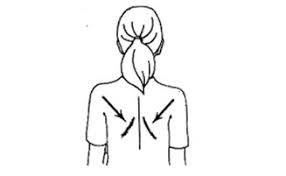
Scapular retraction is bringing them together and pushing them back slightly.
It’s a movement that uses a number of muscles around your shoulder and upper back, including the middle trapezius and rhomboids.
But a healthy scapular movement is actually much more complex than that.
Your shoulder blades need to perform a variety of movements depending on the activity, so the point of these exercises is to build strength, control and coordination, not to permanently squeeze your shoulders back.
How Does Scapular Movement Relate to Forward Head Posture?
The neck, upper back, shoulders, and shoulder blades are involved in many daily activities.
Altered scapular position and movement patterns may accompany forward head posture and neck pain. As a result, rehabilitation programs sometimes include scapular stabilizing and strengthening exercises.
However, this does not mean that shoulder rounding and/or specific postures and movement patterns of the shoulder blades cause forward head posture.
Posture can be influenced by many factors, including:
- neck and upper-back movement
- muscle endurance and coordination
- physical activity
- prolonged sitting
- workstation setup
- pain
- previous injury
- individual anatomy
For that reason, scapular exercises should be used to improve movement and physical capacity rather than to force the body into one “perfect” posture.
What Are the Best Scapular Retraction Exercises?
There is no single best scapular exercise for each individual.
The right choice depends on your strength, mobility, symptoms, equipment, and exercise program.
Some common options include:
- band pull-aparts
- wall angels
- face pulls
- resistance-band rows
- scapular retraction drills without equipment
The objective is to perform them correctly and not try to squeeze the shoulder blades together as hard as you can.
How to Do Band Pull-Aparts
Band pull-aparts are one option for working on upper-back strength and shoulder control.
The Setup
Stand with feet comfortable and evenly spaced.
Grab a light resistance band with both hands in front of you.
Let your shoulders down and relax, not up towards your ears.
The Action
Slowly pull the band apart while keeping your shoulders relaxed and your movement controlled.
Maintain control of the band. You don’t have to pull it to the farthest point.
The Recovery
Slowly move your arms back to the start position.
Make sure you don’t bounce the band forward when recovering.
What to avoid
Don’t:
- shrug your shoulders
- arch your lower back
- pull the band too hard or jerk it
- clench your jaw or hold your breath
If you’re getting sharp pain and not a healthy muscle burn, then stop and reassess.
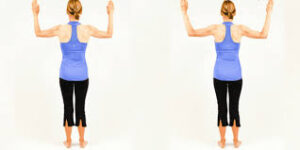
How to Do Wall Angels
Wall angels can help you work on shoulder and upper-back mobility while practicing controlled scapular movement.
The first step in performing this exercise is to find a comfortable position.
To begin, stand facing a wall, but do not press your whole body against it.
The second step is to position your arms.
Make sure you place them in a position that looks like the letter “W” and avoid any tension on the shoulders.
The third step is to slowly move the arms up and then down while maintaining a comfortable position.
Do not make any abrupt movements, and avoid trying to move your arms beyond their range of motion.
The fourth step is to refrain from compensating.
Avoid pushing the lower back or shrugging the shoulders to make the movement.
The position is more important than how high your arms move.
How to Do Face Pulls
Face pulls can be performed using a resistance band attached to a secure anchor.
Step 1: Setup
Attach the resistance band to an anchor approximately upper-chest or face height, depending on your equipment and setup.
Make sure to secure the band properly.
Step 2: Pull towards the face
Hold the band with both hands and slowly pull it toward your face. Let your elbows flare out as needed for the movement.
Step 3: Return to the start position
Slowly return to the starting position.
Do not use momentum to return to the starting position.
If you are not familiar with face pulls or have shoulder pain, a physical therapist or qualified fitness professional can help you determine if the exercise is right for you.
How to Perform Scapular Retraction Without Equipment
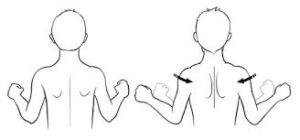
You may not need resistance bands or weights to work on your control of your scapulas.
Seated or standing, in a comfortable position.
Let your shoulders relax.
Make gentle movements with your shoulder blades backward and towards each other, but don’t shrug your shoulders.
Stop and relax.
Your movements should be comfortable.
Don’t push your shoulder blades together as if you are attempting to touch them.
The objective is to make controlled movements and not to hold a position.
Common Scapular Exercise Mistakes
Pulling the shoulder blades together too forcefully
Using too much force may be counterproductive since squeezing the shoulder blades together with great intensity may cause tension in other parts of the body
Shrugging the shoulders
Instead of shrugging the shoulders up toward the ears, one should keep the shoulders as relaxed as possible
Arching the lower back
Many people tend to over-bend the lumbar region when they cannot move their shoulders due to improper scapular position
Keeping the rest of the body relaxed and controlled is essential.
Using momentum
Using rapid and jerky movements may cause uncontrolled shaking, which can make it difficult to properly engage the target muscles.
Momentum should be minimized by using an appropriate speed.
Holding your breath
You should not hold your breath during a light scapular exercise; keep your breathing comfortable and regular.
Trying to hold the same muscular position throughout the day
Doing scapular exercises does not mean that one should constantly squeeze the shoulder blades back while at work or while studying.
Instead, changing positions, exercising, and using appropriate stretches are more practical than sitting for long periods while trying to maintain the same position.
It is also important not to sit for too long without standing up.
How Often Should You Do Scapular Exercises?
There is no magic frequency.
Studies used differing protocols of varied exercises, durations, and combinations.
For instance, a small study involving the stabilization of the scapulae used 3 weekly sessions for 4 weeks, but other studies used different protocols.
These protocols should not be thought of as requirements.
If you’re new to scapular training, it’s best to learn the movement and find a frequency that doesn’t aggravate symptoms.
A physical therapist can help you decide how often to train and how to progress the sets and reps if you’re doing them as a part of a rehabilitation program.
Can Scapular Exercises Help Neck Pain?
They may help some people to relieve their neck pain.
A 2024 systematic review and meta-analysis of randomized controlled trials found moderate evidence supporting the benefits of scapular-specific interventions in reducing pain intensity among people with chronic neck pain.
However, the review found no convincing evidence of the interventions consistently improving neck disability, and no conclusive evidence regarding some outcomes.
Another systematic review found moderate-quality evidence that interventions targeting both the scapula and the neck may reduce pain compared to interventions that only target the neck, although no improvement in disability was seen.
This suggests that while exercises targeting the scapula may be beneficial for some, they should not be considered a primary intervention for all neck pain.
If an exercise consistently makes your symptoms worse, consider getting an individualized assessment from a physical therapist or other qualified healthcare professional.
Can Scapular Exercises Permanently Fix Forward Head Posture?
There is insufficient evidence to conclude that scapular retraction exercises alone can correct forward head posture.
A 2026 systematic review and meta-analysis found that therapeutic exercise can improve craniovertebral angle, pain intensity, and neck function in people with forward head posture and neck pain.
However, this does not establish that these changes are permanent or that scapular exercises alone are sufficient.
What Other Exercises Can You Combine With Scapular Exercises?
The exercises for the scapular can be combined with other regimens.
Depending on the individual’s needs, the following activities can be incorporated into the larger program:
- neck mobility and control
- chin tucks
- upper back mobility
- strengthening
- general physical activity
- ergonomic adjustments
- movement breaks
A broader exercise program can address more than one aspect of movement, strength, and mobility than a single exercise.
You can learn more in our guide to Forward Head Posture Exercises.
For a specific exercise targeting head and neck control, see our guide to Chin Tucks for Forward Head Posture.
If you spend significant time working at a computer, our guide to computer screen positioning and forward head posture may also be useful.
When Should You See a Physical Therapist?
Consider getting a professional evaluation if your symptoms are persistent, worsening or affecting your ability to perform daily activities.
This is especially important if you have:
- persistent or severe neck pain
- pain that shoots down your arm
- numbness or tingling
- unexplained weakness
- marked decrease in neck mobility
- following an injury
- balance or coordination problems
- severe or unusual headaches
- symptoms affecting your ability to perform normal activities
A physical therapist can evaluate your range of motion, your posture, your muscle strength and endurance, your shoulder and upper back mobility and other factors which may be contributing to your symptoms.
You can also read our guide explaining how a physical therapist evaluates forward head posture.
If you are trying to understand whether your symptoms may be related to forward head posture, see our guide to Forward Head Posture Symptoms.
Frequently Asked Questions:
Do scapular retraction exercises correct forward head posture?
They might improve some signs of forward head posture, but they probably aren’t a complete solution
What is the best scapular exercise for forward head posture?
It is unclear if any single exercise is best
Band pull aparts, wall angels, face pulls, rows, and other shoulder blade control exercises may all be helpful
How do you do a scapular retraction exercise?
While sitting or standing, keep your shoulders relaxed and gently move your shoulder blades backward and toward each other. Use a controlled range of motion rather than forcing them together.
Should scapular retractions be painful?
No, but if you feel sharp pain or numbness or pins and needles, then you should probably talk to someone, as it may indicate that the exercise is irritating a nerve or another structure. Stop the exercise and seek an assessment if the symptoms persist.
Can scapular exercises help with neck pain?
They might.
Research suggests that scapular exercises may be a useful part of a physical therapy program for some people with neck pain and other musculoskeletal problems, but they are not a cure-all. Everyone’s situation is different, so make sure that you do what’s best for you.
How often should I do scapular exercises?
That depends on the program, the pain, and the person.
Can I do scapular exercises every day?
Probably, but it isn’t necessary.
You should listen to your body and to your physical therapist or doctor.
Can scapular exercises fix my rounded shoulders?
They may strengthen the muscles and improve mobility in the shoulder blades, but there isn’t a single cause or cure for everyone.
Bottom Line
Scapular retraction and stabilization exercises may help improve some measures of forward head posture and may reduce neck pain in some people.
Studies indicate that exercises targeting the musculature around the scapulae can lead to measurable improvements in selected clinical outcomes, and reductions in neck pain intensity, but they should not be used as a standalone treatment.
Instead, the combination of these exercises with other neck and upper back mobility and strengthening techniques, regular physical activity, and lifestyle adjustments when necessary, can form an effective treatment strategy for related conditions.
Furthermore, it is important to focus on controlled motions and avoid aggressive retraction of the shoulders whenever possible, and seek medical advice if necessary or if the cause of discomfort cannot be resolved on one’s own.
References:
- Im B, et al. Scapular Stabilization Exercise for Neck Pain and Forward Head Posture. PubMed
- Kang JI, et al. Scapular Stabilization Exercise and Neck Alignment in Forward Head Posture. PubMed
- Chen Y, et al. Scapular Treatment for Chronic Neck Pain: Systematic Review and Meta-Analysis. PubMed
- Abd El-Azeim AS, et al. Adding Scapular Stabilization to Postural Correction Exercises for Forward Head Posture. PubMed
- Xing Y, et al. Therapeutic Exercise for Forward Head Posture in Neck Pain Patients. PubMed
Why Trust Us
Our content is developed using peer-reviewed research and systematic reviews, where available. We seek to differentiate between research-supported information and established controversies.
For more information about how health-related content on this site is reviewed, please visit our Why Trust Us page.
Medical Disclaimer
This article is intended for educational purposes only and should not be used as a substitute for individual medical or physical therapy advice. If you have significant pain, neurological symptoms, a recent injury, or another medical condition, consult a qualified healthcare professional before starting or changing an exercise program.
Learn more about how we review health-related content: Medical Review Process