Walking is a straightforward and accessible form of exercise, but can it really help in correcting forward head posture?
The truth is that it all comes down to definitions.
Regular walking supports general health and helps you stay physically active. Some preliminary research also suggests that specific walking-based interventions may help improve forward head posture.
However, ordinary walking alone has not been established as a reliable treatment for changing head position or relieving persistent neck pain.
If your head tends to sit forward relative to your shoulders, walking can be part of a broader approach that includes suitable exercises, comfortable movement habits, and adjustments to your working environment.
This article explains what research says about walking and forward head posture, how to walk comfortably, which exercises may complement walking, and when professional guidance may be useful.
Table of Contents
- Can Walking Fix Forward Head Posture?
- What Does Research Say About Walking and Neck Posture?
- Ordinary Walking vs. Targeted Walking Exercises
- How to Walk With Comfortable, Relaxed Posture
- Exercises to Combine With Walking
- What Walking Cannot Do
- When to Seek Professional Advice
- Frequently Asked Questions
- Bottom Line
- References
Can Walking Fix Forward Head Posture?
Walking may be incorporated into a program of postural improvement, but walking alone isn’t likely to cure forward head posture.
Forward head posture is when your head is positioned in front of your trunk. It may be accompanied by other signs like rounded shoulders and/or limited range of motion in your upper back, but it doesn’t always occur with those problems.
Walking is a beneficial activity that promotes physical activity and can help keep you alert, but it doesn’t specifically target your head posture.
Walking comfortably also gives you an opportunity to practice coordinating your head, trunk, arms, and legs during movement.
While these are positive benefits, they can’t be used as justification for believing that walking will permanently alter your head posture.
If your goal is to improve your posture, treat walking as one part of your normal activity routine rather than expecting it to act as a cure.
What Does Research Say About Walking and Neck Posture?
Research into walking specifically for forward head posture is still evolving.
A 2025 narrative review, published in the Journal of Bodywork and Movement Therapies, looked at seven studies of walking-based interventions for forward head posture.
Backward walking has been investigated in preliminary research involving posture and balance. However, it is different from simply paying attention to your posture during an ordinary walk.
Because you cannot see your path as clearly when walking backward, the activity may increase the risk of tripping or falling. Do not attempt it in traffic, on uneven ground, or in crowded areas. If you have balance problems, mobility limitations, or a history of falls, seek professional guidance before trying it.
This distinction is important, since the findings do not show that ordinary forward walking by itself reliably corrects forward head posture.
Research into therapeutic exercise provides additional insight. A 2018 systematic review and meta-analysis looked at seven randomized clinical trials with a total of 627 participants, finding that therapeutic exercise may be effective for improving certain head-posture metrics in people with forward head posture, and for reducing neck pain.
However, this study looked at corrective exercise programmes, not walking.
Taken together, the evidence suggests three practical points:
- Ordinary walking: A useful way to remain physically active, but not an established stand-alone treatment for forward head posture.
- Specific walking-based interventions: Preliminary findings are promising, but more research is needed.
- Targeted therapeutic exercise: Research supports considering appropriate exercise programmes when the goal is to improve posture measurements or manage associated neck discomfort.
You can read the studies in the references at the end of this article.
Ordinary Walking vs. Targeted Walking Exercises
Not all walking interventions are the same, and knowing the differences can help you set more realistic expectations.
Ordinary Forward Walking
Ordinary forward walking includes the walking you do outdoors, at work, or as part of your daily routine. It helps you stay physically active and can break up long periods of sitting.
Although walking offers general health benefits, it has not been established as a stand-alone treatment for correcting forward head posture. You do not need to force your head into a rigid position while walking.
Backward Walking
Backward walking has been investigated in preliminary research involving posture and balance. However, it is different from simply paying attention to your posture during an ordinary walk.
Because you cannot see your path as clearly when walking backward, the activity may increase the risk of tripping or falling. Do not attempt it in traffic, on uneven ground, or in crowded areas. If you have balance problems, mobility limitations, or a history of falls, seek professional guidance before trying it.
Walking on Slopes with Added Weight
Some preliminary studies have examined walking on inclined or declined surfaces and walking with a front-loaded weight. These methods are not established treatments for forward head posture.
Do not add weight to your head or neck, or start a loaded walking routine specifically to correct your posture without qualified professional guidance. Additional resistance is not automatically beneficial and may increase strain or fall risk.
For most readers, comfortable regular walking is a more practical starting point. Specialized walking interventions should not be treated as necessary steps in a posture-correction routine.
How to Walk With Comfortable, Relaxed Posture
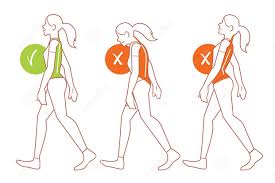
You should not have to keep a rigid pose or be continually tense while walking. The goal is to move comfortably, and not to put extra tension on different parts of your body.
Keep a comfortable gaze
Keep a comfortable gaze when walking. Look ahead, not down at your feet or constantly at your phone
Your head should move freely as you walk, and you should not constantly lock your chin back or strain your neck.
Let your shoulders hang freely
Let your shoulders fall freely instead of pulling them back or locking them.
Your arms should swing naturally and not be over-strained in an attempt to keep good posture (unless of course, you’re trying to build muscle). You do not have to over-exert yourself.
Breathe normally
Breathe normally and comfortably. Do not tighten or lock your stomach muscles for the entire walk, or hold tension in your body to keep from slouching.
Pick a comfortable pace
Start at a pace that suits your fitness and mobility. If you have been inactive, begin with manageable walks and increase the duration gradually as tolerated.
For most adults, the World Health Organization recommends 150–300 minutes of moderate-intensity aerobic activity per week, or 75–150 minutes of vigorous-intensity activity, or an equivalent combination.
These are general health recommendations, not a prescription for correcting forward head posture. Adjust your activity to your abilities and seek professional advice if a health condition affects your exercise choices.
Mix it up throughout the day
Walking is a great way to mix up your activity if you sit all day. You do not have to constantly be in the perfect posture. In fact, it’s unhealthy to do so.
If you work at a computer, take regular movement breaks and make sure your workstation is comfortable. Read our guide to adjusting computer screen position for forward head posture.
Exercises to Combine With Walking
If your aim is to improve forward head posture, walking may be more useful as part of a broader routine that addresses movement control and strength.
The sorts of exercises you may benefit from will depend on your symptoms, physical capabilities, and underlying health issues.
You do not have to do every single type of exercise listed below.
Chin tucks
Chin tucks are a motion where you gently draw your head backwards, maintaining a level gaze. They can help you to work on controlled head positioning and encourage engagement of the relevant muscle groups.
You should work within a comfortable range of motion and not force your head backwards if it provokes discomfort, dizziness, or other unwanted symptoms.
Follow our guide to chin-tuck exercises for forward head posture
Scapular retraction
This exercise helps you practice controlling the muscles around your shoulder blades. It does not guarantee a change in head position, but it may be a useful part of a broader upper-back strengthening and mobility programme.
Learn how to perform scapular retraction exercises.
Upper-back mobility exercises
Upper-back mobility exercises such as gentle thoracic extensions and rotations can help you to work on controlled movements, but avoid putting your spine or neck in an uncomfortable position.
A broader posture-focused exercise programme
A well-rounded programme might combine mobility and strengthening work with exercises that encourage good head and shoulder positioning. For more options, see our guide to forward head posture exercises.
Walking and targeted exercises serve different functions. Walking is a general exercise that encourages you to remain active and involved in everyday movement, whereas targeted exercises may work on specific problem areas or focus on building strength and control.
If you are struggling to identify the right sort of exercises for your particular needs or if you have other persistent symptoms, consult a physical therapist.
What Walking Cannot Do
Walking has many benefits, but it is important not to overestimate what it can accomplish.
Walking alone cannot guarantee that your head will return to a particular position. It does not necessarily strengthen every muscle involved in neck control or identify the cause of persistent neck pain.
Forward head posture does not automatically mean that your spine is damaged or that you will develop long-term complications. The relationship between head position and pain varies between individuals.
If you experience neck discomfort, consider your overall activity levels, daily habits, symptoms, and ability to move comfortably. Do not assume that posture alone explains your pain.

When to Seek Professional Advice
Seek prompt medical assessment for new or worsening limb weakness, persistent numbness or tingling, or other unusual neurological symptoms. Sudden severe symptoms, a significant injury, difficulty walking, or loss of bladder or bowel control warrant urgent medical attention.
You can also read our guide to how a physical therapist evaluates forward head posture.
Frequently Asked Questions:
Can walking fix forward head posture?
There is currently insufficient evidence to support that ordinary walking alone is a reliable treatment for forward head posture. Walking can promote general health and may be part of an overall regimen, but targeted exercises may be indicated to address posture or related neck symptoms.
Does walking with good posture fix the neck?
Walking comfortably with your gaze ahead and your shoulders relaxed can help you avoid unnecessary tension. However, there is no guarante Exercises to Combine With Walkine that consciously adjusting your posture while walking will permanently change your head position.
Is backward walking better than ordinary walking for forward head posture?
A 2025 narrative review found preliminary evidence that backward walking may be beneficial for cervical posture and balance. However, the evidence is limited, and it is not yet possible to conclude that backward walking is generally better than ordinary walking for correcting forward head posture. Due to increased fall risk, backward walking is not appropriate for all individuals.
Should I use weights when walking to fix my forward head posture?
Do not assume that adding weight will improve posture. A few preliminary studies have investigated loaded walking, but loaded walking is not an established treatment for forward head posture. Do not use additional weight on your head or neck for this purpose without individual guidance from a qualified professional.
How long should I walk to improve forward head posture?
There is no established walking duration or schedule proven to correct forward head posture. Choose a duration that matches your fitness and that you can tolerate, and gradually increase as needed. General physical activity guidelines apply to walking as a means of promoting health, but walking is not a guaranteed treatment for forward head posture.
What are some good exercises to do with walking?
Your regimen should be individualized according to your needs and symptoms. Possible options include chin tucks, shoulder blade squeezes, and upper-back mobility exercises. If exercises cause pain or other concerning symptoms they should be discontinued and individual guidance sought.
Can walking help with neck pain?
Physical activity can promote general health, but walking is not a proven treatment for all causes of neck pain. If symptoms persist or are severe it is important to seek individual medical assessment.
Bottom Line
Walking is a useful way to stay active, and preliminary research suggests that certain walking-based interventions may have a role in improving forward head posture. However, ordinary walking alone has not been established as a reliable treatment for changing head position or resolving persistent neck pain.
For a more balanced approach, combine comfortable regular movement with suitable exercises and adjustments to your daily working habits. Avoid rigid posture rules and unproven methods involving added head or neck weight.
If your symptoms persist or you are unsure which exercises are appropriate for you, seek guidance from a qualified healthcare professional.
References
- Ch’ng CC, Lim YL. Can Walking Improve Forward Head Posture? A Narrative Review. Journal of Bodywork and Movement Therapies. 2025;44:815–819.
- Sheikhhoseini R, Shahrbanian S, Sayyadi P, O’Sullivan K. Effectiveness of Therapeutic Exercise on Forward Head Posture: A Systematic Review and Meta-analysis. Journal of Manipulative and Physiological Therapeutics. 2018;41(6):530–539.
- World Health Organization. Physical Activity. General recommendations and health benefits of physical activity.
Why Trust Us?
Learn about our approach to research, content quality, and editorial standards on our Why Trust Us page.
For Educational Purposes Only
This article is for general educational purposes and is not a substitute for individual medical advice, diagnosis, or treatment. Read our medical review process and educational disclaimer.