Prone horizontal abduction, straight-arm shoulder extension, and face pulls are the most reliable mid trap exercises when the scapula is drawn back and slightly down before the arms move. That single cue, retract first, then lift, determines whether the middle trapezius does the work or the shoulders and neck compensate. A 2016 controlled study found that four weeks of this kind of targeted work measurably improved forward head posture. The next sections break down the anatomy, the drills, and the full exercise bank.
TL;DR:
- Strengthening the middle trapezius through targeted exercises can improve forward head posture within four weeks.
- Proper scapular setting before exercises ensures mid trap activation and prevents compensation from shoulder and neck muscles.
- The most effective mid trap exercises include prone horizontal abduction, straight-arm shoulder extension, and face pulls, with a focus on controlled movement and form.
- Consistent practice, high reps with light resistance, and gradual progression are crucial for lasting posture improvements.
- Addressing thoracic mobility and daily habits enhances results, as muscle strength alone cannot correct poor posture.
Table of Contents
- Why the middle trapezius matters for posture
- How do you activate the mid trap before loading it?
- The best mid trap exercises, ranked by effectiveness
- Sets, reps, and a 4-week starter plan
- What mistakes ruin mid trap training?
- Where exercise fits into real posture correction
- Take the next step toward lasting posture correction
- Studies and clinical resources behind this guide
- Sources
Why the middle trapezius matters for posture
The middle trapezius sits between your shoulder blades, running from the spine out to the scapula, and its main job is scapular retraction, pulling the shoulder blades toward the spine. That’s a different action than the upper trapezius, which shrugs the shoulders up, or the lower trapezius, which pulls the scapula down and in. The rhomboids assist the mid trap on retraction, which is why the two get trained together so often, but they sit deeper and pull at a slightly different angle.
When the mid trap is weak, the shoulder blades drift forward and wing outward. That pulls the shoulders into a rounded position, which drags the head forward to keep your eyes level, the classic forward head posture pattern that Bestforwardheadposturefix exists to correct. Strengthen the muscle that holds the shoulder blades back, and you remove one of the main mechanical drivers of that slump.
A PMC-published controlled trial tested exactly this: strengthening the middle and lower trapezius while stretching the upper trapezius and pectoral muscles. The result was a measurable shift in posture and posterior neck alignment after a short program. That’s the model worth copying:
- Strengthen the scapular retractors (mid and lower trapezius, rhomboids)
- Stretch the muscles pulling the shoulders forward (upper trapezius, pec minor)
- Reinforce the pattern with daily posture awareness, not just gym sessions
How do you activate the mid trap before loading it?
Most people can’t feel the mid trap working until they isolate it from the arms and neck. Scapular setting solves that. It’s a low-load rehearsal you do before any loaded exercise, and clinical scapular stabilization protocols treat it as the foundation everything else builds on.
Here’s the routine:
- Sit or stand tall, arms relaxed at your sides.
- Draw both shoulder blades back toward your spine and slightly down, away from your ears.
- Hold that position for 10 seconds without shrugging or arching your lower back.
- Release slowly and repeat for 8 to 10 reps.
- Once that feels automatic, add small movement: prone T, I, and Y raises with a 2 second hold at the top, or band-assisted horizontal retraction pulling a light band apart at chest height.
- Try wall T raises if lying prone bothers your neck: back against a wall, arms out in a T, sliding shoulder blades down and together.
If neck rotation or shoulder impingement makes prone work uncomfortable, do everything seated or standing instead. A seated band row with a deliberate scapular squeeze produces a very similar neuromuscular pattern to the prone version, as long as the movement stays slow and controlled and you set the scapula before pulling.
Pro Tip: Pause for a full two count at the top of every rep before releasing. Most people rush the squeeze and let momentum do the work, which trains the arms instead of the mid trap.
Progress by adding hold time first, then reps, before you ever add resistance.
The best mid trap exercises, ranked by effectiveness
Not every “back exercise” hits the middle trapezius equally. Some rows lean on the lats and biceps and barely touch it. These six, in order of priority, are the ones worth building a routine around.
1. Prone horizontal abduction (prone row, prone T/I/Y)
Lie face down on a bench or the floor, forehead supported. Set your scapulae back and down, then raise your arms out to the sides (T), overhead (Y), or straight back (I), leading with the elbows, not the hands. This is the classic isolation move clinicians reach for first, and clinical scapular stabilization resources list it as a core building block. No equipment needed for regression; add light dumbbells (1 to 3 pounds to start) to progress.
2. Straight-arm shoulder extension
Lie prone or stand hinged forward, arms straight, and sweep them back behind your body like a swimming stroke, keeping the elbows locked. Keeping the arm straight removes a lot of biceps and deltoid assistance, which is why this variation tends to demand more from the mid trap than a bent-elbow row does. Regress with no load; progress with a light band or cable anchored low.
3. Face pull and elevated face-pull variations
Attach a rope or band at roughly shoulder height, pull it toward your face while flaring the elbows out and squeezing the shoulder blades together at the finish. Raising the anchor point slightly above shoulder height shifts more of the pull toward the mid and lower trap rather than the rear delts. Regress with a lighter band or shorter range; progress with heavier resistance or a slow 3 second eccentric.
4. Wrap-around row
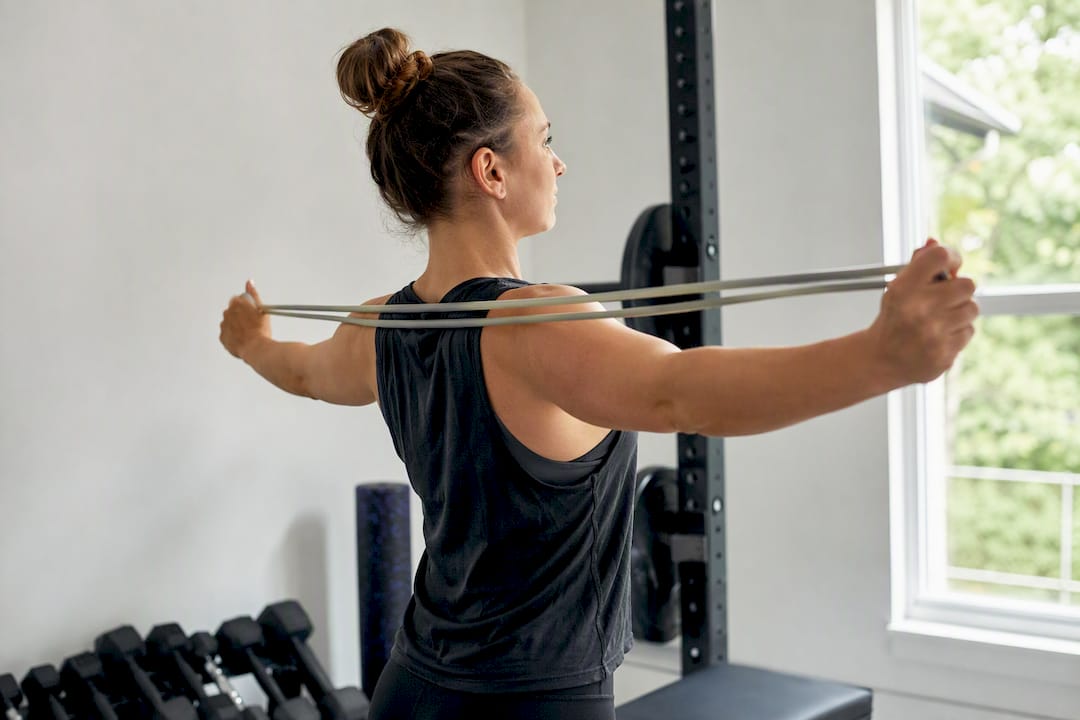
Wrap a band around a post or use a cable at chest height, cross your arms slightly, and pull each hand toward the opposite shoulder in a hugging motion before releasing. This variation works the mid trap through a horizontal path that overlaps with how you’d catch yourself from rounding forward, which makes it a useful bridge exercise between isolated drills and everyday posture. It’s also easy to do standing, which matters for anyone who can’t get on the floor.
5. Band pull-apart
Hold a light resistance band at shoulder height with arms extended, then pull it apart by driving the shoulder blades together, not just by moving the hands. This is the most accessible mid trap exercise on the list. It needs almost no equipment, works anywhere, and is forgiving enough for daily practice.
6. Seated band row with scapular retraction
Anchor a band at chest height, sit tall, and row your elbows straight back while consciously squeezing the shoulder blades before your arms finish moving. The scapular squeeze has to come first, or this turns into a lat and bicep exercise with almost no mid trap involvement.
Where does shoulder angle matter? EMG-informed observations suggest that abducting the arm to roughly 45 degrees, rather than 0 or 90 degrees, tends to increase mid trap recruitment during rows and raises. That’s a useful cue to remember on the T raise and face pull variations: aim the arms at a diagonal rather than straight out to the sides.
Sets, reps, and a 4-week starter plan
Pick 2 to 3 exercises from the list above rather than trying to do all six every session. Beginners get more out of doing prone T/I/Y, band pull-aparts, and face pulls well than doing six exercises poorly.
The general programming rule for mid trap work is high reps, low load, as outlined in this beginner shoulder workout: build strength safely. Aim for:
- 2 to 3 sets of 10 to 20 reps per exercise
- Light resistance to start, around 2 to 3 pounds for dumbbell work or a light band tension
- Training frequency of 3 to 4 sessions per week, since the mid trap responds well to frequent, low-fatigue practice
- Progression by adding reps first, then hold time, then a harder variation, and only then more load
That progression order matters more than most people assume. Jumping straight to heavier weight before the scapula reliably sets itself just trains compensation patterns instead of fixing them.
Four-week starter microcycle:
- Week 1: Scapular setting practice daily, plus band pull-aparts and wall T raises, 2 sets of 15 reps, 3 sessions.
- Week 2: Add prone T/I/Y with no weight, 2 sets of 12 reps each position, alongside pull-aparts, 3 to 4 sessions.
- Week 3: Introduce face pulls and light dumbbell load (1 to 2 pounds) on prone raises, 3 sets of 10 to 15 reps.
- Week 4: Add the wrap-around row and straight-arm extension, increase band tension, 3 sets of 12 to 15 reps across 3 to 4 sessions.
A 2016 randomized trial using a similar strengthening structure over four weeks recorded measurable posture change in that window, which is roughly the timeline worth expecting before judging whether a routine is working. For deeper progressions once this base is solid, a scapular retraction guide walks through more advanced loading options.
What mistakes ruin mid trap training?
The most common error is scapular elevation, shrugging the shoulders up toward the ears instead of pulling them back and down. It quietly shifts the work onto the upper trapezius, the muscle that’s usually already overactive in people with forward head posture. Fix it by cueing “shoulders away from your ears” on every rep, and drop the resistance until you can maintain that position for the full set.
Using arm or elbow momentum to swing the weight up is the second big one. If you can’t slow the rep down and pause at the top, the load is too heavy or the range of motion is too large. Straight-arm extensions are especially prone to this because it’s tempting to fling the arms back rather than sweep them with control.
Arching the lower back or extending through the thoracic spine to fake range of motion shows up often on prone Y raises. Keep the ribs down and the core braced; if you need to arch to get your arm overhead, shorten the range instead.
- Scapular elevation: cue shoulders down and back, lower the load
- Arm momentum: slow the tempo, add a 2 second pause at the top
- Back arching: brace the core, shorten range of motion
- Too much weight, too soon: regress to band or bodyweight until form holds for the full set
Pro Tip: If an exercise causes sharp pain, numbness, or symptoms that radiate down the arm, stop immediately and check with a physical therapist or physician before continuing. Muscle fatigue and a mild burn are normal; nerve-type pain is not.
For anyone with limited shoulder mobility, the thoracic mobility drills guide covers modifications that make prone and overhead positions more tolerable.
Where exercise fits into real posture correction
Mid trap exercises fix one piece of a bigger mechanical picture. You can build a strong middle trapezius and still slump forward eight hours a day at a desk if nothing else changes. The exercises retrain a muscle; daily habits determine whether that strength actually shows up in how you stand and sit.
What gets underestimated is thoracic mobility. A stiff upper back limits how far the shoulder blades can retract, no matter how strong the mid trap gets, which is why pairing this work with mobility drills and upper trapezius stretching tends to outperform strengthening alone. Consistency beats intensity here. Ten minutes of scapular setting and band work most days will change your posture faster than one hard gym session a week.
The simplest carryover habit: every time you catch yourself hunched at a screen, do one 10 second scapular set before going back to work. It costs nothing and reinforces the exact pattern these exercises are teaching your body.
— Madhukar
Take the next step toward lasting posture correction
Bestforwardheadposturefix is the resource that goes beyond a single exercise list, connecting mid trap work to the full picture of forward head posture correction: mobility, habit change, and daily awareness working together instead of in isolation. The structured guides on the site walk through progressions in more depth than any single article can, with posture habit strategies and drills organized so you’re not piecing together random routines from scattered sources.
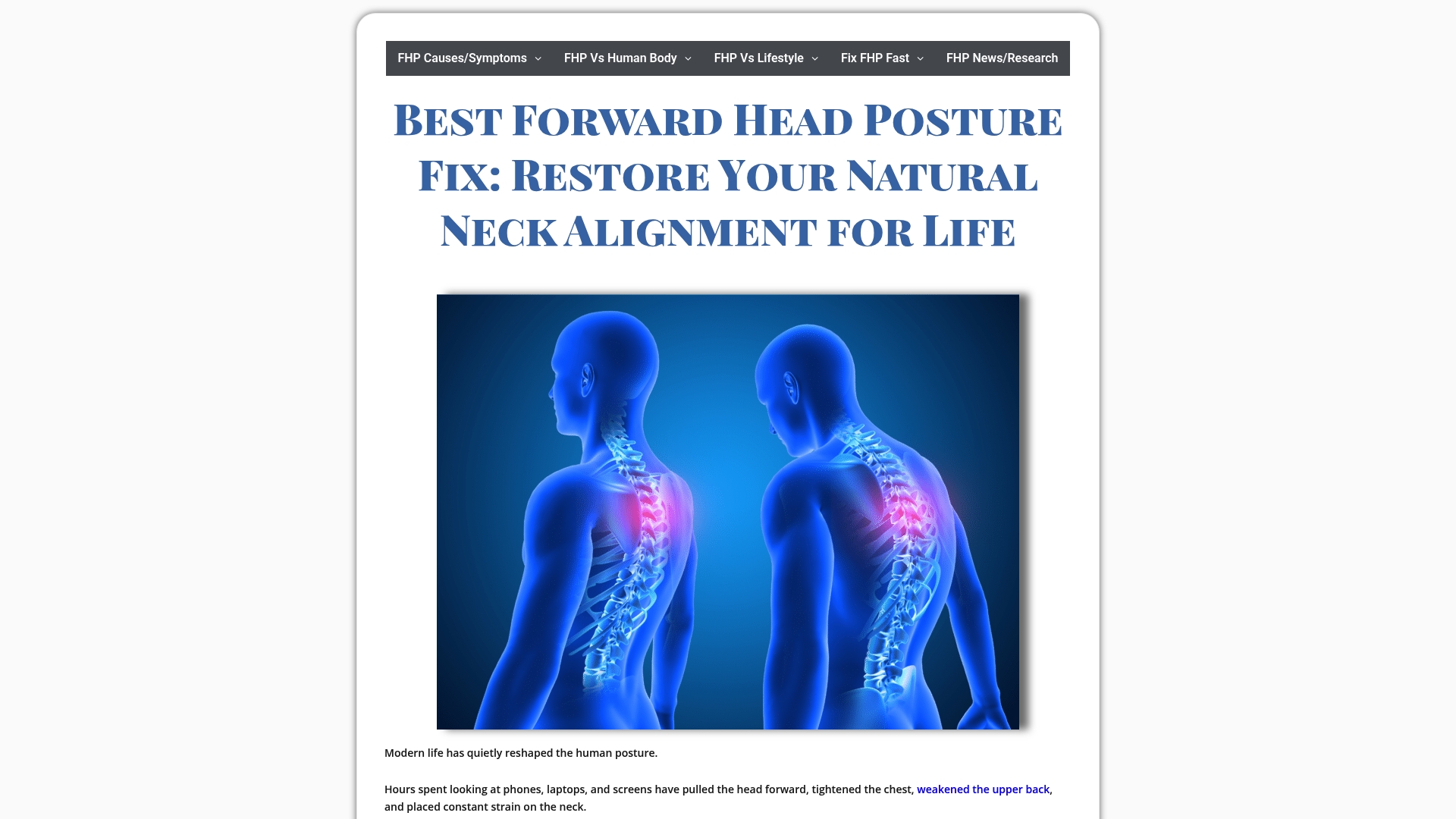
Exploring the site gets you guided exercise progressions, practical daily posture habit guidance, and deeper drill breakdowns than a single article can hold, all built around the same activation-first approach covered here. If rounded shoulders and forward head posture are the problem you’re solving, start with the full posture correction resources and work through the program at your own pace.
Studies and clinical resources behind this guide
- PubMed record: trapezius strengthening and posture (2016), a randomized trial showing four weeks of mid/lower trapezius strengthening and upper trapezius stretching improved forward head posture.
- Effectiveness of strengthening and stretching exercises on upper crossed syndrome (PMC), a controlled study linking scapular strengthening and stretching to measurable posture and thermal changes.
- Scapular stabilisation exercises, Cambridge University Hospitals, clinical patient guidance on scapular setting and progressive stabilization drills.
- NASM: shoulder function and scapular stabilization, on pairing scapular retractor work with serratus anterior and lower trapezius training.
- MedBridge: nine best scapular exercises, covering prone exercises and non-prone alternatives for shoulder impingement.
Sources
- PubMed record: study on trapezius strengthening and posture (2016)
- Effectiveness of strengthening and stretching exercises on upper crossed syndrome (PMC)
- Scapular stabilisation exercises — Cambridge University Hospitals patient information