Yes, stomach sleeping is a leading cause of morning neck pain, and the fix usually starts tonight, not at the mattress store. Only about 7% of adults sleep on their stomachs, yet it’s disproportionately linked to stiffness and headaches because the head gets twisted sideways for hours. Bestforwardheadposturefix recommends starting with a thinner pillow and a small pelvic support tonight, and shifting toward side or back sleeping if the pain doesn’t ease within a couple of weeks.
TL;DR:
- Although only 7% of adults sleep on their stomachs, this position disproportionately causes neck strain, stiffness, and headaches due to sustained cervical rotation.
- Using a very flat or no pillow under the head and adding a thin pillow under the abdomen can significantly reduce neck and lower back strain for stomach sleepers.
- Transitioning to side or back sleeping should involve gradual habit changes, such as starting sessions on healthier positions and using supportive pillows, over several weeks.
- Persistent neck pain beyond two to three weeks despite sleep adjustments indicates the need for medical evaluation, especially if neurological symptoms or weakness develop.
- Addressing daytime forward head posture through awareness and exercises complements sleep posture fixes, potentially speeding up relief from chronic neck pain.
Table of Contents
- Why Does Stomach Sleeping Cause Neck Pain?
- How Can You Reduce Neck Strain While Still Sleeping on Your Stomach?
- How Do You Transition From Stomach Sleeping to Side or Back Sleeping?
- When Should You See a Clinician About Neck Pain?
- The Posture Connection Sleep Advice Usually Misses
- What Actually Matters Here, and What’s Overrated
- A Program Built Around the Habits That Actually Cause This
- Sources
Why Does Stomach Sleeping Cause Neck Pain?
Turn your head to breathe while lying face down, and you’ve put your cervical spine in a position it was never built to hold for seven or eight hours. The Cleveland Clinic explains that stomach sleeping forces sustained rotation and extension of the neck, which loads the small joints and muscles on one side far more than either side or back sleeping does. Add in the natural arch this position creates in the lower back, and the strain doesn’t stay isolated. It travels up the spine.
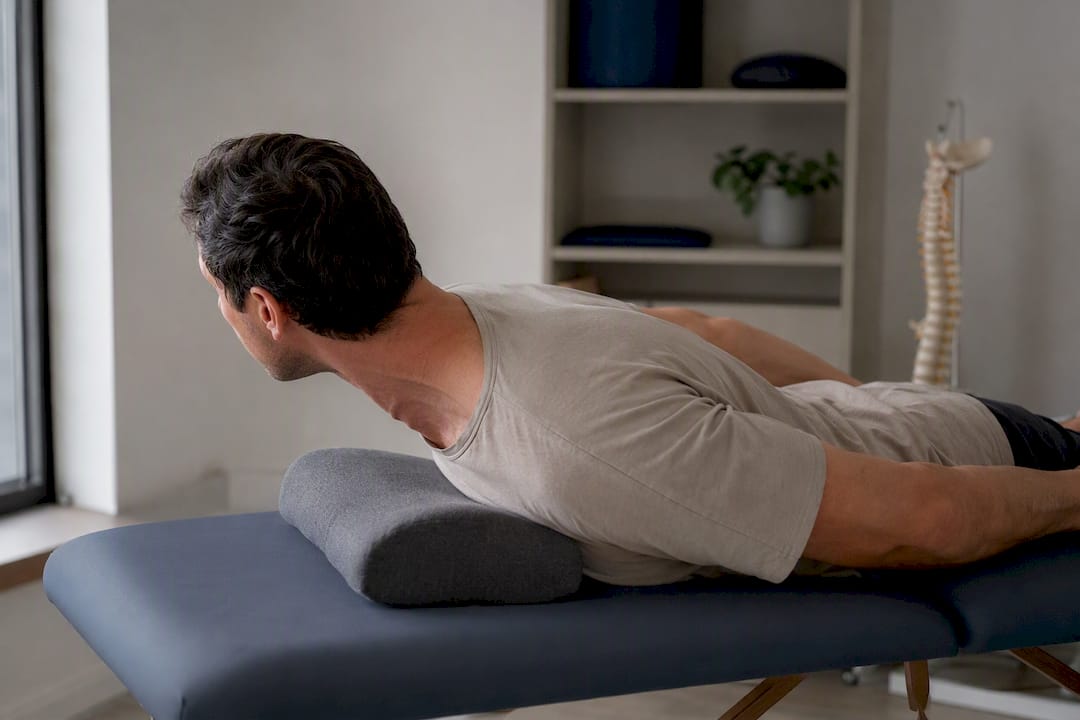
Picture the cervical spine as a stack of blocks meant to sit centered over your shoulders. Rotate the top block 90 degrees and tip it back, then hold that for hours, and something has to absorb the load. That something is usually the muscles along one side of your neck and the small facet joints that were never designed for a static twist.
Only 7% of adults sleep primarily on their stomachs, which makes it the least common of the three main sleep positions, but that low number doesn’t mean it’s low-consequence. Harvard Health Publishing notes that poor sleep posture and disrupted sleep quality are tied to a higher likelihood of developing chronic musculoskeletal pain, including in the neck, over time. Stomach sleeping is often the mechanical trigger that starts that cycle.
The symptoms tend to follow a familiar pattern:
- Morning neck stiffness that eases somewhat as the day goes on
- A dull headache concentrated at the base of the skull
- Tingling or numbness in one arm, especially if that arm was tucked under the pillow
- Soreness that’s noticeably worse on one side, matching whichever way you habitually turn your head
Roughly 7% of adults are stomach sleepers, according to the Sleep Foundation, and while that’s a small slice of the population, it’s a slice that shows up disproportionately often in conversations about morning neck pain and cervical strain.
How Can You Reduce Neck Strain While Still Sleeping on Your Stomach?
If you’re not ready to abandon stomach sleeping tonight, several adjustments genuinely lower the load on your neck without requiring a full position change.
- Go thin or go without a pillow under your head. A thick, lofted pillow exaggerates the neck extension that’s already the core problem. Mayo Clinic guidance suggests using a very flat pillow or skipping one entirely to keep the cervical spine closer to neutral.
- Add a thin pillow under your lower abdomen. This small adjustment reduces the arch in your lower back, and because the spine works as a connected chain, less lumbar extension often translates into less compensatory strain traveling up to your neck.
- Check your mattress firmness. A mattress that’s too soft lets your hips sink, which increases lower back arch and, again, cascades upward. Medium or medium-firm support generally keeps the pelvis and shoulders closer to level. A quick test: press your fist into the mattress at hip level. If it sinks more than an inch or two beyond where your shoulder does, it’s too soft for this position.
- Mind your arms and head placement. Avoid sleeping with an arm tucked overhead or under the pillow, since that position compresses nerves and worsens the tingling many stomach sleepers report. Let your head turn to whichever side feels more natural, and make small adjustments through the night rather than locking into one extreme rotation.
Pro Tip: Skip breathing-hole pillows or specialty face-cradle cushions unless you have a specific medical reason. For most adults, they add cost without meaningfully changing the neck mechanics that actually cause the pain.
These changes help, but they manage the problem rather than solving it. If stiffness, headaches, or arm tingling persist after a couple of weeks of consistent tweaks, that’s your signal to start working toward a different sleep position rather than continuing to patch around this one.
How Do You Transition From Stomach Sleeping to Side or Back Sleeping?
Retraining a sleep position you’ve held for decades doesn’t happen in one night, and expecting it to is the most common reason people give up. A realistic plan works with your habits instead of fighting them outright.
Start with behavioral anchors rather than willpower alone:
- Begin every night on your side or back, even if you end up rolling onto your stomach later
- Wedge a body pillow behind your back to make rolling into the prone position physically harder
- Ask a partner for a gentle nudge if they notice you’ve flipped, or set a phone reminder before bed as a mental cue
From there, follow a gradual schedule instead of an all-or-nothing switch:
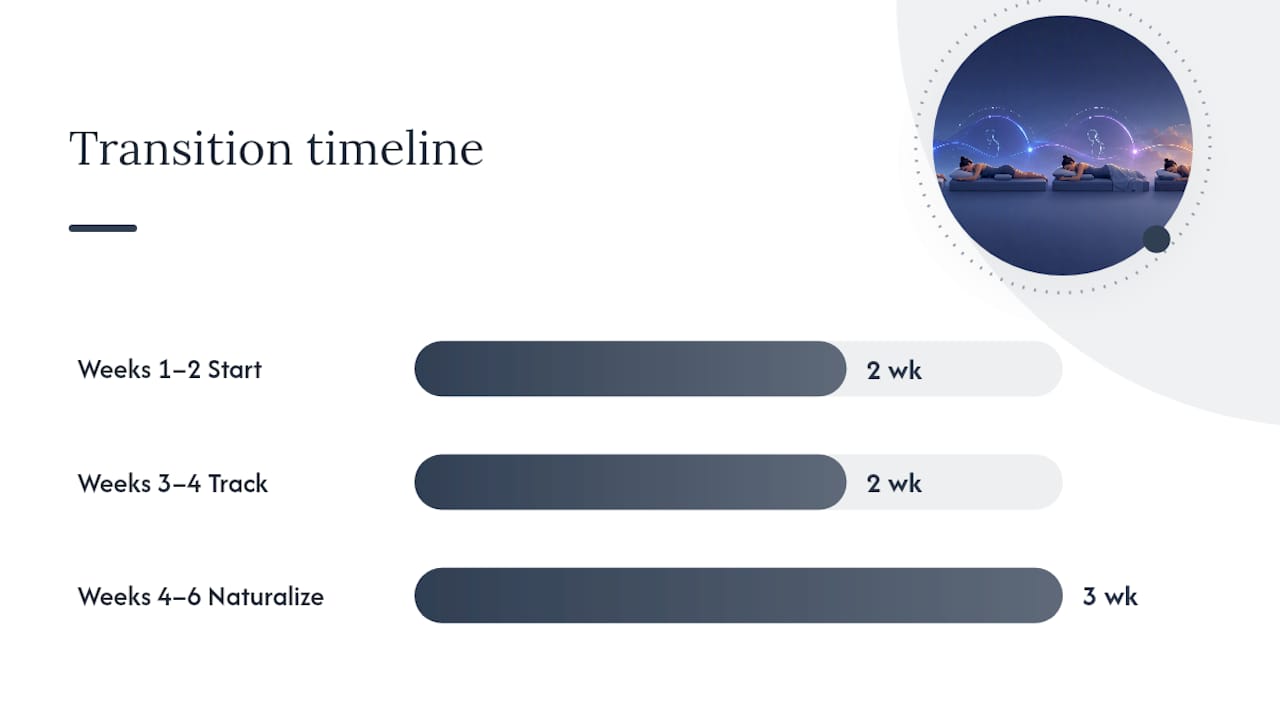
- Weeks 1 to 2: Commit to starting every night on your side or back. Expect some nights to still end with you face down. That’s normal.
- Weeks 3 to 4: Track how many full nights you stayed off your stomach. Aim to increase that count week over week rather than hitting perfection immediately.
- Weeks 4 to 6: Most people notice the new position feels more natural by this point, with fewer conscious corrections needed overnight.
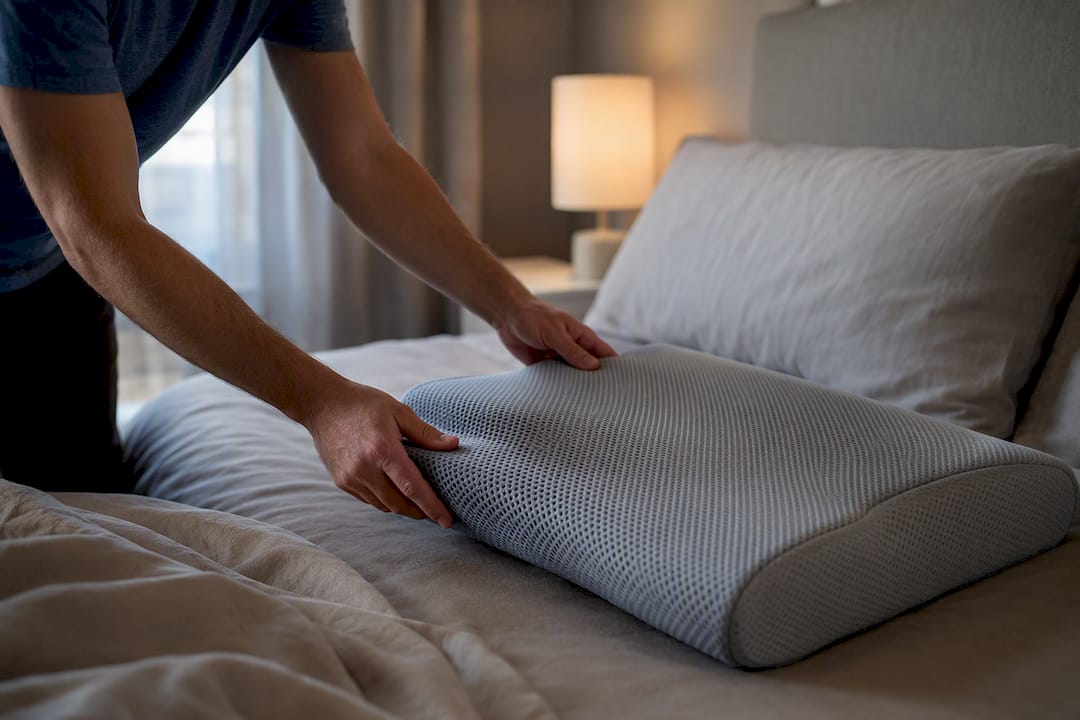
Set up your bed to support the new position: a medium-loft pillow that fills the gap between your ear and shoulder for side sleeping, or a low, supportive pillow that keeps your chin level for back sleeping. Add gentle morning neck stretches during this stretch, since clinical guidance from the Hospital for Special Surgery points out that pairing a gradual habit shift with morning mobility work speeds up adaptation and reduces the transient soreness that comes with any new sleep position. Expect a bit of discomfort in week one. That’s your body adjusting, not a sign you’re doing it wrong. If you’re curious how side sleeping specifically affects neck alignment, side sleeping neck pain fixes covers pillow height and positioning in more detail.
When Should You See a Clinician About Neck Pain?
Most stomach-sleeping neck pain responds to the mattress, pillow, and positional changes covered above. But certain symptoms mean it’s time to get a professional opinion instead of continuing to self-manage.
- Pain that persists or worsens beyond two to three weeks despite consistent changes
- Progressive weakness in your arm or hand, not just occasional tingling
- Numbness that doesn’t resolve once you’re up and moving for the day
- Unexplained weight loss alongside neck or shoulder pain
- Any sudden, severe neurological symptom, including dizziness or coordination problems
A primary care doctor is a reasonable first stop for a general evaluation, while a physical therapist typically assesses movement patterns and muscle imbalances directly. For pain that’s lingered for months or radiates down an arm, a pain medicine specialist can determine whether imaging or a more targeted intervention is warranted. Most cases resolve with a structured exercise and posture program long before imaging becomes necessary, according to Mayo Clinic’s guidance on red flags requiring medical review.
The Posture Connection Sleep Advice Usually Misses
Fixing your pillow solves the sleep half of the problem. The other half is what your neck does during the sixteen hours you’re not in bed. Bestforwardheadposturefix built its approach around this gap: habit change, postural awareness, and muscle rebalancing that address forward head posture during the day, which compounds whatever strain builds overnight from stomach sleeping.
A few night-friendly cues worth adding to your routine:
- Supine chin tucks before lights out: lying on your back, gently draw your chin toward your throat for five seconds, repeat ten times, to reinforce a neutral cervical curve before sleep.
- Scapular setting: gently draw your shoulder blades down and back while lying flat, holding briefly, to counteract the rounded-shoulder pattern that often accompanies forward head posture.
- A neck roll positioned under the natural curve of your neck, not under your head, can reinforce alignment during the transition period. Detailed roller positioning steps walk through exact placement.
Stop any exercise that sharpens pain rather than easing it, and check with a clinician if discomfort increases. For full stretch sequences and progression timelines, neck stretch routines for forward neck posture breaks down the mechanics step by step.
What Actually Matters Here, and What’s Overrated
The research supports a narrower claim than most sleep advice implies: stomach sleeping isn’t inherently dangerous for everyone who does it, but it’s a mechanical risk factor that becomes a real problem once symptoms show up. The conventional wisdom treats pillow shopping as the whole solution. It isn’t. A thinner pillow reduces extension, but it does nothing about the daytime forward head posture that’s often already loading the same muscles before you even lie down.
If you take one thing from this, prioritize the pelvic support pillow before you buy anything expensive. It’s the cheapest, lowest-effort change with the clearest mechanical logic behind it. Save the full position transition for when mitigation stops working, because forcing a habit change before you need one just adds frustration without added benefit. And treat daytime posture as part of the same problem as nighttime posture. They’re not separate issues with separate fixes.
— Madhukar
A Program Built Around the Habits That Actually Cause This
Pillow swaps and pelvic supports handle the nighttime half of neck strain. The daytime half, the forward head posture that builds up over years of desk work and phone scrolling, needs its own structured approach. That’s the gap Bestforwardheadposturefix was built to close.

The site’s guides walk through progressive exercise plans, awareness-building habits, and muscle rebalancing routines designed to work alongside the sleep changes covered above, not replace them. Combining both fronts tends to produce faster relief than tackling sleep position alone, since daytime posture and nighttime strain reinforce each other. If your mornings still feel stiff after adjusting your pillow setup, the next step is addressing what your neck does the other sixteen hours of the day. Visit Bestforwardheadposturefix to start the full posture correction program and see which habit shifts fit your routine.
Sources
The clinical claims in this guide draw from established medical publishers, not general wellness advice. Worth bookmarking directly:
- Sleep Foundation — Sleep facts & statistics
- Harvard Health Publishing — Say “good night” to neck pain
- Cleveland Clinic — Sleeping on your stomach
- Mayo Clinic — Sleeping positions and back pain
For continued reading on the posture side, how neck posture affects sleep quality and posture correction techniques for neck pain both build on the mechanics covered here.
This article is general information, not a substitute for advice from a qualified doctor. Consult a qualified healthcare professional about your own circumstances before acting on anything here.