Yes, rounded shoulders can usually be corrected, and you don’t need a gym membership to start. The single best short routine is a daily doorway pec stretch, band pull-aparts, scapular retractions, and a round of thoracic extension work. That combination hits the three things actually causing the problem at once: a tight chest and front-shoulder chain pulling you forward, a weak mid and upper back that can’t hold you upright, and a stiff thoracic spine that won’t let your shoulder blades sit where they should.
You’re not choosing one fix over another here. You’re stretching what’s short, strengthening what’s weak, and mobilizing what’s stuck, which is exactly the combination research on forward shoulder posture points to as effective.
Do the short routine daily, ideally in under 10 minutes:
- Doorway chest stretch: 3 sets of 30 seconds per side.
- Band pull-aparts: 2 sets of 15 to 20 reps.
- Scapular retractions: 2 sets of 12 to 15 reps, held 2 seconds each.
- Thoracic extension over a foam roller: 8 to 10 slow reps.
One safety cue matters more than any rep count: stretch to tension, never to pain. If a movement pinches or sends a sharp signal down your arm, back off the range and check the causes and self-assessment section below before pushing further.
Key Takeaways
Rounded shoulders respond best to a combined routine of chest stretching, scapular strengthening, and thoracic mobility work done consistently over 8 to 12 weeks.
| Point | Details |
|---|---|
| Start with the core four | Doorway stretch, band pull-aparts, scapular retractions, and thoracic extension form the highest-return daily routine. |
| Balance pull and push | Aim for roughly two pulling exercises per pushing exercise to avoid reinforcing the rounded pattern. |
| Expect gradual timelines | Early changes show up in 4 to 8 weeks; substantial rebalancing takes 3 to 6 months of consistency. |
| Fix sleep and desk setup | Avoid stomach sleeping and set monitors at eye level to stop reinforcing rounded posture overnight and at work. |
| Use guided resources when stuck | Bestforwardheadposturefix offers structured, sequenced guides for readers who want a full program beyond a single routine. |
Table of Contents
- How To Fix Rounded Shoulders With Targeted Exercises
- Sample Routines: Beginner, Intermediate, and Maintenance Plans
- What Causes Rounded Shoulders, and Do You Have Them?
- Mistakes That Slow Down Your Progress
- How Long Does It Take to Fix Rounded Shoulders?
- Fixing Sleep Posture and Desk Ergonomics
- When Rounded Shoulders Need a Clinician’s Eye
- Why This Sequence of Exercises Actually Works
- Frequently Asked Questions
- Sources
How To Fix Rounded Shoulders With Targeted Exercises
Fixing rounded shoulders is a matter of undoing years of habit, one rep at a time. Below is the full corrective library, with setup, execution, and the mistakes that quietly stall most people’s progress.
1. Doorway chest stretch
This targets the pectoralis major and minor, the muscles that shorten from hours of hunching over a screen and pull your shoulders forward.
Stand in a doorway, forearm and elbow against the frame at roughly shoulder height, and step forward until you feel a stretch across the front of your chest. Hold 20 to 30 seconds, then switch sides. Do 2 to 3 sets per side, daily. To progress, raise your arm slightly above shoulder height to hit the lower pec fibers, or lean further through the doorway. To regress, lower your arm below shoulder height and reduce how far you step through.
Common mistakes: arching your lower back to fake range (keep your ribs down and core braced), and cranking your neck toward the stretch instead of keeping it neutral.
2. Wall angels
Wall angels retrain your shoulder blades to move correctly while keeping your spine in a more upright position.
Stand with your back, head, and arms against a wall, elbows bent at 90 degrees. Slide your arms up overhead while keeping contact with the wall, then back down. Do 2 sets of 10 to 12 reps, most days of the week. If your lower back arches off the wall or your arms can’t stay flush, shorten the range of motion until control improves. Progress by adding a light resistance band around your wrists.

Common mistakes: letting the ribs flare up and shrugging the shoulders toward the ears instead of sliding smoothly.
3. Scapular retraction (shoulder blade squeeze)
This isolates the rhomboids and mid trapezius, the muscles most people have neglected for years.
Sit or stand tall, arms relaxed at your sides, and pull your shoulder blades together and slightly down, as if pinching a pencil between them. Hold 2 to 3 seconds, release slowly. Do 2 to 3 sets of 12 to 15 reps daily. Add light dumbbells or a resistance band for progression. Full step-by-step scapular retraction technique covers additional cueing if you’re struggling to feel the right muscles fire.
Common mistakes: shrugging instead of retracting, and using momentum rather than a slow, controlled squeeze.
4. Band pull-aparts
A staple for postural endurance because it trains the rear delts and upper back through a full range without heavy load.
Hold a light resistance band at shoulder height, arms extended, and pull it apart by driving your shoulder blades together, then return with control. Do 2 to 3 sets of 15 to 20 reps, 3 to 4 times per week. Higher-repetition, moderate-load pulling work like this builds postural endurance better than heavy, low-rep training alone. Progress with a thicker band; regress with a lighter one or fewer reps.
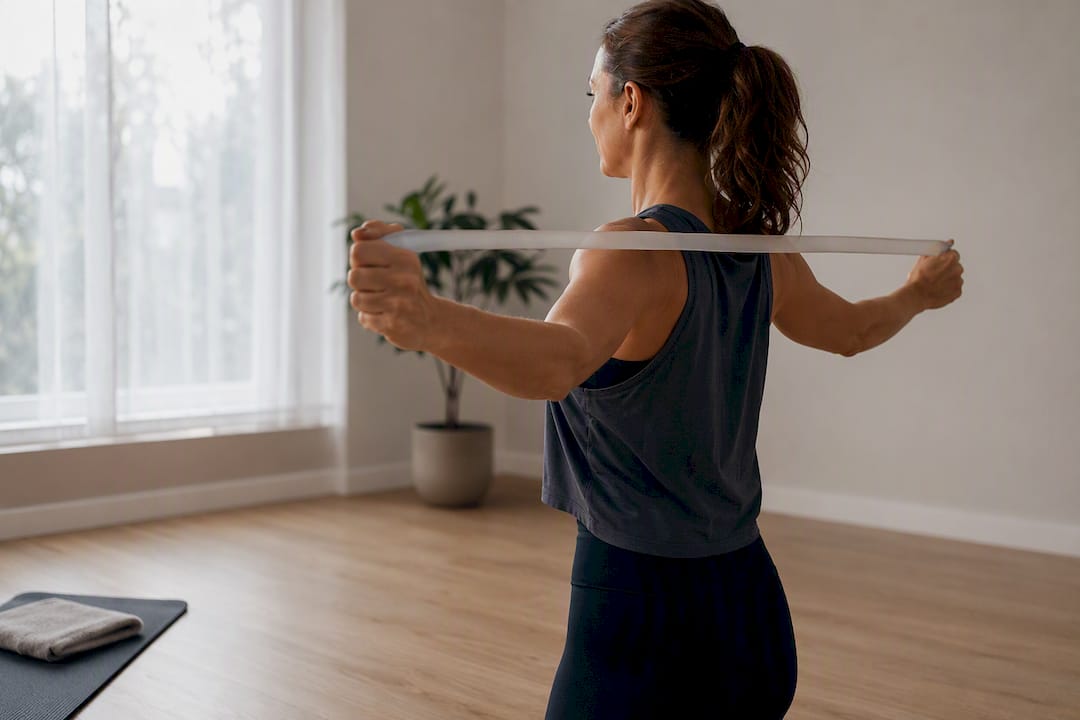
Common mistakes: bending the elbows too much (turns it into a row) and rushing the tempo.
5. Prone I/T/Y
This three-part drill strengthens the lower trapezius, mid trapezius, and rear delts, the muscles responsible for holding your shoulders back and down.
Lying face down on a bench or the floor, raise your arms overhead in a “Y” shape, then out to the sides in a “T,” then down by your hips in an “I,” lifting each position off the ground briefly. Do 1 set of 8 to 10 reps per letter, 2 to 3 times weekly. Add light wrist weights to progress; drop the range of motion to regress if your lower back complains.
Common mistakes: shrugging near the ears and using back extension instead of shoulder muscles to lift the arms.
6. Scapular wall slides
A hybrid of mobility and stability work that teaches your shoulder blades to rotate upward correctly during overhead motion.
Stand with your back against a wall, arms in a “W” position with elbows and wrists touching the wall. Slide your arms upward into a “Y” while maintaining wall contact, then return. Do 2 sets of 10 reps, 3 times weekly.
Common mistakes: losing wall contact partway up, and arching the lower back to fake overhead range.
7. Thoracic extension (foam roller)
Restoring thoracic mobility is arguably the most overlooked piece of the puzzle. A stiff mid back forces your shoulders forward no matter how strong your rhomboids get.
Lie with a foam roller placed horizontally under your shoulder blades, knees bent, hands supporting your head. Gently extend backward over the roller, then curl back up. Do 8 to 10 slow reps, then reposition the roller slightly and repeat, for 3 to 5 minutes total. Foam-roller thoracic work has been shown to increase thoracic extension range of motion in people with a stiff mid back. For a longer mobility sequence, see this guide on stretching the upper back for forward head posture.
Common mistakes: extending only through the neck instead of the mid back, and moving too fast to feel where you’re actually stiff.
8. Serratus anterior activation (band)
The serratus anterior stabilizes your shoulder blade against the rib cage. When it’s weak, your shoulder blades wing and drift forward.
Loop a band around your upper back and hold both ends at chest height. Punch your arms forward, protracting your shoulder blades at the end range, then return. Do 2 sets of 12 to 15 reps, 2 to 3 times weekly.
Common mistakes: shrugging during the punch, and using arm strength instead of driving the movement from the shoulder blade.
9. Lateral neck flexion stretch
Rounded shoulders rarely travel alone. Tight upper traps and neck muscles usually come along for the ride.
Sit tall, tilt your ear toward one shoulder while keeping the opposite shoulder pressed down, and hold 20 to 30 seconds per side. Do 2 sets per side, daily. Gently rest a hand on the tilted side of your head for extra stretch as you progress.
Common mistakes: rotating the head instead of purely tilting, and shrugging the stretched-side shoulder up to shorten the range unintentionally.
Pro Tip: Exhale slowly during the working phase of every strengthening move (the squeeze, the pull, the punch). Holding your breath spikes tension through the neck and upper traps, the exact muscles you’re trying to calm down.
A randomized controlled evidence pool on forward shoulder posture found that combining stretching, thoracic mobility, and upper-back strengthening, not any single exercise alone, produced the measurable improvement in scapular positioning.
Sample Routines: Beginner, Intermediate, and Maintenance Plans
You don’t need to do all nine exercises every day. Structure them into a plan that matches your current capacity and schedule.
Beginner (weeks 1 to 4):
- Daily micro-routine: doorway chest stretch, scapular retractions, lateral neck flexion stretch (5 minutes total).
- Two strengthening sessions per week: wall angels, band pull-aparts, prone I/T/Y (2 sets each).
Intermediate (weeks 5 to 12):
- Three to four sessions weekly, alternating strengthening days (band pull-aparts, prone I/T/Y, serratus punches) with mobility days (thoracic extension, scapular wall slides).
- Add a dedicated 10-minute mobility block before or after workouts, not just as a warm-up afterthought.
Maintenance (ongoing):
- Two strengthening sessions weekly, three sets per exercise instead of two.
- A 5-minute desk reset (chest stretch plus scapular retractions) every couple of hours during work.
- Full foam-roller thoracic session once or twice weekly to keep mobility from backsliding.
Progression rules are simple: once a set feels easy for all prescribed reps two sessions in a row, add 2 to 3 reps or move to a slightly thicker band. If a joint aches rather than just feels worked, drop back to the prior week’s volume and reassess your form before adding anything.
What Causes Rounded Shoulders, and Do You Have Them?
Rounded shoulders usually build up gradually from a handful of overlapping habits, not one single cause.
- Prolonged sitting with rounded posture trains your body to hold that shape even when you stand up.
- Device use (phones, laptops) pulls your head forward, dragging your shoulders with it.
- Muscle imbalance develops as your chest and front delts tighten while your mid and upper back muscles weaken from disuse.
- Thoracic stiffness locks your upper back into a rounded position, so your shoulders literally can’t sit further back even if you try.
Run this three-part self-test at home. First, stand relaxed and check in a mirror whether your ears sit in front of your shoulders rather than stacked above them. Second, stand with your heels, glutes, and upper back against a wall. If your shoulders can’t touch the wall without real effort, that’s a scapular contact problem. Third, try a chin tuck paired with a shoulder squeeze. If either feels stiff or awkward rather than just unfamiliar, that tells you where to start.
Failed the wall test but the chin tuck felt fine? Prioritize thoracic extension work. Tight through the doorway stretch specifically? Lean harder into the pec stretching routine before adding more strengthening volume.
Mistakes That Slow Down Your Progress
Most people who struggle to fix rounded shoulders aren’t lazy. They’re just training the wrong ratio.
Pro Tip: If your workouts are heavier on chest presses and push-ups than on rows and pulls, you’re reinforcing the exact posture you’re trying to fix. Aim for roughly two pulling exercises for every pushing exercise.
- Overloading push-focused training (bench press, push-ups) without matching pulling volume keeps the anterior chain dominant.
- Wearing a posture brace as a long-term fix trains your body to depend on external support instead of building the strength to hold position on its own.
- Rushing into deep stretches or forcing end-range motion causes strain rather than progress. Discomfort is fine; sharp pain is a stop signal.
- Skipping thoracic mobility work entirely and only doing strength exercises usually stalls results around week 3 or 4, because a stiff mid back caps how far your shoulders can actually move back.
How Long Does It Take to Fix Rounded Shoulders?
Most people notice early changes within 4 to 8 weeks of consistent daily and weekly work, mainly in the form of less neck tension and an easier time holding an upright position without thinking about it. Substantial rebalancing, the kind where good posture starts to feel automatic, typically takes 3 to 6 months. After that, it becomes a maintenance job rather than a correction project.
Track progress with the same three-part self-test every 2 to 3 weeks: the wall test, ear-shoulder alignment in a mirror, and how your shirts fit across the shoulders and upper back. A simple log with a date, which exercises you did, and a 1 to 10 discomfort rating is enough to spot patterns.
Corrective programs paired with basic education about posture and behavior change tend to improve pain and function faster than exercise alone, largely because people actually stick with them.
Fixing Sleep Posture and Desk Ergonomics
What you do for 8 hours in bed and 8 hours at a desk matters as much as your exercise routine, sometimes more.
- Sleep on your back with a supportive pillow that keeps your neck neutral, or on your side with a pillow thick enough to keep your spine straight, not tilted.
- Avoid stomach sleeping. It rotates your neck for hours and reinforces the exact rounded, forward pattern you’re correcting.
- Set your monitor at eye level so you’re not craning down or forward.
- Take a movement break every 30 to 60 minutes at a desk, even if it’s just standing and doing one round of scapular retractions.
A full desk ergonomics checklist can help you audit your whole setup in one pass.
Pro Tip: Stack a 60-second posture reset onto something you already do daily, like right after you close a video call. Habit stacking makes consistency automatic instead of something you have to remember.
When Rounded Shoulders Need a Clinician’s Eye
Self-guided correction is appropriate for most people, but a few signs mean it’s time to get an in-person assessment instead of pushing through on your own.
- Numbness, tingling, or weakness radiating down an arm.
- Acute, severe pain that doesn’t ease with rest or gentle movement.
- A history of osteoporosis, recent trauma, or a fall involving your neck or upper back.
A physical therapist or orthopedist is the right first stop for most cases; your primary care provider can refer you if needed. Bring your self-test results, a timeline of symptoms, and your exercise log. Clinicians typically start with manual therapy and targeted rehab, reserving imaging for cases where those red flags actually show up. For more on what that process looks like, see how physiotherapy helps correct forward head posture.
Why This Sequence of Exercises Actually Works
Rounded shoulders develop from three compounding problems: an anterior chain (chest and front delts) that adapts by shortening, scapular retractors and lower and mid trapezius that weaken from disuse, and a thoracic spine that stiffens into flexion until it physically limits how far back your shoulders can sit.
Clinical guidance converges on a simple rule that cuts through a lot of conflicting advice: stretch what’s tight, strengthen what’s weak, and mobilize the thoracic spine. Programs that combine all three consistently outperform single-focus routines built around stretching alone or strengthening alone.
That’s precisely why the doorway stretch, retraction work, and foam-roller extension get paired together instead of treated as separate options to pick from. Applied physiotherapy research backs combining these approaches rather than leaning on a single method or a passive device like a posture brace.
On load progression: increase volume or resistance only when your current level feels genuinely easy, not just tolerable. Muscle fatigue and mild next-day soreness are normal; sharp or radiating pain during a movement is your cue to scale back immediately and reassess technique before adding anything else.
Author perspective: why we teach it this way
Most posture advice treats stretching, strengthening, and mobility as competing philosophies. They’re not. They’re three parts of one mechanical problem, and skipping any one of them is why so many people stretch for months with nothing to show for it. We built this program around short, repeatable routines because habit change beats intensity. A five-minute daily block you’ll actually do outperforms a perfect 45-minute session you’ll quit in two weeks. This approach draws on physiotherapy literature and standard clinical rehab practice, not a single-method trend.
Where to go next for a guided plan
Reading the routine is one thing. Following it consistently for 8 weeks without losing track of your reps, your form cues, or whether you’re actually progressing is a different challenge entirely. That’s the gap Bestforwardheadposturefix was built to close: instead of a stack of disconnected exercise lists, you get structured, sequenced guides that walk you from self-assessment through daily habit-building, without guessing which move to prioritize first.

The site’s guides go deeper into the exact stretching and strengthening breakdowns referenced here, plus habit-change tools for people who’ve started routines before and stalled out by week three. If you want a longer, structured path rather than piecing together a routine on your own, start by browsing the full library of posture correction guides and pick the track that matches your current self-test results.
Frequently Asked Questions
Can rounded shoulders actually be corrected?
Yes, in most cases. Consistent stretching, strengthening, and thoracic mobility work produce measurable improvement, and it’s rarely too late to start, even for people who’ve had the posture for years.
How long does a rounded shoulders fix take?
Expect early improvements, like less neck tension and easier upright sitting, within 4 to 8 weeks. Full rebalancing where good posture feels automatic usually takes 3 to 6 months of steady work.
How should I sleep to help fix rounded shoulders?
Back sleeping with a neck-neutral pillow works best. Side sleeping with proper pillow height is fine too. Stomach sleeping is the position to avoid since it rotates your neck and reinforces forward rounding for hours at a time.
Do I need equipment to start?
No. A doorway, a wall, and eventually a light resistance band cover nearly the entire exercise library described above.
What’s the biggest mistake people make trying to fix this on their own?
Overloading pushing exercises without matching pulling volume, and relying on posture braces instead of building the strength to hold position naturally.
This article is general information, not a substitute for advice from a qualified doctor. Consult a qualified healthcare professional about your own circumstances before acting on anything here.
Sources
Recommended
- Neck Alignment Exercises: 3-Minute Daily Routine to Fix Forward Head Posture – Home
- Is Deep Tissue Massage the Secret to Fixing Nerd Neck? Find Out Now – Home
- How to Integrate Chin Tucks into a Rehabilitation Routine? – Home
- How to Stretch the Chest Muscles to Open the Shoulders and Improve Posture? – Home