The Alexander Technique improves posture by teaching you to unlearn habitual muscle tension and restore a better working relationship between your head, neck, and spine. Randomized trial evidence backs this up, but only when hands-on lessons are paired with ongoing practice. The sections below cover the core principles, what the research actually found, what a lesson looks like, and how to apply the method to your desk, your phone, and your daily posture habits.
TL;DR:
- Short courses of six lessons combined with daily practice can provide most of the posture benefits demonstrated in research, especially for back pain relief.
- Consistent application of awareness and direction cues, such as “head forward and up,” helps release habitual tension rather than forcing an upright posture.
- Practicing simple movements like wall angels and mindful walking reinforces neuromuscular coordination and supports ongoing posture improvements.
- Applying ergonomic adjustments, like raising screens and taking microbreaks, enhances the effects of Alexander Technique principles in daily life.
- Finding a qualified teacher involves checking credentials and avoiding claims of instant fixes or treatments outside musculoskeletal tension and coordination.
Table of Contents
- What Is the Alexander Technique for Posture?
- How the Technique Changes Your Posture
- What the Research Actually Shows
- What Happens in an Alexander Technique Lesson
- Daily Habits That Apply Alexander Technique Principles
- Finding a Qualified Alexander Technique Teacher
- Why Awareness Beats Willpower for Fixing Posture
- Where Bestforwardheadposturefix Fits Into Your Next Step
- Sources
- FAQ
What Is the Alexander Technique for Posture?
The Alexander Technique is an educational method, not an exercise program. You don’t stretch, strengthen, or hold a position. You learn to notice the tension habits you’ve built up over years and interrupt them before they fire off automatically.
Four ideas anchor the whole method. Primary control refers to the relationship between your head, neck, and spine, which Alexander teachers treat as the coordination hub for everything else your body does. Awareness means noticing tension in the moment rather than after your neck already aches. Inhibition is the deliberate pause before reacting, the moment where you stop yourself from jutting your chin forward or hunching your shoulders. Direction is the mental cue of thinking your head forward and up, which lengthens rather than compresses the spine.
Alexander teachers apply these ideas to ordinary movement, including:
- Sitting down and standing up from a chair
- Walking and turning
- Lifting objects from a low shelf or the floor
- Reaching for a phone or looking at a screen
Nothing here is exotic. It’s the movement you already do, done with less unnecessary gripping.
How the Technique Changes Your Posture
Most posture advice tells you to sit up straight and hold it. The Alexander Technique takes a different position: forcing a “correct” posture just swaps one kind of tension for another, and your muscles fatigue and you slouch again within minutes.
What actually shifts with AT practice is neuromuscular coordination. Alexander teachers describe primary control as the head/neck/spine relationship that organizes tone throughout the rest of the body, and unnecessary co-contraction, the habit of bracing muscles that don’t need to be working, is exactly what the technique targets. Instead of muscular stiffening, you use inhibition and direction cues to release tension you didn’t know you were holding.
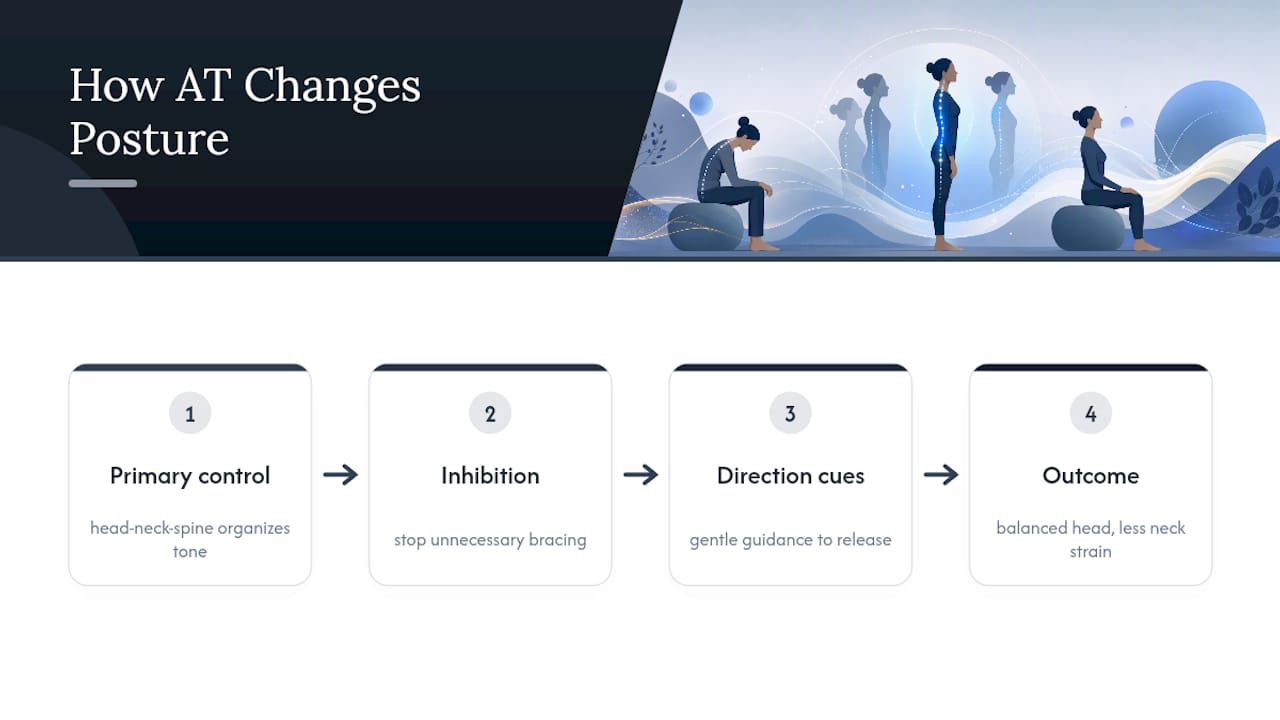
People who practice consistently describe the change less as “standing straighter” and more as a felt shift: less gripping at the base of the skull, a head that seems to balance rather than sit pinned forward, and a noticeable ease getting out of a chair without the usual neck strain. Harvard Health’s overview of the method describes this as learning to notice and release habitual tension in ordinary tasks like holding a phone or sitting at a desk, which matters directly if forward head posture from screen use is what brought you here.
What the Research Actually Shows
The strongest evidence for the Alexander Technique comes from a UK randomized controlled trial known as the ATEAM study. Participants with chronic or recurrent back pain who took a full course of Alexander lessons saw a substantial reduction in disability scores and days spent in pain at one year, compared to usual care. That’s a substantial, durable effect for a non-drug, non-surgical intervention.
The trial’s most practical finding for busy readers: six lessons combined with a prescribed exercise program produced close to the same disability benefit as the full course, according to the ATEAM trial published in PMC. Fewer lessons plus consistent practice can get you most of the way there.
Independent evidence evaluations have since summarized the broader research landscape more cautiously. A government-commissioned review of natural therapies concluded the Alexander Technique probably reduces disability and may reduce pain for chronic musculoskeletal conditions, language that reflects real but bounded confidence rather than a blanket cure claim. Trial sizes vary, outcome measures differ across studies, and none of this evidence suggests results hold up without continued practice. Posture retraining isn’t a one-time fix you bank and forget.
What Happens in an Alexander Technique Lesson
A lesson looks nothing like a physical therapy session or a yoga class. You stay in your regular clothes. Most of the work happens while you do familiar movements. Expect three elements in nearly every session, as described in BMJ’s reporting on the technique:
- Verbal direction. The teacher talks you through the thinking cues: head forward and up, releasing rather than gripping, as you move.
- Gentle hands-on guidance. Light hand contact on your neck, shoulders, or back gives you feedback on tension you can’t feel yourself yet.
- Guided everyday movement. You practice sitting, standing, walking, or bending, the same actions you’ll repeat all day outside the lesson.
Course length varies by goal and budget. Six lessons paired with a home exercise routine is a realistic entry point and delivered close to the full benefit on some measures in the ATEAM trial. Twenty-four lessons, spread over several months, produced the strongest and most durable results for chronic pain. Somewhere between those two, most people notice measurable changes, less habitual neck tension, easier transitions from sitting to standing, within the first two to three months, provided they keep practicing the directions outside the lesson room.
Daily Habits That Apply Alexander Technique Principles
You don’t need a teacher in the room to start applying the basics. Small, repeated adjustments during the hours you spend at a desk or on a phone matter more than one long stretching session.
For screen time specifically:
- Raise your screen so the top third sits at eye level, cutting the pull to jut your chin forward. Screen position affects neck posture more than most people realize.
- Build a habitual pause. Every time you unlock your phone, silently think “head back and up” before you look down.
- Set a microbreak reminder every 30 to 40 minutes to release your neck and shoulders, even for ten seconds.
Three simple practice moves reinforce the same coordination:
- Semi-supine constructive rest. Lie on your back, knees bent, feet flat, head supported by a small book, for 5 to 15 minutes. This is the classic Alexander rest position for releasing spinal tension.
- Wall angels. Stand against a wall and slide your arms up and down, keeping shoulders and lower back in contact, a movement also recommended in Cleveland Clinic’s posture guidance.
- Mindful walking. Walk a hallway or a block focusing only on the head/neck relationship, letting your head lead rather than drop forward.
Pro Tip: AT directions work best alongside targeted strengthening and stretching, not instead of them. A body that’s chronically weak in the upper back will keep collapsing forward no matter how well you think “head up,” so pair awareness practice with the kind of exercises covered in guides on how posture correction techniques reduce neck pain.
Finding a Qualified Alexander Technique Teacher
Look for teachers listed with a recognized national or regional Alexander Technique society, most maintain public directories you can search by location or by whether a teacher offers in-person or remote lessons. Reputable teacher training runs 1,600 hours over three years, so credential-checking is worth the five minutes it takes.
Before booking, ask a prospective teacher:
- How many training hours and how many years have you been certified?
- What does a typical first lesson involve?
- Can I observe part of a session before committing to a course?
- What’s your cancellation policy and full price for a single lesson versus a package?
Walk away from anyone promising an instant fix, pushing branded products as mandatory, or claiming AT treats conditions outside musculoskeletal tension and coordination. The method is educational, not medical, and any teacher who blurs that line is overselling it.
Why Awareness Beats Willpower for Fixing Posture
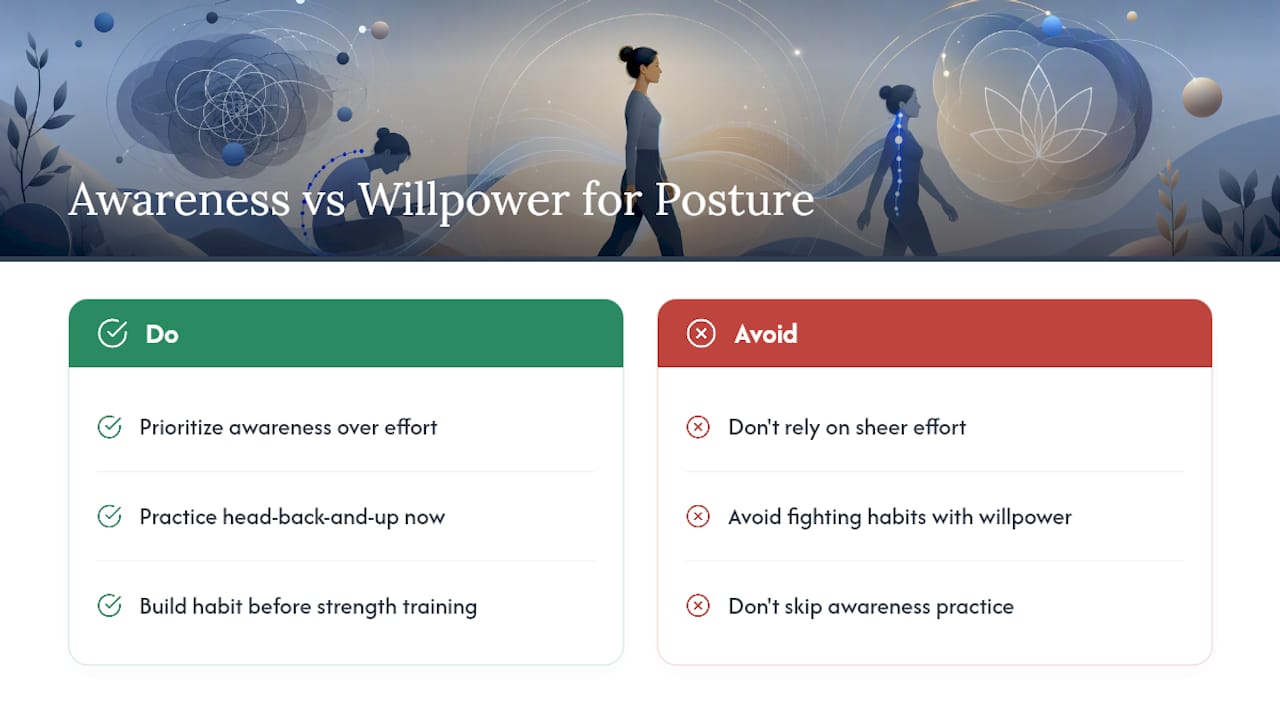
Most posture advice fails because it asks you to fight your own habits through sheer effort, and effort runs out by 3 p.m. What the Alexander Technique gets right, and what conventional “sit up straight” advice misses, is that posture is a coordination problem before it’s a strength problem. You can have strong enough muscles and still slump, because the habit fires faster than your intention to correct it.
That’s the gap this educational approach is built around: habit change and awareness building before muscle rebalancing, not instead of it. Practicing the head-back-and-up direction while reading this on your phone, right now, tends to produce an immediate, noticeable release at the base of the skull. That small test is a fair preview of what consistent practice does over months.
— Madhukar
Where Bestforwardheadposturefix Fits Into Your Next Step
If the ATEAM numbers convinced you that lessons plus practice beat willpower alone, the next question is what to practice between sessions, or instead of them if a teacher isn’t accessible where you live. The site builds structured guides around exactly that gap: habit change routines, ergonomics breakdowns, and posture assessments designed to work alongside Alexander Technique lessons rather than replace the hands-on parts that make it effective.

Start with a baseline check using the site’s guide on how to assess neck alignment for forward head posture, then work through the desk and device guides that translate AT’s daily-life focus into concrete screen habits. If forward head posture from phone use is your main concern, the cellphone and forward head posture resources are the most direct next read on the site.
Sources
The ATEAM randomized trial remains the strongest single piece of evidence on lesson counts and outcomes. The government evidence evaluation offers a more cautious, independent read on confidence levels. Harvard Health explains AT’s history and daily application in plain language, and a pilot ergonomics study shows the method applied to a posture-demanding profession. Persistent or severe pain deserves a conversation with a doctor or physical therapist before you rely on any self-directed approach.
- Randomised controlled trial of Alexander technique lessons, exercise, and massage (ATEAM) for chronic and recurrent back pain – PMC
- Natural Therapies Review 2024 – Alexander Technique evidence evaluation
- The Alexander Technique can help you (literally) unwind – Harvard Health
- Posture exercises and practical tips – Cleveland Clinic
FAQ
Does the Alexander Technique Help With Posture?
Yes. Randomized trial evidence shows AT lessons reduce disability and pain days in people with chronic back conditions, and the underlying mechanism, retraining the head/neck/spine relationship, applies directly to forward head posture from screen use.
Is the Alexander Technique Legit?
It’s a legitimate, evidence-supported educational method, not a fringe therapy. Government evidence reviews describe it as probably reducing disability and possibly reducing pain, which is measured, credible language rather than a miracle claim.
What Are the Core Principles of the Alexander Technique?
The method rests on primary control (the head/neck/spine relationship), awareness of habitual tension, inhibition (pausing before reacting), and direction (thinking the head forward and up to release rather than compress the spine).
Can You Correct Years of Bad Posture?
Habitual tension built up over years can shift with consistent practice, though it’s re-education rather than a quick fix. The ATEAM trial found benefits held at one year, but only for participants who kept practicing what they learned in lessons.