The single change that protects your neck while nursing is bringing your baby to your breast instead of leaning forward to reach them. Keep your chin gently tucked, shoulders relaxed, and arms fully supported so your spine stays neutral. This matters because a substantial share of breastfeeding parents report neck pain(https://pmc.ncbi.nlm.nih.gov/articles/PMC10318971/), and short exercise breaks between feeds help reduce the cumulative strain that can build up over time.
TL;DR:
- Proper breastfeeding posture involves placing the baby at breast height, with the neck in neutral alignment, relaxed shoulders, and supported arms to prevent strain.
- Setting up an ergonomic feeding station with lumbar support, pillows under both forearms, and foot support reduces the risk of developing forward head posture and neck pain.
- Combining short, daily scapular stabilization exercises, chin tucks, and chest stretches can significantly improve neck pain and mobility within weeks.
- Habit-linking exercises to routine activities like diaper changes or naps ensures consistent practice and better long-term posture correction.
- Seek medical evaluation if neck numbness, weakness, severe pain, or no improvement occurs after several weeks of ergonomic adjustments and exercises.
Table of Contents
- What Is Correct Breastfeeding Posture, and Why Does It Matter?
- How Do You Set Up an Ergonomic Feeding Station?
- What Exercises Fix Forward Head Posture From Breastfeeding?
- How Do You Make Posture Habits Stick While Caring for a Newborn?
- When Should You See a Physical Therapist for Neck Pain?
- A Note on Fixing This the Right Way
- Where to Find Structured Posture Programs and Exercise Guides
- Sources
- FAQ
What Is Correct Breastfeeding Posture, and Why Does It Matter?
Correct breastfeeding posture means positioning your baby at breast height, not lowering your head and shoulders to reach a baby positioned too low or too far away. Clinicians call the opposite pattern forward head posture (FHP), a forward jut of the head and neck that develops when you spend hours a day looking down at a feeding infant. It is a mechanical problem with a mechanical fix.
Baby-to-breast, not breast-to-baby. This is the core principle behind every ergonomic recommendation for nursing parents. When you reposition your baby at breast height using pillows or a nursing cushion, your neck stays upright. When you hunch down toward the baby instead, you load your cervical spine in a flexed position for the entire feed. That difference, repeated eight to twelve times a day, is what separates a sore neck from a pain-free one.
Once baby is at the right height, check three things:
- Neutral cervical alignment: a gentle chin tuck, eyes forward rather than sharply downcast, ears roughly over your shoulders.
- Relaxed shoulders: if your shoulders are creeping toward your ears, your arms need more support underneath them, not more effort from you.
- Lumbar contact: your lower back should touch a firm cushion or chair back, not float in open space.
Forearm support matters just as much as neck position. Prop both forearms on pillows so your shoulders stay down and your arms are not doing isometric work for the length of the feed. That small adjustment prevents the shoulder-elevation pattern that feeds directly into upper back and neck strain.
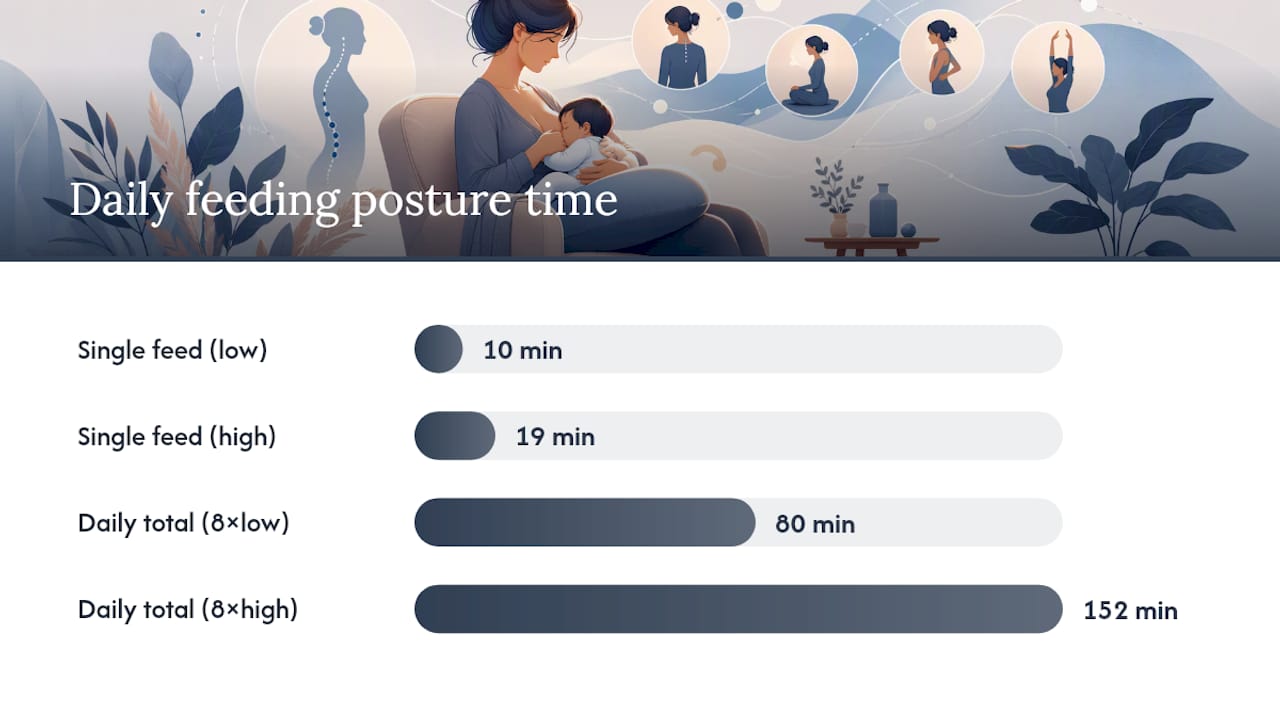
Timing counts too. A typical feed runs 10 to 19 minutes, and a single feed in good posture rarely causes trouble. The damage comes from repetition. Eight feeds a day at the low end of that range is still over two hours of held posture, and if that posture is flexed forward, the load compounds every single day.
Pro Tip: Set a phone timer for the halfway point of long feeds. When it buzzes, do a slow shoulder roll and chin tuck without disturbing the latch. It takes five seconds and resets your alignment mid-feed.
How Do You Set Up an Ergonomic Feeding Station?
A good setup does the postural work for you, so you’re not fighting gravity for twenty minutes at a time. Build this once and reuse it for every feed.
- Pick a chair with real lumbar support, or add a firm cushion behind your lower back. A soft couch that lets your pelvis sink back invites a forward-leaning slouch.
- Stack pillows under both forearms at breast height, whether you use a dedicated nursing pillow or two firm cushions from your couch.
- Add a footstool or low box under your feet. Feet flat and knees slightly elevated keeps your pelvis level instead of tipping forward.
- For side-lying or semi-reclined feeds, match your head pillow height to your torso elevation. Too high or too low and your neck ends up flexed or overextended even while you’re lying down.
- Keep a side pillow within reach for semi-recline positions, so you can shift support without breaking the feed.
A checklist of nursing-friendly gear can help you figure out which pillows and stools are worth buying versus improvising with what’s already in your house.
What Exercises Fix Forward Head Posture From Breastfeeding?
Exercise between feeds is where the real correction happens, and the evidence for it is stronger than most parents expect. A randomized controlled trial found that adding scapular stabilization exercises to standard posture education produced significantly bigger improvements in pain (measured by VAS), neck disability (NDI), and cervical range of motion (CROM) than posture advice alone. A separate trial testing Pilates combined with breastfeeding positioning adjustments found similar gains: better craniovertebral angle, more cervical mobility, less pain, and improved quality-of-life scores compared with positioning changes by themselves.
Neither program takes long. Here’s a realistic four-move rotation:
- Scapular retractions: squeeze your shoulder blades together and hold for 5 seconds, 10 reps, 2 to 3 sets. Full scapular retraction technique details are worth reviewing before you start.
- Chin tucks / deep neck flexor isometrics: pull your chin straight back (not down), hold 5 seconds, 10 reps. These are the same isometric neck exercises used in clinical FHP protocols.
- Band rows or prone scapular work: if you have a light resistance band, 10 to 15 rows once or twice a day reinforces the retraction pattern.
- Pectoral doorway stretch: 30 to 60 seconds per side, once daily, to counter the chest tightness that pulls shoulders forward.
Link each set to something you already do. After every other feeding, or during a diaper change, run through one exercise. That is enough; you do not need a 30 minute session to see the trial-level benefits described above.
There’s a simple reason small forward shifts add up: each additional inch the head drifts forward increases the load your neck muscles have to hold. A few degrees of slouch during a 15 minute feed doesn’t feel like much in the moment, but multiplied across a day of feeds, it explains why so many parents develop symptoms in the first few weeks postpartum rather than gradually over months.
Pro Tip: Stop any exercise immediately if you feel sharp pain, tingling, or numbness radiating into your arm or hand. Muscle fatigue is expected; nerve symptoms are not.
Progression is simple: once 2 sets of 10 feels easy for a week, add a third set or a short isometric hold at the end of the retraction. Do not add resistance or duration faster than that.
How Do You Make Posture Habits Stick While Caring for a Newborn?
Sleep deprivation kills good intentions fast, so tie every exercise to something that already happens on autopilot.
- Habit-link, don’t schedule. Do chin tucks after every diaper change and scapular retractions when the baby goes down for a nap. You’ll do the exercises 8 to 10 times a day without ever “finding time” for them.
- Aim for micro-sets, not marathon sessions. Several 60 second bouts spread through the day beat one long session you’ll skip when you’re exhausted.
- Check yourself with a mirror or a quick selfie during a feed once a week. Compare ear position to shoulder position; drift forward is the tell.
- Keep a one-line pain diary. Rate neck discomfort 0 to 10 each evening. A trend downward over two weeks tells you the habit is working; a flat or rising trend means you need to adjust your setup or add supervised care.
- Watch your gaze. Staring down at your baby’s face for the whole feed is the single most common trigger for forward head drift. Glance up and scan the room every few minutes instead of holding a fixed downward gaze.
When Should You See a Physical Therapist for Neck Pain?
Ergonomics and micro-exercises resolve most breastfeeding-related neck pain within a few weeks. Get evaluated sooner if you notice any of the following:
- Numbness or tingling that spreads down your arm or into your hand.
- Progressive weakness in your grip or arm.
- Sharp, severe pain rather than a dull ache or fatigue.
- No improvement after 2 to 4 weeks of consistent posture changes and exercise.
A physical therapist can add supervised scapular stabilization work, manual therapy, or muscle energy technique (MET) approaches. One trial found that reciprocal inhibition MET techniques reduced neck pain and disability in breastfeeding patients with forward head posture, in some measures outperforming the autogenic inhibition variant. Clinicians typically track progress with the same outcome measures used in these trials: pain on a VAS scale, disability on the NDI, and mobility via CROM, so you will have concrete numbers to judge whether treatment is working. A short-term option like a cervical support collar may come up in that conversation too, though it is a bridge, not a fix.
A Note on Fixing This the Right Way
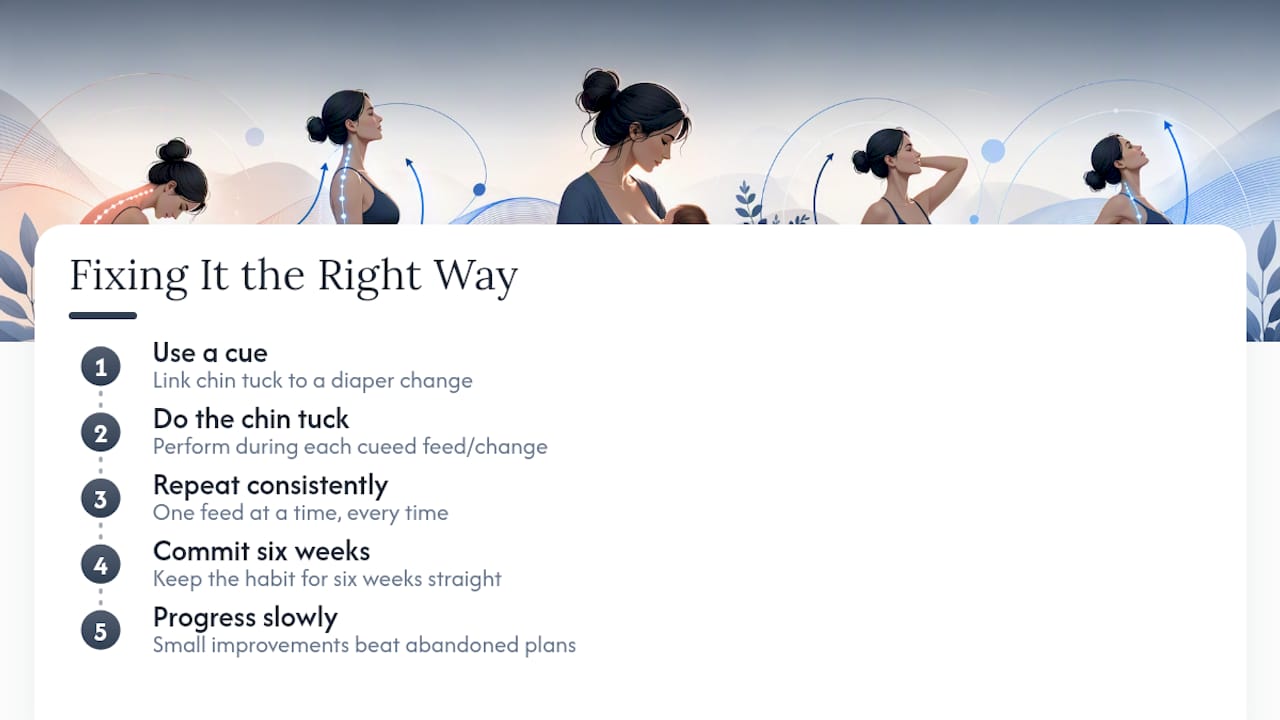
Most advice about nursing pain treats it as something to endure until the baby grows out of the newborn stage. That’s backwards. Forward head posture from breastfeeding is a mechanical habit you build one feed at a time, which means it’s also a habit you can rebuild one feed at a time. The parents who get lasting relief aren’t the ones who found a perfect pillow. They’re the ones who linked a chin tuck to a diaper change and kept doing it for six weeks straight.
Go slow. A slightly better setup this week, one more exercise habit next week, is worth more than a perfect plan you abandon after three days.
— Madhukar
Where to Find Structured Posture Programs and Exercise Guides
Bestforwardheadposturefix is built for exactly this problem: rebuilding neck alignment through consistent habit change instead of a one-time fix that fades after a few weeks. Where most nursing advice stops at “sit up straight,” Bestforwardheadposturefix breaks the correction into structured, habit-linked steps built around the same muscle-rebalancing principles behind the scapular stabilization and Pilates research already cited.

The site walks through exercise tutorials and a habit-tracking framework designed to help posture exercises become habitual for new parents. If you’re dealing with ongoing stiffness, headaches, or a neck that feels locked forward even outside of feeds, the Bestforwardheadposturefix are the natural next stop. If you notice numbness, weakness, or pain that isn’t easing after a few weeks of consistent changes, see a clinician before continuing any exercise program on your own.
Sources
- Breastfeeding-related musculoskeletal pain prevalence and associations (PMC)
- The influence of breastfeeding factors on the prevalence of back and neck pain (BMC Musculoskeletal Disorders, 2024)
- Effect of scapular stabilization exercise on breastfeeding women with non-specific neck pain: a randomized controlled trial
- Effect of pilates exercises plus breastfeeding positioning adjustment on craniovertebral angle in breastfeeding women with FHP (Scientific Reports, 2026)
FAQ
What Causes Neck Pain During Breastfeeding?
Prolonged forward-flexed head posture during feeds strains the neck and upper back, and over half of breastfeeding parents report this kind of pain at some point.
Is Forward Head Posture From Nursing Permanent?
No. It develops from repeated posture during feeds, and it responds well to ergonomic setup changes plus consistent, short exercise habits over a few weeks.
How Long Should a Breastfeeding Session Last for Good Posture?
Session length itself (typically 10 to 19 minutes) is less important than posture during that time; supported, neutral alignment for the full feed matters more than shortening it.
What Exercises Help Fix Breastfeeding-Related Neck Strain?
Scapular retractions, chin tuck isometrics, band rows, and pectoral doorway stretches done in short daily sets have shown measurable improvement in clinical trials on pain and mobility.
When Should I See a Doctor for Nursing-Related Neck Pain?
See a clinician if you notice numbness, weakness, sharp pain, or no improvement after 2 to 4 weeks of consistent posture and exercise changes.