The fastest way to fix bad posture is also the simplest: check your alignment once an hour, move for 30 to 60 seconds after each check, and do two or three targeted strength moves daily. MedlinePlus and Harvard Health both point to the conclusion that consistent small corrections beat occasional perfect posture. Expect looser shoulders and less neck strain within a few weeks, with some symptom relief showing up even sooner.
TL;DR:
- Consistently checking your alignment hourly and doing targeted strength moves daily can lead to noticeable improvements within weeks.
- Moving regularly throughout the day helps distribute load better than maintaining a static perfect pose for long periods.
- Setting environmental cues and attaching posture checks to existing routines can boost long-term habit formation.
- Strengthening the upper back muscles and stretching the chest are key exercises for reversing a hunched stance.
- Adjusting daily activities like sleep position, desk setup, and activity posture prevents habits that worsen alignment.
Table of Contents
- What Is Posture, and Why Does It Need to Move?
- Why Posture Habits Matter More Than You Think
- What Daily Habits Are Wrecking Your Posture?
- How Do You Build a Daily Posture Routine That Sticks?
- Which Exercises Actually Strengthen Posture?
- How Should You Set Up Your Desk, Phone, and Bed?
- How Do You Turn These Actions Into Permanent Habits?
- How Bestforwardheadposturefix Approaches Posture Habit Change
- Does Posture Affect Your Mood and Confidence?
- How Should Posture Habits Change for Driving, Sleeping, and Other Activities?
- How Do You Keep Good Posture During Exercise and Sports?
- A Realistic Note on Staying Consistent
- Want a More Structured Plan? Here’s Where to Start
- Sources
- FAQ
What Is Posture, and Why Does It Need to Move?
Posture is how efficiently your joints line up with minimal muscle effort, not how straight you can force yourself to sit. Your spine has three natural curves, at the neck, mid-back, and low back, and healthy alignment means your ears stay roughly over your shoulders, and your shoulders over your hips, according to MedlinePlus.
Here’s the part most people miss: posture isn’t a pose. It’s a pattern of movement. Static posture, holding one position, matters far less than dynamic posture, how often you shift, stand, stretch, and change positions throughout the day. A body that changes position frequently distributes load better than one locked into a “perfect” chair position for several hours straight.
Why Posture Habits Matter More Than You Think
Slouched posture doesn’t just look tired. It compresses your rib cage, which can shallow your breathing, and it throws off the balance reflexes your inner ear and joints rely on, according to National Geographic. Chronic forward-leaning posture has also been linked to digestive discomfort and lower mood, since a collapsed chest cavity and constant muscle tension both feed into how you feel physically and mentally.
Posture is one lever among several. Bone density, body weight, and general fitness all shape how your spine holds up over time, so don’t expect posture fixes alone to solve every ache. The encouraging news: it’s usually not too late. Harvard Health notes that targeted stretching and strengthening can measurably improve even long-standing rounded shoulders and a hunched stance.
What Daily Habits Are Wrecking Your Posture?
A handful of repeated behaviors cause most of the damage, and each one has a fast fix.
- Tech neck. Looking down at your phone for hours tilts your head forward, adding pounds of effective load to your neck. Swap: hold your phone at eye level, or prop it up rather than tilting your chin down.
- Slouched sitting. Sinking into a chair rounds your lower back and shoulders. Swap: sit with your hips at the back of the seat and shoulder blades lightly drawn together.
- Marathon sitting. Long, uninterrupted sitting stiffens hip flexors and weakens your core. Swap: set a 30 to 60 minute timer to stand or walk.
- Poor sleep position. Stomach sleeping and unsupportive pillows twist the neck for hours. Swap: side or back sleeping with a pillow that keeps your neck neutral.
- One-shoulder bags. A heavy bag on one side pulls your spine sideways. Swap: alternate sides or switch to a backpack.
Minute fix: Right now, roll your shoulders back and down, tuck your chin slightly, and take five slow breaths. That’s it. Thirty seconds, no equipment.
How Do You Build a Daily Posture Routine That Sticks?
Posture habits stick when they’re tied to cues you already encounter, not to willpower you have to summon from nothing; see this flexible guide to build a daily routine as a new mom for practical routine-building strategies that can help parents adapt habits amidst busy schedules. A workable daily structure looks like this:
- Morning check (60 seconds): Stand against a wall, heels and shoulder blades touching, and notice how that alignment feels before you start your day.
- Hourly micro-moves (30 to 60 seconds): Set a phone alarm to stand, stretch your arms overhead, and roll your shoulders.
- Mini reset after long sits: After a drive or a long meeting, do 10 seconds of chin tucks and a standing backbend.
- Evening mobility (2 to 3 minutes): Stretch your chest and upper back before bed to undo the day’s forward lean.
Cues work best when stacked onto something automatic. Check your posture after your first sip of coffee, before you open your laptop, or right after you sit down for a meeting. Bestforwardheadposturefix’s guide to daily posture self-checks walks through cue placement in more detail if you want a deeper starting point.
Pro Tip: Pick one cue for week one, not five. Trying to install an entire routine on day one is the single biggest reason posture habits fail to survive past the weekend.
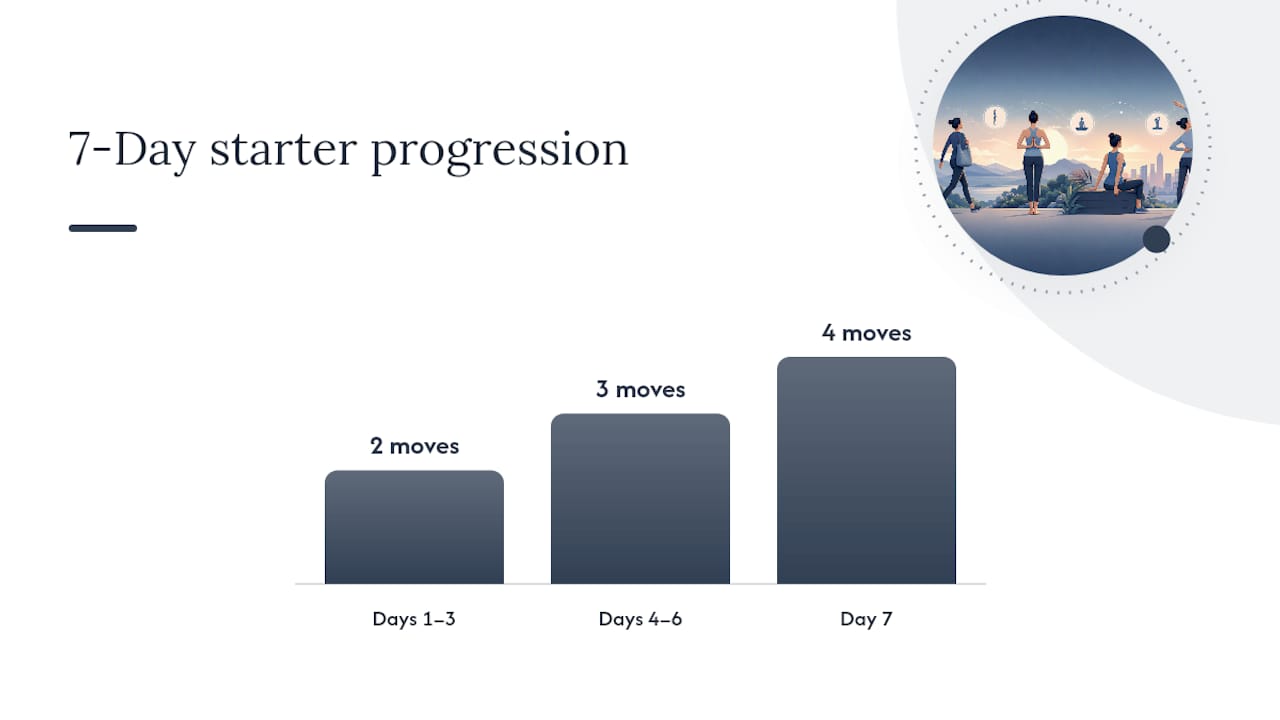
For a 7-day starter plan, spend days 1 through 3 just doing the morning check and one hourly alarm. Add the evening stretch on day 4. By day 7, you’re running the full routine without thinking about it.
Which Exercises Actually Strengthen Posture?
Weak upper-back muscles and tight chest muscles are the two biggest drivers of rounded shoulders, and a small, repeatable set of moves addresses both.
- Scapular squeezes: Pull your shoulder blades together and hold for 5 seconds. Do 2 to 3 sets of 10 to 15 reps.
- Rows (band or bodyweight): Strengthens the mid-back muscles that pull shoulders out of a forward slump. 2 to 3 sets of 8 to 12 reps.
- Modified planks: Builds the core stability that supports your spine when you’re not actively thinking about posture. Hold 20 to 40 seconds, 2 to 3 rounds.
- Chest-opening stretch: Clasp your hands behind your back and lift gently, or use a doorway stretch. Hold 30 to 60 seconds.
- Thoracic mobility drills: Seated or kneeling rotations that loosen the mid-back. 8 to 10 reps each side.
Clinician-authored guidance from Harvard Health consistently points to this exact combination, strengthening the upper back while stretching the chest, as the pattern most likely to reverse a hunched stance. Running through this set twice a day is enough for most people to notice a difference within a few weeks.
Stop any move that causes sharp pain, and if you have osteoporosis or a recent spinal surgery, check with your provider before starting rows or planks. For deeper stretching detail, see how to stretch the chest muscles to open the shoulders and how to stretch the upper back to correct forward head posture.
How Should You Set Up Your Desk, Phone, and Bed?
Your environment either reinforces good posture habits or fights them every single day, and small setup changes remove a lot of the daily strain before you even have to think about it.
- Monitor: Top of the screen at eye level, about an arm’s length away.
- Chair: Lumbar support engaged, feet flat on the floor, hips slightly above knee height.
- Keyboard and mouse: Close enough that your elbows stay near your sides at roughly 90 degrees.
- Sit/stand alternation: Shift position every 30 to 60 minutes even with a good chair, since no single setup replaces movement.
- Phone and tablet: Bring the device up to eye level instead of dropping your chin down to it.
- Driving: Headrest close to the back of your skull, seat angled so your shoulders stay against the seatback.
- Sleep: A mattress that keeps your spine neutral, plus a pillow sized to fill the gap between your neck and shoulder.
- Shoes: Supportive, cushioned footwear over flat, unsupportive soles, especially if you’re on your feet most of the day.
OSHA’s ergonomics guidance backs the monitor and chair specifics above, and the Cleveland Clinic adds that supportive footwear helps protect your spine’s natural curves during standing tasks. For a full walk-through, Bestforwardheadposturefix’s 7-step desk setup guide covers the workspace audit in more depth.
How Do You Turn These Actions Into Permanent Habits?
Habits form fastest when you attach a new action to something you already do without thinking. Do a posture check right after brushing your teeth. Do your scapular squeezes while your coffee brews. This is habit stacking, and it works because you’re borrowing an existing cue instead of building a new one from scratch.
Track progress with something low effort: a weekly photo from the side, a quick symptom note (“neck tension: better/same/worse”), or a simple checklist you tick off. For the strength moves, increase reps or hold times gradually every one to two weeks rather than jumping straight to advanced variations.
Plateaus are normal. If you stop noticing improvement after a few weeks, it usually means the routine has become too easy, not that it stopped working. Add a set, extend a hold, or add a new movement direction. Some days your neck will feel tighter than others regardless of what you did right, and that variability is expected, not a sign you’re failing.
How Bestforwardheadposturefix Approaches Posture Habit Change
The approach focuses on building awareness of your own alignment, changing the small daily habits that undo it, and rebalancing the muscles that got weak or tight in the process. That’s a structured approach rather than a one-time fix. The daily posture self-check guide and the computer setup walkthrough are two starting points for readers who want the next level of detail beyond this article.
Does Posture Affect Your Mood and Confidence?
Posture and mental state run in both directions. A hunched, collapsed stance restricts breathing, and shallower breathing is tied to higher stress reactivity, which can make you feel more anxious without any obvious external cause. Several small studies on posture and mood have found that sitting upright, versus slumped, changes self-reported energy and confidence levels in the short term, even before any physical strength changes kick in.
There’s also a simple feedback loop worth understanding. Rounded shoulders and a dropped head are the same posture we associate with sadness or defeat, and holding that shape for hours a day, every day, at a desk or on a phone, can reinforce the emotional state that goes with it. Straightening up doesn’t erase stress, but it removes one physical input that’s quietly working against you.
Confidence has a physical component too. People consistently read an upright, open posture as more assured, and that perception shapes how others respond to you in meetings, interviews, and everyday interactions. That’s not about performing confidence. It’s about not accidentally broadcasting exhaustion through your shoulders when that’s not actually how you feel.
The practical takeaway: the same hourly posture checks and chest-opening stretches you’re doing for your neck are doing double duty on your mood. You don’t need a separate mental health routine layered on top. The physical habit-building already covered in this guide is the intervention, and the mood benefit is a side effect worth noticing rather than a reason to add more to your plate.
How Should Posture Habits Change for Driving, Sleeping, and Other Activities?
Posture isn’t one setting you dial in once. It shifts depending on what you’re doing, and treating driving the same as desk work, or sleep the same as sitting, misses where a lot of daily strain actually comes from.
Driving puts your neck in a fixed forward position for extended stretches, often worse than desk posture because your hands are locked on the wheel and you can’t easily shift position. Keep your headrest close to the back of your head, not several inches back, and adjust your seat so your shoulder blades stay against the seatback rather than leaning forward toward the wheel. On long drives, use rest stops for the same 10 second chin tucks and shoulder rolls you’d do at your desk.

Sleeping posture matters because you spend six to nine hours in it without any conscious correction. Stomach sleeping twists your neck sideways for hours and tends to flatten your lower back’s natural curve. Side sleeping with a pillow between your knees, or back sleeping with a pillow under your knees, keeps your spine closer to neutral. Pillow height matters as much as position: too high or too low and your neck curves the wrong way regardless of which side you favor.
Other everyday activities deserve the same attention. Cooking at a low counter encourages hunching, so bring items up to waist height when you can. Carrying groceries or kids on one hip pulls your spine sideways the same way a one-shoulder bag does, so alternate sides deliberately. Even scrolling on a couch benefits from propping your phone rather than curling forward over it.
The pattern across all of these is the same: identify where your body defaults into a fixed, unsupported position, then build in a small correction or a break. You don’t need an activity-specific system. You need to notice.
How Do You Keep Good Posture During Exercise and Sports?
Good posture during exercise protects you from the injuries that come from compensating with the wrong muscles, and it starts before you even begin moving. Brace your core lightly, think about keeping your spine in a neutral position rather than arched or rounded, and set your shoulders back and down before lifting or swinging anything.
Strength training is where posture breakdown shows up fastest. Rounded shoulders during overhead presses or an arched lower back during deadlifts usually means the weight is heavier than your form can currently support. Drop the load until you can maintain a neutral spine through the full range of motion, then build back up.
Running and cardio reward an upright torso with a slight forward lean from the ankles, not the waist. Slumping forward from the waist while running fatigues your lower back and reduces how efficiently you breathe, which matters over longer distances.
Racket and ball sports put asymmetric load on one side of your body repeatedly, so counterbalance with core work and opposite-side stretching on your off days. A tennis or golf swing that’s technically correct can still create long-term imbalance if nothing offsets the one-sided repetition.
Cycling deserves a specific mention: a bike fit that’s too aggressive rounds your back for the entire ride, undoing the exact posture gains you’re working on elsewhere. If your neck or lower back aches after every ride, the fix is usually the bike setup, not your effort.
The general rule holds across all of it: posture during movement should feel supported, not forced. If you’re gripping, straining, or holding your breath to maintain a position, that’s a sign the load or the form needs adjusting, not a sign you need to try harder.
A Realistic Note on Staying Consistent
Some weeks your neck will feel tight no matter how many checks you do, and that’s normal variability, not proof the routine failed. Progress in posture work looks like fewer bad days, not zero bad days. Stack small, repeatable actions onto habits you already have, and give the process weeks, not days, before judging whether it’s working.
— Madhukar
Want a More Structured Plan? Here’s Where to Start
Bestforwardheadposturefix exists for the reader who’s done the quick fixes in this article and wants the next layer: structured routines, step-by-step self-checks, and exercise demonstrations that go deeper than a single blog post can.

The guidance is organized around building awareness of alignment patterns, adjusting daily habits that undo good posture, and rebalancing specific muscles that got weak or tight. This is a structured path you can follow at your own pace, with self-check walkthroughs, exercise breakdowns with proper form cues, and ergonomic setup guides that go beyond basic checklists.
None of this replaces a conversation with a physical therapist or doctor if you’re dealing with persistent pain, numbness, or a recent injury. It’s built to complement that care, not stand in for it. If you’re ready to turn today’s routine into a full plan, start browsing the structured guides at Bestforwardheadposturefix and pick the first habit you want to build.
This article is general information, not a substitute for advice from a qualified doctor. Consult a qualified healthcare professional about your own circumstances before acting on anything here.
Sources
- Guide to good posture
- Is it too late to save your posture?
- How better posture can improve your overall health
FAQ
What Are Good Posture Habits?
Good posture habits include checking your alignment hourly, moving every 30 to 60 minutes, keeping your phone and monitor at eye level, and doing daily strengthening moves like scapular squeezes and chest stretches.
What Are Four Signs of Poor Posture?
Common signs include rounded shoulders, a forward-leaning head, an exaggerated curve in the lower or upper back, and one shoulder sitting visibly higher than the other.
Can You Correct Years of Bad Posture?
Yes, in most cases. Harvard Health notes that targeted stretching and strengthening can produce measurable improvement even in long-standing rounded shoulders and a hunched stance.
How Do You Break the Habit of Slouching?
Attach a posture check to something you already do daily, like brushing your teeth or making coffee, and pair it with a physical cue like a phone alarm until the check happens automatically.
Is It Ever Too Late to Improve Your Posture?
Rarely. Most people see measurable change within a few weeks of consistent daily checks and targeted exercises, regardless of how long the poor posture has been present.