
In this article, I’ve explained the six muscles in my cervical spine I had to fix in order to correct my forward neck posture.
I did not developed forward head posture overnight.
It was a slow and steady process that took a couple of years to get completely formed. The forward shift of the head owing to the voluntary tilt to the cervical spine is what is termed as a ‘forward neck’.
So, in my case, my head was almost always 2 inches in front of my body’s normal posture. I figured this out when I saw my profile in the mirror. Two things caught my eye:
@ My earlobes were a few inches ahead of my cervical spine.
@ My shoulders were always hunched forward.
My friendly often made fun of me saying, “I had sloping shoulders – just like a twin slide.” It was not the crane neck posture but the stiffness and pain in the neck and upper back muscles that got my attention.
The aches and pains had become so severe that I had no choice but to look for a permanent forward head posture fix. I even started to suffer from tension headaches.
Nonetheless, first I had to find out which muscles in my cervical spine were damaged by my forward neck posture.
So, my write-up today is all about these neck muscles only. I had to first correct them if I was to regain my normal head posture.
So, let’s get started:
Article Contents:
1) Interesting Facts on My Cervical Spine?
2) What was the Side Effect of My Forward Neck on My Sternocleidomastoid Muscles?
3) How were My Suboccipital Muscles affected by My Forward Neck Posture?
4) What was the Ill Effect of My Forward Head Posture on My Trapezius Muscles?
5) How was My Deep Cervical Flexors Damaged by My Nerd Neck?
6) How did My Bad Neck Damage My Levator Scapulae Muscle?
7) FAQs on Text Neck and Muscle Damage
8) How My Vulture Neck Posture Damage My Erector Spinae?
8) Takeaway
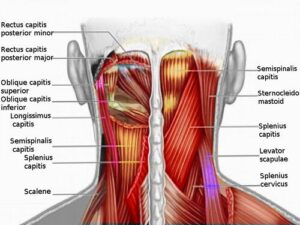
Interesting Facts on My Cervical Spine?
My spine consists of three major parts. These are the Atlas, the Axis and the Facet Joints.
Let me walk you through how each of these enable my cervical spine to work optimally:
@ The first is the cervical spine. The second is the Thoracic spine and the third is the Lumbar spine.
@ While the cervical portion covers my neck, the Thoracic covers my middle back. The Lumbar covers the lower back – all the way down to my hip.
@ My cervical bone (just like yours) consists of 7 bones. These are stacked one over the other. These are divided into seven parts – C1 to C7 vertebrae.
@ The first vertebrae are termed as the Atlas. This is termed as the C1 vertebrae. It holds my head upright and hence, the term ‘Atlas’ has been given to it.
@ The second vertebrae is termed as C2. It is termed Axis. C2 vertebrae is right below my C1 vertebrae. It permits the Axis to shift from side to side. So, I can shift my head from one side to another (left to right and vice versa) with the help of the Axis.
@ The facet joints connect the C1 to C7 vertebrae with the spinal bone. These facet joints are responsible for allowing my head to shift forwards, backwards and sideways.
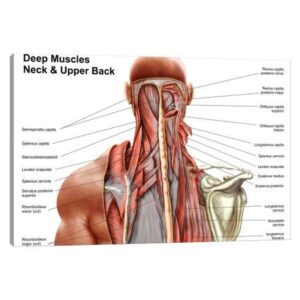
What was the Side Effect of My Forward Neck on My Sternocleidomastoid Muscles?
The Sternocleidomastoid Muscles are located at the back of the spine. The anterior and posterior angles of the neck are demarcated by these muscles.
This palpable muscle is responsible for allowing me to rotate my neck from side to side. My flawless head/ neck movement was hampered as the anterior and posterior angles of the sternocleidomastoid muscles lose their synchronization.
All this was owing to my forward neck posture. Both the superficial and surface muscles of the neck were damaged and needed to be fixed. I later learned that the total number of red (anaerobic) fibers increased and the white (aerobic) fibers decreased, in my sternocleidomastoid muscles.
So, I found it difficult to rotate my neck and even shift the head forward or backwards.
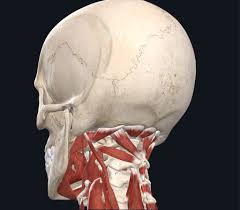
How were My Suboccipital Muscles Affected by My Forward Neck Posture?
The next muscle group that were stretched by my bad neck posture were the Suboccipital Muscles. These muscles are located right under my occipital bone.
All the movements between my skull and the C1 vertebrae are controlled via these muscles. These comprise of 4 muscles namely:
@ the rectus capitis posterior major,
@ rectus capitis posterior minor,
@ obliquus capitis and
@ obliquus capitis superior.
My bad neck posture forced the suboccipital muscles to become super-stiff. Owing to the strained Suboccipital Muscles, I suffered dull constant pain on top of my neck.
The pain shifted from the top of my neck to my forehead as well. My “stress headaches” were also caused by the trauma suffered by my Suboccipital Muscles.
All this was owing to my vulture neck posture.
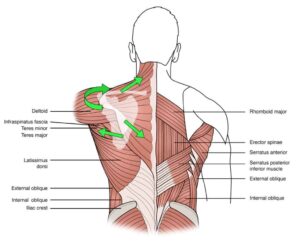
What was the Ill Effect of My Forward Head Posture on My Trapezius Muscles?
The third muscle on my neck that was affected adversely by my poor neck posture was my trapezius muscles. These muscles extend from my cervical to thoracic.
Basically, my neck and trunk are connected via this muscle.
My trapezius are the most extensive muscle group in my body. I found out (much to my dismay) that my bad neck posture had unnaturally stretched the superior, inferior as well as the middle portion of my trap muscles.
The maximum damage done to my trapezius muscles resulted in hampered bilateral contraction of my neck.
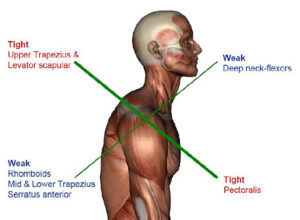
How was My Deep Cervical Flexors Damaged by My Nerd Neck?
The next muscle group in my neck that were damaged by my constant forward head movement was my deep cervical flexors. This muscle is located at the back of the spine.
While there are 4 sub-muscles that comprise of deep cervical muscles, I shall discuss only longus coli in this article. Apparently, longus colli is responsible for helping my chin move forward.
So, my head tends to shift forward and retract backwards via the aid of longus colli. Because I suffered from my forward neck posture, my longus colli was overtly stretched.
This in turn forced my head to slouch 2 inches forward from its natural position. My spine has to therefore bear a weight of 40 pounds because of this.
How did My Bad Neck Damage My Levator Scapulae Muscle?
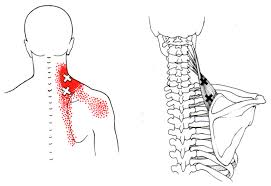
The next muscle that was affected adversely because of my bad neck posture is an extrinsic muscle. It is termed levator scapulae.
The vertebral column is affixed to the upper limb via the aid of the Levator Scapulae. In simpler words, it stretches from the C1 vertebra to the C4 vertebra.
As I was bending my head forward constantly, this muscle in the neck was damaged. I could feel the muscles on the side of my neck to become exceedingly stiff.
Neck rotation and shifting my neck from one side to the other therefore became a rather painful task. So apparently, my crane neck posture has indeed stiffened and damaged my Levator Scapulae.
It needed to be fixed.
How My Vulture Neck Posture Damaged My Erector Spinae?
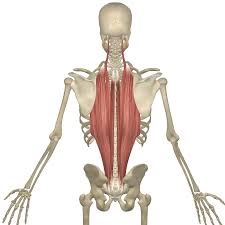
The last and final muscle that was damaged by my forward neck posture was the erector spinae. It is a core muscle that lies just beneath the thoracolumbar fascia.
As the bilateral contraction of the erector spinae was compromised, I was unable to maintain optimal head extension. Even head rotation and flexion was compromised owing to irregular unilateral contraction of the erector spinae.
Stiffness in the neck and upper back that later caused lower back pain was all a resultant of a damaged Erector Spinae. This was all a handiwork of my bad neck posture.
FAQs on Text Neck and Muscle Damage
Q-1: Why did fixing just six specific cervical muscles make such a big difference in my forward neck posture?
A-1: Forward neck posture isn’t caused by one weak muscle—it’s a pattern imbalance. Research shows that over 65% of desk workers develop forward head posture due to tight front-neck muscles and weak deep stabilizers.
By targeting six key muscles—deep neck flexors, sternocleidomastoid, upper trapezius, levator scapulae, suboccipitals, and scalene muscles—you correct both strength and tension. This balanced approach improves alignment faster than random exercises.
Q-2: How do weak deep neck flexors silently worsen forward head posture over time?
A-2: Deep neck flexors act like internal support cables for your head. Studies indicate that people with forward head posture show up to 30% reduced endurance in these muscles.
When they weaken, your head drifts forward, forcing larger muscles to compensate. Strengthening them helps pull the head back into neutral alignment and reduces strain on the cervical spine.
Q-3: Why was my sternocleidomastoid muscle tight even though I thought I needed to strengthen it?
A-3: This is a common misconception. The sternocleidomastoid (SCM) often becomes overactive, not weak. EMG studies reveal that individuals with poor posture show increased SCM activation during simple movements.
Instead of strengthening it, releasing and relaxing this muscle reduces neck tension and prevents it from pulling your head forward excessively.
Q-4: What role did my upper trapezius play in creating that constant neck stiffness?
A-4: The upper trapezius tends to become overworked when posture is off. Research suggests that prolonged sitting increases trapezius muscle activity by up to 40%, leading to stiffness and fatigue. This muscle elevates the shoulders and contributes to neck tension, so relaxing it while strengthening lower stabilizers is key to correcting posture.
Q-5: How did fixing my levator scapulae reduce both neck pain and shoulder tightness?
A-5: The levator scapulae connects your neck to your shoulder blade. When tight, it pulls your neck downward and forward.
Studies show that this muscle is a major contributor to neck pain in over 50% of office workers. Stretching and releasing it improves shoulder positioning and reduces the forward pull on your cervical spine.
Q-6: Why were my suboccipital muscles causing headaches along with poor posture?
A-6: Suboccipital muscles sit at the base of your skull and control fine head movements. When your head shifts forward, these muscles shorten and tighten.
Research indicates that tension in this area is linked to tension headaches in nearly 70% of cases. Releasing them not only improves posture but also reduces headache frequency.
Q-7: How do scalene muscles affect breathing and posture at the same time?
A-7: Scalenes assist in both neck movement and breathing. When posture is poor, they become overactive to help lift the rib cage.
Studies show that individuals with forward head posture rely more on accessory breathing muscles, increasing fatigue. Relaxing the scalenes helps restore proper breathing patterns and reduces neck strain.
Q-8: Why didn’t general neck exercises work until I targeted these six muscles specifically?
A-8: Generic exercises often miss the root cause—muscle imbalance. Research shows that targeted corrective exercise programs are 2–3 times more effective than general strengthening routines for posture correction.
By focusing on the exact muscles involved, you address both weakness and tightness, leading to faster and more lasting results.
Q-9: How long did it realistically take to see posture improvement after fixing these muscles?
A-9: Most people begin noticing changes within 4–6 weeks of consistent corrective exercises.
Clinical studies support this, showing measurable posture improvement in as little as one month with daily training. However, full correction may take 8–12 weeks depending on severity and consistency.
Q-10: Can fixing these six muscles permanently correct forward neck posture, or does it come back?
A-10: Correction can be long-lasting, but only with maintenance. Studies suggest that posture can regress within 2–3 weeks if corrective habits are abandoned.
The key is combining muscle work with lifestyle changes like proper desk ergonomics and regular movement. When maintained, improvements can be sustained for years.
Key Takeaway:
Fixing forward neck posture isn’t about doing more exercises—it’s about doing the right ones.
By focusing on these six critical cervical muscles, you address the root cause of imbalance rather than just the symptoms. With consistency, awareness, and the right approach, lasting posture correction is absolutely achievable.
Takeaway
There are approximately 20 muscle groups that help my neck and head remain stable. If any of these is stretched or damaged then, my neck and head movement would be compromised.
My text neck caused brain fatigue and I had a tough time figuring out that my weakened spinal muscles were to be blamed for this.
The above 6 muscles of my neck were either stretched or damaged because of my forward head. If I do not correct my forward head then, the muscle aches and pains can lead to further complications.
Some of these complications include breathing issues, pain in the chest, pain in the lower back, TMJ issues, upper back pain and muscle imbalance. All this may ultimately lead to poor body posture.
So, the moment I realized that I was suffering from bad neck posture, I immediately focused on fixing the 6 muscles of my neck (the ones I have discussed above) that were damaged.
Recommended:
- https://bestforwardheadposturefix.com/how-poor-head-alignment-impacts-throat-muscles/
- https://bestforwardheadposturefix.com/how-forward-neck-syndrome-tightens-the-quadriceps-muscles/
- https://bestforwardheadposturefix.com/how-to-use-a-roller-for-stretching-tight-neck-muscles/
- https://bestforwardheadposturefix.com/how-genetically-short-neck-muscles-cause-head-forward-position/
- https://bestforwardheadposturefix.com/how-to-stretch-the-chest-muscles-to-open-the-shoulders-and-improve-posture/
- https://www.jospt.org/doi/full/10.2519/jospt.2009.2872
- why trust us?
- for educational purpose only
- https://www.sciencedirect.com/science/article/abs/pii/S0021929001002068