
Forward Head Posture (FHP), often referred to as “tech neck” or “text neck,” is more than just a physical nuisance—it’s a social game-changer.
This subtle shift in posture, where the head juts forward relative to the spine, doesn’t just strain the neck and back. It also alters your facial expressions, disrupts eye contact, and unintentionally sends the wrong signals during social interactions.
In today’s hyper-visual world, where video calls and face-to-face communication hinge on subtle cues, FHP can quietly sabotage your first impressions.
This article by BestForwardHeadPostureFix research team dives into the specific ways forward head posture affects how your face is perceived and how effectively you connect with others through eye contact.
Using the latest evidence from leading posture research and psychology sources, we’ll explore the mechanics and implications of this common postural misalignment.
Article Index
- Understanding Forward Head Posture
- Forward Head Posture Facial Expressions
- How Posture Affects Eye Contact
- Neck Posture and Social Perception
- Correcting Forward Head Posture for Better Communication
- Posture’s Impact on Nonverbal Cues
- Improving Eye Contact Through Posture Correction
- FAQs on Poor Neck Posture and Facial Expression
- Psychological Effects of Poor Posture
- Conclusion
My View of Forward Head Posture
Forward Head Posture, or FHP, is what happens when your head slowly starts drifting ahead of your shoulders—usually thanks to hours hunched over screens, bad desk ergonomics, or the classic slouch on the couch.
It might feel subtle, but anatomically, it’s a big deal. Every inch your head moves forward from its natural alignment adds about 10 pounds of extra strain on your neck muscles, as explained by the Cleveland Clinic.
That is like your neck carrying a bowling ball all day—no wonder your traps are tight, your neck feels stiff, and your upper back constantly aches.
But here is the twist: FHP doesn’t just stay in the body—it leaks into your social life. It changes how you hold your face, how you make eye contact, and even how people read your expressions.
These are not just physical problems anymore—they are communication barriers. And that is where the story of FHP gets surprisingly personal, and a lot more impactful.
Forward Head Posture Facial Expressions – The Uncanny Conection
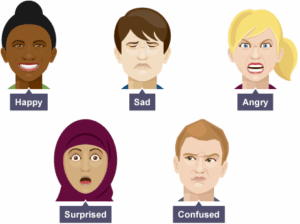
Facial expressions are a blend of muscular movement and structural positioning. While we often credit the muscles around the eyes and mouth for expressing emotions, head orientation plays a surprisingly large role.
When your head juts forward and tilts down—as it does in Forward Head Posture (FHP)—it physically alters the way facial skin is pulled and how muscles engage. This results in unintended expressions that do not match your internal emotional state.
The downward tilt can accentuate glabellar lines (between the brows), draw the corners of the mouth downward, and create shadows under the eyes, giving off a fatigued, angry, or sad appearance—even if you are feeling fine.
Scientific research supports this phenomenon. A study in the journal Cognition and Emotion showed that head tilt significantly influences how neutral faces are perceived; downward head angles were consistently rated as more submissive or sad.
Likewise, a 2020 study from the University of Bamberg revealed that posture alone, even without facial movement, changed how observers interpreted emotion.
Picture a job interview: You may feel confident, but if your head is tilted forward, your facial tension could be misread as nervousness or discomfort.
Or consider a casual chat—your friend might ask, “Are you okay?” even when you’re relaxed, simply because your face seems downcast due to posture.
In short, your neck angle can hijack your facial signals. With FHP, you are not just communicating with your face—your posture is doing the talking too, and it might be sending the wrong message.
How Posture Affects Eye Contact?
Eye contact is one of the most powerful nonverbal cues we have—it signals presence, confidence, interest, and honesty.
But Forward Head Posture (FHP) quietly undermines this essential social tool. When your head juts forward and tilts slightly down, your natural line of sight shifts downward too.
Instead of looking straight ahead, your eyes may appear to be gazing downward, even if you are trying to make direct contact. It is subtle, but it can send the wrong message.
According to Harvard Health Publishing, FHP can reduce upward gaze range by tightening the suboccipital muscles at the base of the skull and altering cervical joint mobility.
In real-world terms, this means you may struggle to comfortably meet someone’s eyes without straining your neck or arching your brows.
Imagine trying to make a heartfelt point in a conversation but being perceived as evasive or disinterested just because your eyes are not aligning properly.
In virtual settings, things get worse. If your screen is below eye level, FHP exaggerates the downward gaze—making it look like you are avoiding eye contact, even when you are fully engaged.
Over time, this can affect how colleagues perceive your attentiveness, trustworthiness, or emotional engagement during meetings, interviews, or presentations.
Neck Posture and Social Perception
Posture does not just shape how your body feels—it shapes how the world sees you. From job interviews to first dates, your body language is constantly sending signals, many of them below the radar of conscious thought.
While an upright posture conveys confidence, energy, and openness, Forward Head Posture (FHP) tends to suggest the opposite: insecurity, disinterest, or even low self-esteem.
Studies in Social Psychological and Personality Science show that people instinctively associate poor head and neck alignment with diminished leadership potential and trustworthiness.
In one experiment, participants rated individuals with forward-leaning heads as less confident and less socially competent—even when their facial expressions were neutral.
This effect was particularly strong in evaluations of dominance, suggesting that posture alone can impact how capable or assertive someone appears.
Consider two candidates in a job interview: both equally qualified, but one slouches with a forward neck while the other sits upright. Subconsciously, the upright candidate is more likely to be seen as reliable and assertive.
The same applies in everyday conversations. You might feel friendly and engaged, but if your neck is jutting forward and your posture appears closed off, people may interpret it as aloofness or lack of enthusiasm.
In a world where first impressions count, posture acts as a silent social resume—and FHP can leave you misunderstood.
Correcting Forward Head Posture for Better Communication
Thankfully, FHP is not a life sentence. With awareness and effort, it can be reversed or significantly improved. Corrective strategies include:
- Ergonomic adjustments (raising screens to eye level)
- Postural exercises (such as chin tucks and neck stretches)
- Regular movement breaks from digital devices
The American Physical Therapy Association recommends daily stretching and strengthening routines to retrain neck and upper back musculature.
As posture normalizes, facial expressions return to their natural resting tone, and eye contact becomes more aligned with your communication partner.
This physical recalibration doesn’t just change how you feel—it changes how you’re perceived.
Posture’s Impact on Nonverbal Cues
Nonverbal cues—such as micro-expressions, eyebrow positioning, and subtle eye movements—play a fundamental role in human communication.
These facial details convey emotions faster and more authentically than words ever can. But when your head is constantly tilted forward due to Forward Head Posture (FHP), these cues can be distorted or suppressed.
A downward-tilted head flattens the forehead, causes the eyebrows to appear furrowed or disengaged, and reduces the clarity of expressive movements around the eyes and mouth.
For example, the look of surprise may be lost because the raised brows are less visible, or engagement may be misread as disinterest due to a downward gaze.
Research from the International Journal of Behavioral Development emphasizes that nonverbal signals often carry as much weight—if not more—than verbal ones in shaping perception, emotion, and trust during interactions.
In critical settings like job interviews, public speaking, or even first dates, posture-induced distortions in facial intent can create a mismatch between what you are feeling and what others perceive.
Correcting FHP realigns not just your body, but also your expressiveness. When your head is upright and balanced, micro-expressions are more visible and congruent with your spoken words—allowing your personality and emotional authenticity to come through clearly and confidently.
Improving Eye Contact Through Posture Correction
Restoring proper head alignment resets your visual axis, bringing your gaze back to a natural horizontal plane. This makes eye contact feel less forced and more instinctive.
According to the Mayo Clinic, individuals undergoing posture correction therapies often describe feeling noticeably more “engaged” and “open” in conversation—not due to any change in personality, but because their improved posture allows for more comfortable and confident eye contact.
Eye alignment is crucial in both in-person and virtual communication. In the digital age, where much of our interaction happens over screens, the eyes have become our primary nonverbal tool. A forward-leaning head can distort this, making it appear as though you are looking down or away—even if you are not.
Realigning the head and neck promotes a level gaze that projects attentiveness, confidence, and sincerity.
It improves social chemistry, especially in first impressions. So correcting posture is not just an aesthetic upgrade—it enhances how effectively and authentically you connect with others.
Psychological Effects of Poor Posture
The way we carry ourselves not only shapes how others perceive us—it profoundly affects how we feel about ourselves.
A 2017 study from San Francisco State University found that individuals who adopted slouched or forward head postures were more likely to recall sad memories and experience feelings of helplessness, in contrast to those maintaining upright, aligned posture.
This suggests that posture can directly influence emotional state and cognitive processing.
Forward Head Posture (FHP) can trap individuals in a subtle but powerful negative feedback loop. As the posture distorts facial expressions, it may lead to awkward social responses—people may misinterpret your mood or confidence.
These repeated misunderstandings can dent self-esteem over time, causing people to withdraw socially or avoid eye contact. Unfortunately, eye contact avoidance is strongly correlated with heightened social anxiety and lower perceived confidence.
Correcting FHP helps break this loop. By restoring physical alignment, you naturally regain more authentic expression and presence—boosting both emotional well-being and social confidence.
FAQs on Poor Neck Posture and Facial Expression
Q-1: How does forward head posture affect facial expressions and eye contact?
Conclusion
Forward Head Posture may start as a neck issue, but its ripple effects extend deep into the fabric of our social lives. From altering facial expressions and sabotaging eye contact to affecting how others perceive us—and how we perceive ourselves—FHP is a silent communicator with a loud impact.
The good news? It is fixable.
By investing in posture awareness and simple corrective techniques, you can reclaim your natural expressiveness, reestablish meaningful eye contact, and project the confident, engaged version of yourself that you were always meant to show the world.
So next time you catch yourself craning toward your phone or laptop, remember: looking up isn’t just good for your neck—it is great for your face.
References: