Breathing and posture affect each other in both directions: slumped shoulders and a forward-jutting head restrict how far your diaphragm can drop, and shallow, chest-dominant breathing trains your body to hold that same collapsed shape. Fix one without the other and you’re working against your own physiology. Fix both together and the changes compound.
If you want to act on that right now, do three things. First, spend two minutes practicing diaphragmatic breathing, feeling your lower ribs expand sideways rather than your chest heaving upward. Second, run a quick occiput-to-wall check, standing with your heels, hips, and shoulder blades against a wall, and noting how far your head sits from the surface. Third, build a two-minute breathing drill into something you already do daily, like brushing your teeth or waiting for coffee to brew.
The evidence behind this isn’t speculative. Trials published through MDPI’s International Journal of Environmental Research and Public Health and studies indexed on PubMed have measured real, quantifiable improvements in chest expansion and spinal alignment after structured breathing programs. Bestforwardheadposturefix builds its exercise routines around exactly this kind of rehab-grade evidence, not generic wellness advice.
- Prioritize diaphragmatic breathing over chest breathing during any posture work.
- Run the occiput-to-wall test before and after two weeks of practice to see if distance improves.
- Treat the two-minute breathing drill as non-negotiable daily maintenance, not an occasional extra.
Key Takeaways
Breathing and posture form a self-reinforcing loop, so lasting improvement requires retraining diaphragmatic breathing and correcting spinal alignment together rather than treating either one in isolation.
| Point | Details |
|---|---|
| Diaphragm drives both systems | The diaphragm stabilizes your spine through intra-abdominal pressure while also powering respiration, so restricted posture limits both functions at once. |
| Forward head posture cuts chest expansion | Kyphosis and forward head positioning compress the lower ribs, reducing diaphragmatic excursion and increasing accessory muscle use. |
| Mouth breathing reshapes posture over time | Habitual mouth breathing correlates with forward head projection and altered hyoid position, especially in developing children and adolescents. |
| Trials show measurable gains | Breathing exercises improved chest expansion in most participants in one university student trial, and boosted diaphragmatic excursion beyond corrective exercise alone in a controlled trial lasting several weeks. |
| Structured programs beat scattered tips | Bestforwardheadposturefix provides progressive, evidence-informed routines that combine breathing retraining with posture correction for readers who want a sequenced plan rather than isolated advice. |
This article is general information, not a substitute for advice from a qualified doctor. Consult a qualified healthcare professional about your own circumstances before acting on anything here.
Table of Contents
- How Breathing and Posture Share the Same Muscular System
- Why Slouching and Forward Head Posture Choke Your Breathing
- Why Chest Breathing and Mouth Breathing Wreck Your Alignment
- What the Clinical Trials Actually Found
- How to Practice Diaphragmatic Breathing for Better Posture
- Simple Tests to Track Your Breathing and Posture Progress
- When Breathing or Posture Problems Need a Professional
- The Habit That Actually Sticks Beats the Perfect Program
- Where to Go for a Structured Breathing and Posture Program
- Sources
How Breathing and Posture Share the Same Muscular System
Your diaphragm isn’t just a breathing muscle. It’s a dome-shaped structure that attaches to your lower six ribs, your sternum, and your lumbar spine through the crura, tendinous fibers that anchor it directly to the vertebrae. When it contracts and flattens, it doesn’t just pull air into your lungs. It also increases intra-abdominal pressure, which stiffens your trunk the same way inflating a bicycle tire makes the wheel structurally sound.
Physiotherapists often describe this system using the “trunk canister” model: the diaphragm forms the roof, the pelvic floor forms the floor, and the transversus abdominis muscle wraps around the sides like a corset, with the thoracic cage completing the structure. When all four pieces coordinate, you get a stable spine and efficient breathing at the same time. When one piece is compromised, usually because posture has locked the rib cage into a fixed position, the whole system loses efficiency.
Rib mobility is the part most people never think about. Your lower ribs need to flare outward and slightly rotate for the diaphragm to descend fully. If your thoracic spine is stuck in a rounded position, a pattern common with hours of screen time, those ribs stay compressed. The diaphragm can still contract, but it has nowhere to expand into, so your body recruits accessory muscles instead.
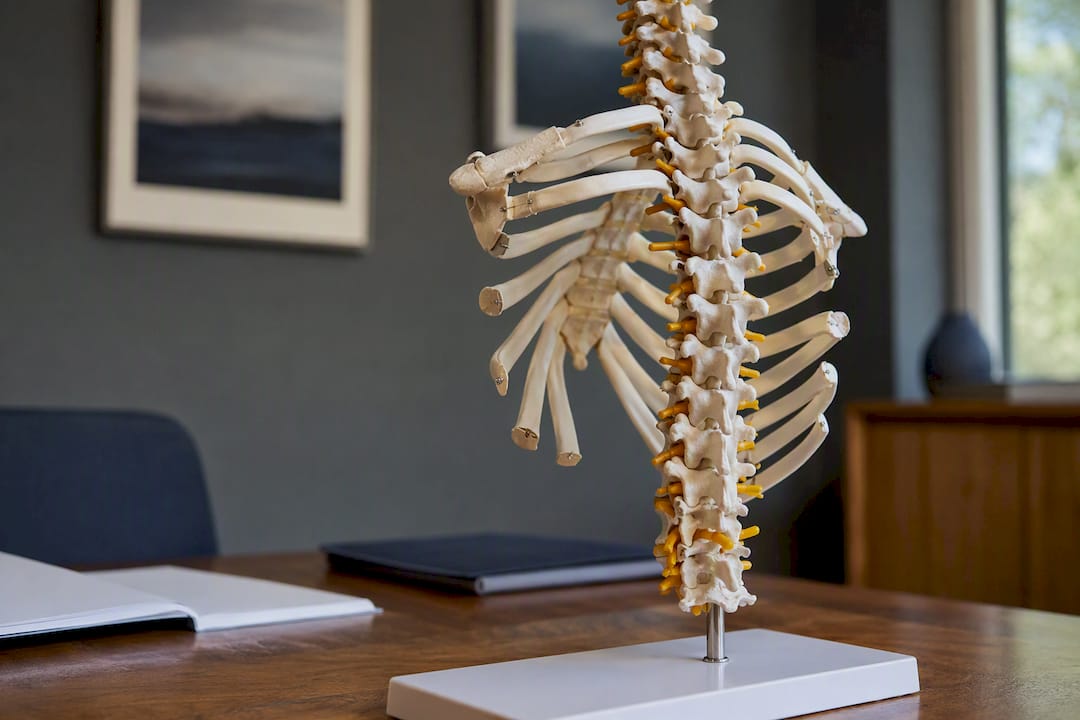
Those accessory muscles include the scalenes and upper trapezius in your neck, along with the pectoralis minor across your chest. They’re designed for occasional, high-demand breathing, like sprinting. Using them for every resting breath, hour after hour, keeps your neck and shoulders in a state of low-grade chronic tension.
Pro Tip: Place one hand on your belly and one on your lower ribs. If only the top hand moves when you breathe, you’re likely relying on accessory muscles instead of your diaphragm.
Research on postural malalignment backs this up directly. According to Physiopedia’s clinical summary, forward head posture and thoracic kyphosis measurably reduce diaphragmatic efficiency and chest wall mobility, forcing the body to lean on secondary muscles to move air. That’s the mechanical root of why posture correction and breathing retraining need to happen together rather than as separate projects.
- The diaphragm connects mechanically to your spine, not just your lungs.
- Rib mobility, not just lung tissue, determines how much air you can move.
- Chronic accessory muscle use is a downstream symptom of restricted rib mechanics, not a separate problem.
Why Slouching and Forward Head Posture Choke Your Breathing
Forward head posture and a rounded upper back don’t just look uncomfortable. They physically compress the space your lungs need to expand. When your head sits forward of your shoulders, your cervical spine extends to compensate, and that chain reaction pulls your thoracic spine into more flexion, closing down the lower ribs where most of your resting breath capacity lives.
The measurable consequences show up in respiratory testing. Physiopedia’s review of postural effects on the diaphragm notes that malalignment reduces both chest wall mobility and ventilatory efficiency, and some clinical cohorts studying mouth breathing and posture have found lower FVC and FEV1 values, the standard spirometry measures of how much air you can forcibly exhale, in individuals with these postural patterns. The pediatric research on this is particularly striking: a cross-sectional study of mouth and nose breathing children found that mouth breathers showed distinct postural compensations alongside altered pulmonary function measures, though the relationship isn’t identical across every study population.
You don’t need a spirometer to notice the pattern in yourself. A few signs tend to show up together:
- Breaths that feel shallow or “stuck” in the upper chest rather than expanding the lower ribs and belly.
- Persistent tightness across the neck and upper traps, even without heavy physical activity.
- Visibly reduced side-to-side rib movement when you watch yourself breathe in a mirror.
- A sense of needing to “catch” a full breath periodically, even at rest.
None of these are dramatic on their own. That’s exactly why they get ignored for years while the underlying pattern reinforces itself. The rib cage that doesn’t move stays stiff, and the stiffness makes it harder to move it the next time you try. Breaking that cycle is less about a single fix and more about consistently giving your ribs permission to move again.
Why Chest Breathing and Mouth Breathing Wreck Your Alignment
The relationship runs the other way too. Habitual mouth breathing and chest-dominant breathing don’t just result from bad posture, they actively cause postural drift over time, particularly in developing bodies. Several observational studies on children and adolescents have found that habitual mouth breathers tend to show forward head projection, altered hyoid bone positioning, and a tendency toward scapular elevation compared to nasal breathers, according to the same pediatric posture and pulmonary function research cited above.
The mechanism makes sense once you trace it through. Breathing through the mouth changes the resting position of the tongue and jaw, which shifts head position to keep the airway open. Hold that adapted head position for years during growth and skeletal development, and it becomes the body’s new default, not just a temporary adjustment.
Chest-dominant breathing creates a parallel problem in adults. When the diaphragm isn’t doing its share of the work, the trunk canister loses its main source of internal stability. Your body compensates by recruiting the upper chest and shoulder muscles more, which pulls the shoulders forward and up. Rounded shoulders and neck extension become the postural signature of someone who’s been breathing “high” for years without realizing it.
Breaking this loop takes proprioceptive retraining, meaning you have to relearn what a full breath actually feels like, because your nervous system has adapted to shallow chest breathing as normal.
- Hand-on-belly cueing helps you notice when the diaphragm, not the chest, initiates the breath.
- Lateral rib expansion drills retrain the specific muscles that chest breathers stop using.
- Nasal breathing during rest and light activity reduces the postural drift associated with chronic mouth breathing.
- Consistency matters more than intensity. Short daily practice beats occasional long sessions for retraining a habit this automatic.
What the Clinical Trials Actually Found
The clearest evidence for treating breathing and posture as one system comes from two study types: comparative trials in healthy young adults and randomized controlled trials in people with diagnosed postural conditions.
A trial published in MDPI’s International Journal of Environmental Research and Public Health tested classical breathing exercises against currently popular training programs like yoga and Pilates in female university students. The breathing exercise group showed significant improvements in chest expansion, with roughly 93% of participants improving on that measure, along with meaningful gains in occiput-to-wall distance and spinal mobility as measured by the Schober test. That last point matters: breathing exercises performed as well as, and in some measures better than, established mobility practices that get far more popular attention.
The second trial targeted a more specific population. A 12-week randomized controlled trial in postmenopausal women with kyphosis compared corrective exercises alone against corrective exercises combined with diaphragmatic breathing. Both groups improved their kyphosis angle and quality of life scores, but the group that added diaphragmatic breathing showed significantly greater gains in diaphragmatic excursion, the actual distance the diaphragm travels during a breath, than the corrective-exercise-only group.
The pattern across these trials is consistent even though the populations differ: adding structured breathing work to postural correction produces measurable gains that posture exercises alone don’t fully deliver. In the kyphotic women’s trial, diaphragmatic excursion improved significantly more in the combined group, a finding that lines up with the university student data on chest expansion and occiput-to-wall improvement.
| Study population | Intervention tested | Key measured outcome |
|---|---|---|
| Female university students | Classical breathing exercises vs. yoga/Pilates | Chest expansion improved in about 93% of participants; occiput-to-wall distance improved |
| Postmenopausal women with kyphosis | Corrective exercises with vs. without diaphragmatic breathing | Diaphragmatic excursion improved significantly more with breathing added |
These findings come with real caveats. Sample sizes in both trials were modest, and the populations were specific, healthy young women in one case, postmenopausal women with a diagnosed kyphosis in the other. Neither trial tells you exactly what to expect if you’re a 35-year-old office worker with mild forward head posture and no diagnosed spinal condition. What they do establish is a consistent physiological direction: breathing retraining measurably changes chest mechanics and spinal alignment markers, and it does so faster when paired with corrective exercise rather than used alone. A broader look at related trials indexed through PubMed’s public health research shows the same pattern repeating across smaller, targeted studies, which is encouraging even if none of them is large enough to settle the question definitively.
How to Practice Diaphragmatic Breathing for Better Posture
Getting this right isn’t complicated, but most people skip the setup phase and go straight to breathing “deeply,” which usually just means breathing harder with the wrong muscles. Here’s the progression that clinicians actually use.
- Start lying down. Lie on your back with knees bent, feet flat on the floor. Place one hand on your upper chest and one on your belly, just below your rib cage. Breathe in slowly through your nose and try to keep the top hand nearly still while the bottom hand rises. You should also feel your lower ribs pushing outward to the sides, not just your belly rising, since true diaphragmatic breathing expands the rib cage in three dimensions, not just forward.
- Add lateral rib awareness. Once the belly-hand cue feels natural, wrap a resistance band or towel around your lower ribs and hold the ends loosely in each hand. As you inhale, feel the band stretch outward against your ribs. This corrects the common mistake of “belly puffing” without actual rib expansion, which looks like diaphragmatic breathing but doesn’t restore real thoracic mobility.
- Progress to supported seated. Sit in a chair with your back supported, feet flat, and repeat the same breathing pattern. Seated posture challenges the pattern more than lying down because gravity now pulls your rib cage toward collapse, which is exactly the position you’re trying to retrain.
- Move to unsupported standing. Standing removes the backrest entirely. Focus on keeping your rib cage stacked over your pelvis rather than flared up and forward, a common overcorrection. This is also where you start integrating a subtle chin tuck to align your head over your shoulders.
- Integrate with thoracic mobility work. Pair your breathing practice with dedicated thoracic mobility drills so the joints have the range of motion the breath is trying to use. Breathing into a stiff thoracic spine has a ceiling; mobility work raises that ceiling.
- Add dynamic movement. Practice diaphragmatic breathing while walking or during light activity. This is the step most programs skip, and it’s the one that determines whether the new pattern survives outside a quiet room.
For anyone dealing with breathlessness or anxiety-driven shallow breathing, paced breathing and pursed-lip techniques help slow the respiratory rate and reduce the sense of air hunger. Inhale through the nose for a count of four, then exhale slowly through pursed lips for a count of six to eight. The longer exhale activates the parasympathetic nervous system and tends to reduce accessory muscle recruitment almost immediately.
Common errors are predictable once you know what to look for. Shoulder hiking during inhalation means accessory muscles are still doing the work. A belly that pushes out without any rib movement means you’re getting abdominal distension, not diaphragmatic expansion. And holding your breath between inhale and exhale, often a subconscious habit under stress, defeats the purpose of the entire drill.
Pro Tip: Film yourself from the side during a 30-second breathing practice. Most people are shocked to see their shoulders rising on every inhale, a pattern that’s nearly invisible from the inside but obvious on video.
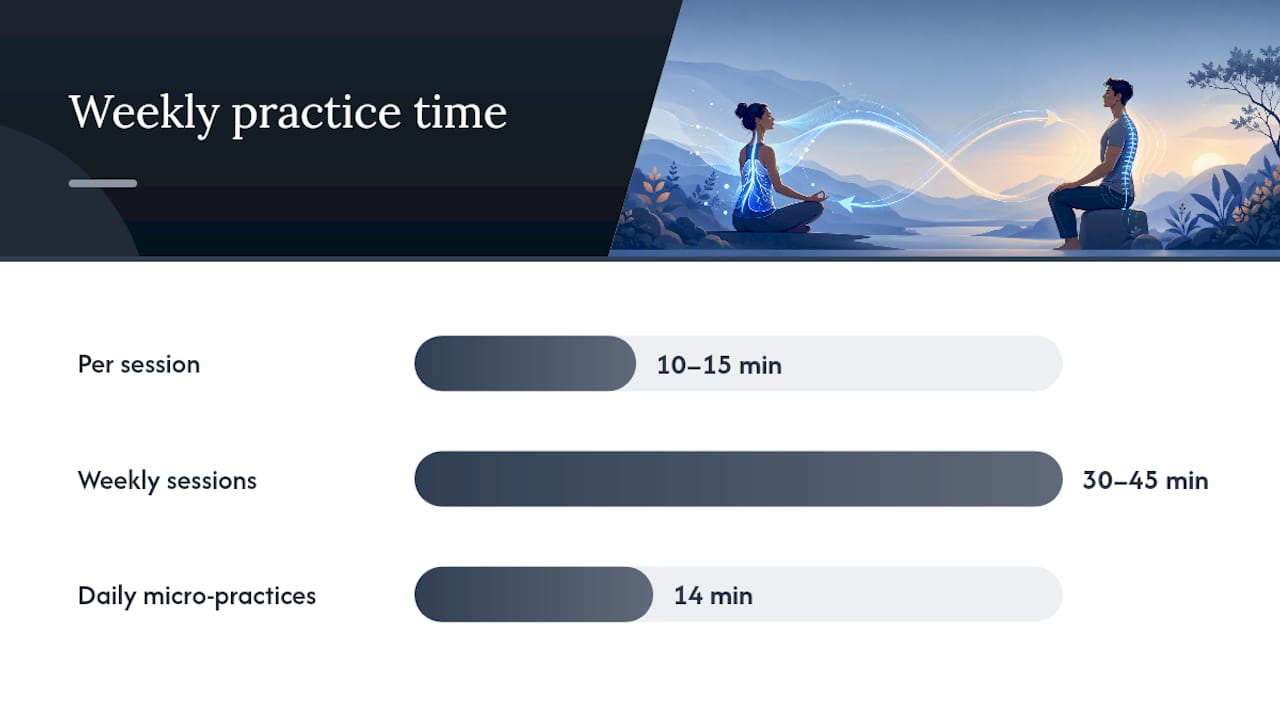
A realistic weekly structure looks like this: three dedicated 10 to 15 minute sessions per week working through the progression above, combined with daily two-minute micro-practices at natural pause points, like before a meal or after sitting down at your desk. Pair the breathing work with neck alignment exercises and, if kyphosis is part of your pattern, targeted thoracic kyphosis exercises so the breathing gains have a stable structure to reinforce.
Simple Tests to Track Your Breathing and Posture Progress
You don’t need clinical equipment to establish a baseline and track change over weeks. Four measurements cover most of what matters.
- Occiput-to-wall distance. Stand with heels, buttocks, and shoulder blades against a wall. Try to touch the back of your head to the wall without tilting your chin up. Measure the gap in inches or centimeters if it doesn’t touch.
- Chest expansion. Wrap a tape measure around your chest at nipple level. Note the measurement after a full exhale, then after a maximum inhale. The difference is your chest expansion figure.
- Fingertip-to-floor. Bend forward from standing, knees straight, and measure the distance from your fingertips to the floor. This tracks overall spinal and hamstring flexibility, which interacts with breathing mechanics.
- Breathing pattern observation. Lie down, place hands on chest and belly, and watch which one moves first and most during ten relaxed breaths.
Log these once every two weeks rather than daily. Daily fluctuation from hydration, fatigue, or stress will mask real trends and just frustrate you. A meaningful change is usually a chest expansion increase of an inch or more, or an occiput-to-wall gap that closes noticeably over four to six weeks of consistent practice.
- Retest at the same time of day for consistency, ideally morning before activity fatigue sets in.
- Use the same wall, tape measure, and starting position each time to avoid measurement drift.
- If your occiput-to-wall distance isn’t budging after six weeks of consistent practice, that’s a signal to get a professional assessment rather than push harder alone.
Home tests are useful for tracking trends, but they can’t diagnose why a gap isn’t closing. That’s where a clinician’s tools, spirometry, diaphragmatic ultrasound, or a hands-on structural exam, pick up where a tape measure leaves off.
When Breathing or Posture Problems Need a Professional
Most breathing and posture issues respond well to consistent home practice. Some don’t, and knowing the difference matters.
Get evaluated promptly if you notice any of the following: new or worsening breathlessness that appears without exertion, chest pain, fainting or near-fainting episodes, numbness or weakness in your arms or hands, or signs pointing toward sleep apnea like loud snoring and daytime exhaustion despite adequate sleep hours.
Different specialists handle different pieces of this puzzle:
- Physiotherapists handle breathing retraining and postural correction directly, using hands-on assessment and progressive exercise programs.
- ENT specialists or dentists evaluate structural causes of chronic mouth breathing, like enlarged tonsils, deviated septum, or airway anatomy.
- Pulmonologists assess suspected obstructive or restrictive lung disease when spirometry results fall outside normal ranges.
A clinical assessment typically includes spirometry to measure lung volumes, a SNIP test (sniff nasal inspiratory pressure) to gauge diaphragm strength, occiput-to-wall measurement, and sometimes diaphragmatic ultrasound to directly visualize how far the muscle moves during breathing. Massage therapists and chiropractors, like the practitioners behind this guide to shoulder posture, can also help address the muscular tension that keeps compensatory breathing patterns locked in place.
The Habit That Actually Sticks Beats the Perfect Program
Most people don’t fail at breathing retraining because the technique is too hard. They fail because they treat it as a separate task competing for time against everything else in a day. The programs that actually work attach the practice to something that’s already automatic: a cue triggers a short burst of practice, and that burst gets paired with a routine you never skip.
A cue-practice-pairing loop might look like this: every time you sit down at your desk, that’s the cue. You do 60 to 90 seconds of diaphragmatic breathing before touching your keyboard. That’s the practice. Pairing it with something as fixed as sitting down means you’re not relying on willpower or memory, you’re relying on a routine you already have.
The real obstacles are predictable: people forget, it feels awkward at first, and results aren’t visible in week one. Solve forgetting with a physical trigger, not an app reminder you’ll dismiss. Solve awkwardness by practicing somewhere private for the first two weeks. Solve invisible progress by measuring your occiput-to-wall distance at week two, not day two, because that’s roughly when consistent practice starts showing up in the numbers.
Case studies and individual results vary by starting point, consistency, and whether structural issues are involved. That variability is normal and not a reason to abandon the process early.
— Madhukar
Where to Go for a Structured Breathing and Posture Program
If everything above makes sense but you’re not sure how to sequence it into an actual weekly habit, that’s the gap Bestforwardheadposturefix is built to close. Rather than a single tip or a one-off exercise video, the site offers stepwise programs that combine breathing retraining with targeted posture correction, so you’re not guessing which drill to do first or how to progress once the basics feel easy.

The educational library covers everything from assessing your own neck alignment to pillow positioning for overnight alignment, giving you a full-day framework instead of a single exercise to repeat in isolation. This approach fits best if you’re the kind of reader who wants to understand the mechanics behind a routine, not just follow instructions blindly, and who’s willing to put in a few weeks of consistent practice rather than expecting an overnight fix.
Start with the neck alignment exercises page to build your baseline routine, then layer in the breathing progressions from this article as your rib mobility improves.
Sources
- Effects of Classical Breathing Exercises on Posture, Spinal and Chest Mobility among Female University Students Compared to Currently Popular Training Programs
- Effect of adding diaphragmatic breathing to corrective exercises on kyphotic angle and diaphragmatic excursion in postmenopausal kyphotic women: A randomized controlled trial
- Body posture and pulmonary function in mouth and nose breathing children: cross-sectional study
- The Effect of Posture on the Diaphragm – Physiopedia