Side sleeping wins for most adults, mainly because it keeps the airway open and eases pressure on the spine, but it isn’t universal. Back sleeping still has a place for people without apnea or reflux who want the flattest possible spinal position, and exceptions like late pregnancy and severe GERD change the calculus entirely.
TL;DR:
- Side sleeping generally alleviates snoring, reduces acid reflux when on the left side, and is more forgiving on the body in most situations.
- Back sleeping offers even weight distribution and minimizes facial creasing but can worsen airway collapse and reflux for many users.
- Proper setup, including matching pillow loft and firmness to your sleeping position, is crucial to avoid stiffness or discomfort regardless of position.
- Transitioning to a new sleep position should be gradual over several weeks, with adjustments based on specific health conditions like reflux or neck pain.
- Stomach sleeping is strongly discouraged as it twists the neck and flattens the spine’s natural curve, often leading to discomfort and poor posture.
Table of Contents
- Back vs Side Sleep Comparison: The Real Trade-Offs
- Which Position Is Best for Your Specific Health Condition?
- How Should You Set Up Pillows and a Mattress for Each Position?
- How Do You Retrain Your Body to Sleep in a New Position?
- How Can You Protect Your Neck Alignment While Sleeping?
- Why There’s No Single Perfect Sleep Position
- Let Bestforwardheadposturefix Help You Sleep Without the Morning Neck Ache
- Sources
- FAQ
Back vs Side Sleep Comparison: The Real Trade-Offs
Side sleeping is the most common position among adults, with back sleeping being the second most common according to Harvard Health Publishing. That’s not an accident. Side sleeping tends to be more forgiving on the body in more situations than back sleeping, though each position brings its own list of upsides and downsides worth weighing honestly.
Side sleeping pros:
- Keeps the airway more open, which cuts down on snoring and mild obstructive sleep apnea symptoms
- Recommended position during pregnancy, especially on the left side, to ease pressure on major blood vessels
- Left-side sleeping specifically reduces acid reflux by limiting backflow into the esophagus, per National Geographic
- Distributes weight in a way that often relieves lower back pain when paired with a knee pillow
Side sleeping cons:
- Can compress the shoulder and hip you sleep on, leading to soreness over time
- May create facial or chest skin creasing from sustained pressure against the pillow
- Can encourage a slouched, curled posture if you don’t consciously keep your spine long
Back sleeping pros:
- Distributes body weight evenly across the widest surface area, which many people find genuinely comfortable
- Keeps the spine in a neutral position when the mattress and pillow are matched correctly
- Avoids the facial pressure that causes creasing, a small but real cosmetic upside
Back sleeping cons:
- Gravity pulls the tongue and soft tissue backward, worsening snoring and airway collapse for many sleepers
- Can aggravate acid reflux by making it easier for stomach acid to travel upward
Stomach sleeping deserves a quick word here, mostly as a warning. It twists the neck to one side for hours and flattens the natural spinal curve, and it’s the position most frequently discouraged by sleep and posture experts alike. If you’re currently a stomach sleeper, transitioning away from it tends to pay off fast.
Which Position Is Best for Your Specific Health Condition?
The “best” position depends heavily on what you’re dealing with, and treating this as one-size-fits-all advice misses the point entirely.
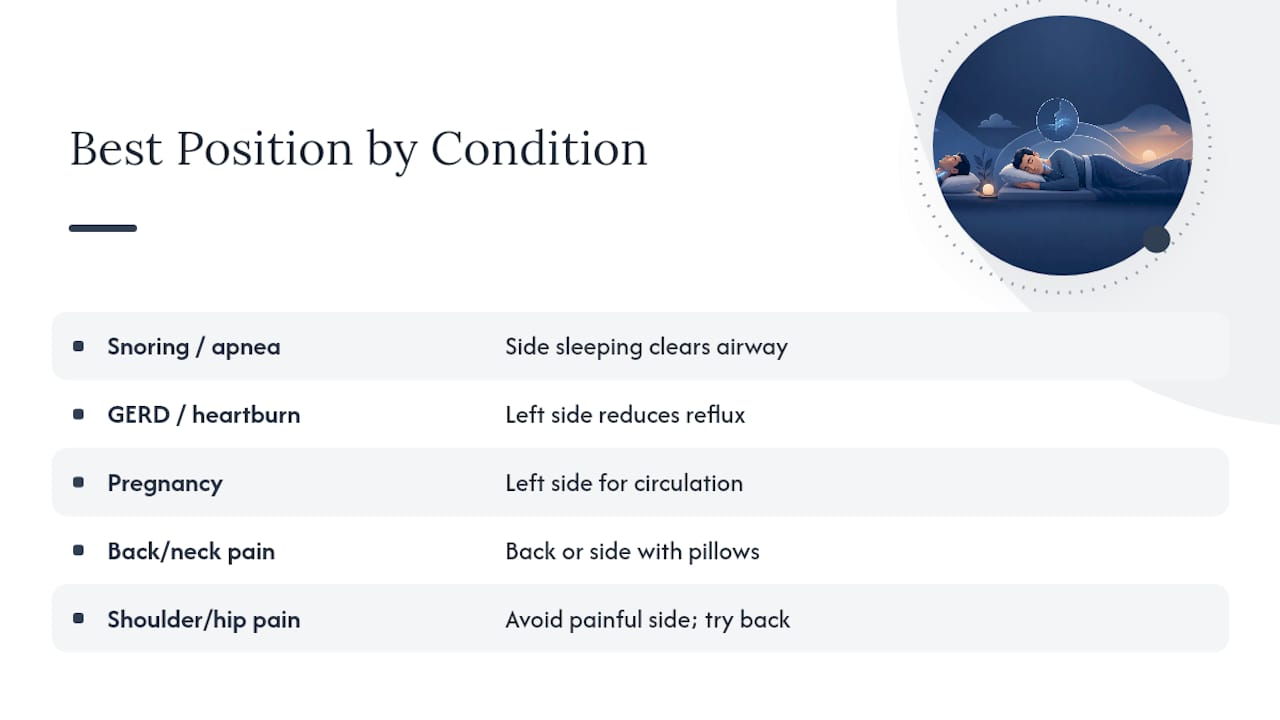
Snoring and sleep apnea. Lying flat on your back lets gravity pull the tongue and throat tissue backward, narrowing the airway. Side sleeping keeps that passage clearer, which is why it’s the go-to positional fix for position-dependent obstructive sleep apnea. Some people get meaningful relief just from switching sides at night, without any other intervention.
GERD and heartburn. Left-side sleeping reduces acid reflux because of how the stomach sits relative to the esophagus at that angle, according to National Geographic. Right-side sleeping can actually make reflux worse for some people. If heartburn wakes you up, try the left side first before assuming you need medication.
Pregnancy. Left-side sleeping is the standard recommendation once you’re further along, since it reduces pressure on the vena cava and supports better circulation for both parent and baby, a point echoed by Mayo Clinic.
Back and neck pain. This is where things split. Back sleeping with a pillow under the knees can relieve lumbar strain for some people, while others do better on their side with a pillow between the knees to keep the pelvis level, according to the Sleep Foundation.
Shoulder or hip pain. Side sleeping on the painful joint almost always makes things worse. Switch to the opposite side or try back sleeping instead.
If breathlessness, numbness, or pain gets worse instead of better after a week of adjustments, that’s a signal to talk to a clinician rather than keep experimenting on your own.
How Should You Set Up Pillows and a Mattress for Each Position?
Getting the position right matters less than most people assume if the support underneath you is wrong. A mattress or pillow that’s too old or poorly matched to your body will undo even the “correct” sleep position, a point Johns Hopkins Medicine makes clear.
- Match pillow loft to shoulder width. Side sleepers generally need a thicker, firmer pillow that fills the gap between the ear and shoulder, keeping the neck level with the spine. Back sleepers need something thinner and flatter so the head doesn’t tip forward.
- Add a knee pillow if you sleep on your side. This keeps the hips stacked and takes pressure off the lower back and pelvis.
- Try an under-knee pillow or wedge if you sleep on your back. It relieves lumbar pressure and helps some people who wake up with a stiff lower back.
- Reassess mattress firmness. Side sleepers usually want a bit more give at the shoulder and hip; back sleepers need firmer, more even support.
- Test at home before committing. Sleep on a setup for a full week, and if you’re waking up with new stiffness, numbness, or headaches, something in the setup is wrong, not just the position itself.
Pro Tip: Press your fist into an old pillow. If it doesn’t spring back within a few seconds, it’s lost the loft you need for proper alignment, no matter how good your sleep position is.
How Do You Retrain Your Body to Sleep in a New Position?
Switching sleep positions rarely works overnight, literally. Gradual, staged changes hold up far better than trying to force a new posture in one night.
- Night one: set up the environment, not the habit. Get the right pillow and, if switching to side sleeping, a body pillow to rest against. Don’t expect to stay in the new position all night yet.
- Week one: use physical cues. Place a body pillow behind your back or a rolled towel along your spine to discourage rolling back into your old position.
- Weeks two through four: build tolerance gradually. Add small time increments in the new position rather than forcing a full night immediately.
- Adjust evening habits if reflux or apnea is a factor. Skip heavy meals and alcohol within a few hours of bedtime, since both relax the throat muscles and worsen airway collapse.
- Stop and check in with a clinician if symptoms escalate. Increased breathlessness, numbness, or sharp pain means the transition needs professional input, not more persistence.
How Can You Protect Your Neck Alignment While Sleeping?
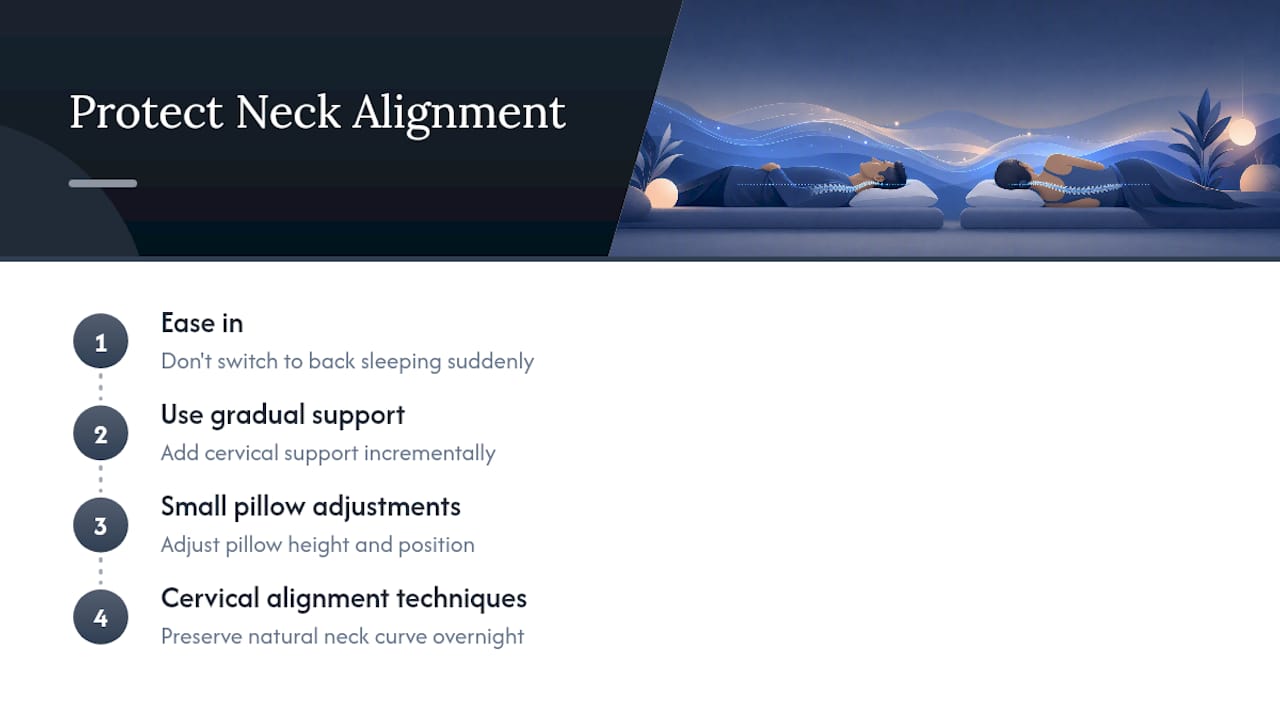
If you deal with forward head posture, sudden back sleeping can spike morning neck tension. Ease in with gradual cervical support and small pillow adjustments to correct forward head posture instead of switching all at once. Cervical pillow alignment techniques help preserve your neck’s natural curve overnight.
Why There’s No Single Perfect Sleep Position
Clinical guidance keeps circling back to one idea: individualize it. What works for your coworker’s reflux might wreck your shoulder. Sleep position also isn’t isolated from the other 16 hours of your day. Slouching at a desk feeds the same misalignment that a bad pillow makes worse at night, which is why daytime posture and nighttime alignment are really one continuous problem, not two separate ones. Get your support right first, then let position follow from your specific conditions.
— Madhukar
Let Bestforwardheadposturefix Help You Sleep Without the Morning Neck Ache
This site provides guidance for readers experiencing neck pain that spans from sleep into daily activities. Instead of a one-size-fits-all pillow recommendation, it offers gradual repositioning strategies to help manage changes in sleep position and reduce stiffness.

If reflux is part of your sleep trouble too, this pregnancy heartburn relief guide from a trusted partner covers a practical step-up plan worth pairing with left-side sleeping. For neck pain that shows up unevenly, the one-sided neck pain guide breaks down likely causes and fixes. Start with the forward head posture sleep guide to build a plan around your specific pain points tonight.
This article is general information, not a substitute for advice from a qualified doctor. Consult a qualified healthcare professional about your own circumstances before acting on anything here.
Sources
- Is your sleep position helping or hurting you? – Harvard Health Publishing
- Mayo Clinic Minute: What is the best sleeping position? – Mayo Clinic News Network
- Side sleeping benefits – National Geographic
- Choosing the best sleep position – Johns Hopkins Medicine
- Side sleeping: Which side should you sleep on? – Sleep Foundation
FAQ
What is the 10 5 3 2 1 rule for sleep?
It’s a pre-bedtime countdown guideline covering caffeine, food, work, screens, and snooze timing, though it isn’t specific to back or side sleeping positions; it’s a broader sleep hygiene checklist.
What is the unhealthiest position to sleep in?
Stomach sleeping is generally considered the least favorable position because it twists the neck and flattens the spine’s natural curve for hours at a time.
What is the most natural sleeping position?
Side sleeping is the most common position among adults and tends to align best with the body’s natural need for an open airway and neutral spine, especially with a knee pillow.
Is sleeping on my back better than my side?
Back sleeping supports even weight distribution and spinal neutrality, but side sleeping generally wins for snoring, sleep apnea, reflux, and pregnancy, making it the more broadly recommended option for most adults.