Forward head posture responds to daily, targeted work: chin tucks, scapular retractions, and chest stretches performed two to three times a day, paired with habit and workstation changes. Most people notice looser, more mobile necks within four weeks. Larger, more stable improvement in alignment and pain typically takes six to twelve weeks of consistent practice.
TL;DR:
- Most people see small postural improvements within four weeks of daily exercises, but larger, lasting changes usually take six to twelve weeks.
- Combining neck strengthening, stretching, and scapular stabilization exercises yields better results than focusing on a single movement pattern, despite low to very low quality evidence.
- Tracking progress with weekly photos of your craniovertebral angle and noting pain or headache changes helps determine if improvements are occurring.
- Maintaining awareness through frequent posture checks during daily activities is crucial for long-term correction, aligning with habits like adjusting phone and desk setup.
- Seek professional evaluation immediately if symptoms like numbness, weakness, severe dizziness, or increasing pain develop during the correction process.
Table of Contents
- Fixing Neck Posture: The 8-Minute Daily Routine
- What Does the Research Actually Show?
- How Do You Measure Forward Head Posture at Home?
- How Do You Make Posture Changes Stick?
- When Should You See a Professional Instead?
- Why Does Running Trigger or Worsen Forward Head Posture?
- How Does Neck Position Affect Your Whole Running Form?
- Beyond the Neck: Fixing Running Form Holistically
- Do Shoes and Gear Actually Influence Neck Posture?
- What Should You Watch for With These Exercises?
- Why Habit-First Correction Beats Quick Fixes
- Where to Find the Full Routines and Tracking Templates
- Sources
- FAQ
Fixing Neck Posture: The 8-Minute Daily Routine
You don’t need a gym membership or a clinic referral to start correcting forward head posture. You need eight minutes, a wall or a chair, and consistency. The exercises below show up again and again in clinical reviews of effective corrective exercise programs for forward head posture, and none require equipment.
Here’s the sequence, in order:
- Supine chin tucks — Lie on your back, knees bent, feet flat. Gently nod your chin toward your throat without lifting your head off the floor, as if giving yourself a slight double chin. Hold 5 seconds, release. Do 10 reps. Once that feels easy, add a 2 to 3 second hold at the top and progress to 15 reps.
- Scapular retractions — Sitting or standing, pull your shoulder blades back and slightly down, like you’re tucking them into your back pockets. Hold 5 seconds, release. Do 12 to 15 reps. Add a resistance band across your chest for progression.
- Pectoralis stretch — Stand in a doorway, forearm on the frame at shoulder height, and lean forward gently until you feel a stretch across your chest. Hold 20 to 30 seconds per side.
- SCM stretch — Tilt your ear toward one shoulder, then rotate your chin slightly toward the ceiling on the opposite side. Hold 20 seconds per side.
- Wall angels — Stand with your back flat against a wall, arms bent at 90 degrees. Slide your arms up and down slowly, keeping contact with the wall. Do 8 to 10 reps.
Split this into two or three micro-sessions of 2 to 4 minutes across your day, or knock it out in one 10 to 15 minute block. Both approaches work. Stop any movement that produces sharp pain, numbness, or tingling. Mild muscle fatigue or a gentle stretching sensation is normal; anything electric or shooting is not.
Pro Tip: Start chin tucks and retractions seated for your first week, especially if you have any dizziness history. Once you’re comfortable with the movement pattern, move to the supine version for a stronger deep neck flexor activation. Also resist the urge to snap into a rigid, chest-out military stance between sets. Overcorrection creates its own tension pattern and tends to fatigue quickly.
What Does the Research Actually Show?
The evidence for exercise based correction is real, but it comes with caveats worth understanding before you commit to a program. A 2024 systematic review and meta-analysis found that therapeutic exercises combining strengthening, stretching, and scapular stabilization measurably improved forward head posture, rounded shoulders, and thoracic kyphosis, with combined neck and thoracic programs outperforming single-focus routines on craniovertebral angle and pain outcomes.
A separate 2026 meta-analysis pooling 13 randomized trials reached a similar conclusion but flagged something important: the certainty of the underlying evidence ranges from low to very low. That doesn’t mean the exercises don’t work. It means the trials are small, methods vary, and you should treat “6 weeks and you’re fixed” claims with skepticism. Consistency across multiple movement patterns beats chasing a single miracle exercise.
Older research backs the mechanism directly. A randomized controlled trial published in Physical Therapy found that targeted neck stabilization exercises changed sitting posture in people with chronic neck pain, one of the earlier pieces of evidence that neck-specific work translates into measurable postural change, not just symptom relief.
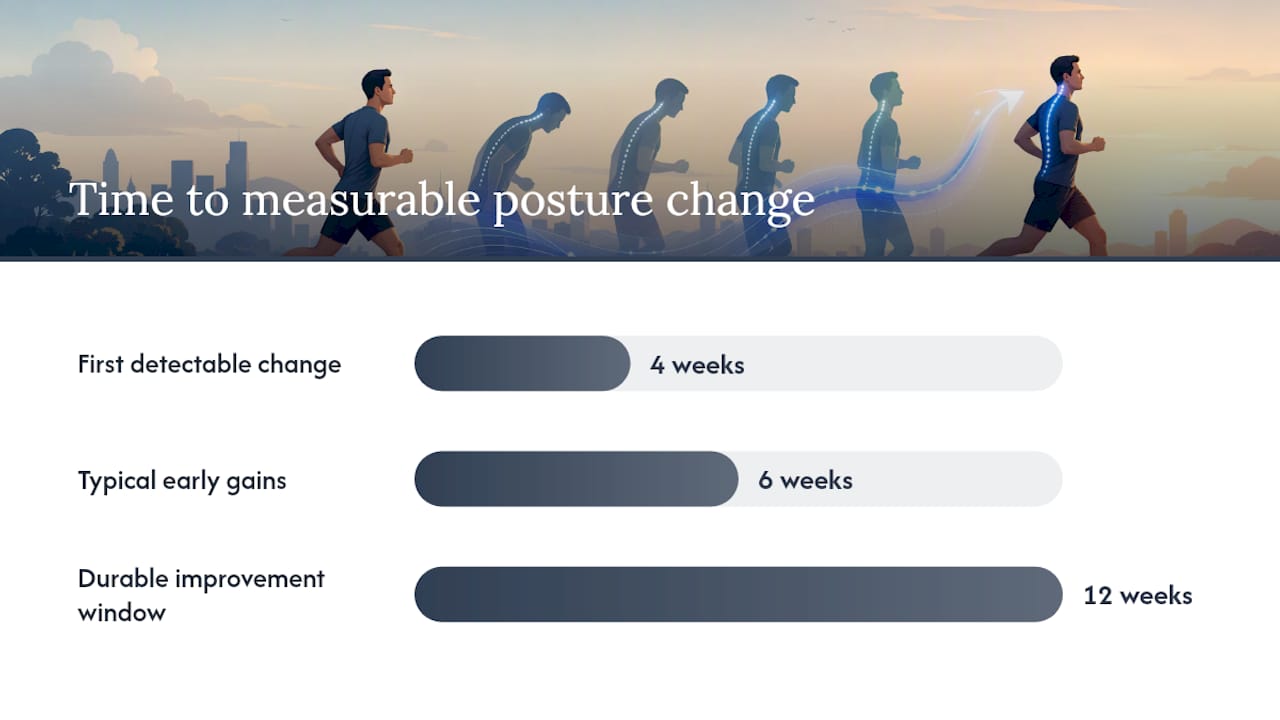
Key numbers to know:
the frequency of cervicogenic headache among people with forward head posture in a cross-sectional study of participants. Low craniovertebral angle and poor sleep quality independently predicted these headaches, which suggests posture work may help, though headaches have multiple causes and correlation isn’t full causation here.
- 4 weeks: the point where randomized trials most often first detect measurable CVA change with consistent daily practice.
- 6 to 12 weeks: the typical window for larger, more durable gains, especially with combined neck, thoracic, and scapular programs.
How Do You Measure Forward Head Posture at Home?
Craniovertebral angle, or CVA, is the angle formed between a horizontal line through the C7 vertebra (the bony bump at the base of your neck) and a line drawn up to the tragus, the small flap of cartilage in front of your ear canal. A smaller angle means your head sits further forward relative to your shoulders. Clinicians use it because it’s simple, visual, and correlates with symptoms in research like the cervicogenic headache study mentioned above.
You can approximate it yourself:
- Stand relaxed in your normal posture, side-on to a wall, wearing fitted clothing so your shoulder and ear are visible.
- Set a phone camera at shoulder height, about 6 feet away, and take a photo.
- Mark or visually locate the C7 bump and the tragus of your ear.
- Compare photos week to week rather than trying to calculate an exact degree. Angle trend matters more than a single precise number.
- Log the photo alongside a simple weekly note: pain on a 0 to 10 scale, headache frequency, and sleep quality.
A basic spreadsheet or even a notes app works fine for this tracking. Full instructions on the photo and measurement protocol are covered in this step-by-step alignment assessment guide. If your photos are inconsistent, lighting varies wildly, or you’re not seeing any trend after eight weeks of honest effort, that’s the point to get a professional measurement instead of guessing.
How Do You Make Posture Changes Stick?
Exercise sessions fix muscle imbalance. Habits fix the other 23 hours of your day. The biggest reason posture correction fails isn’t weak muscles, it’s the awareness gap: without a trigger to notice your position, you’ll slouch back into old patterns within minutes of finishing your routine.
The fix is anchoring. Tie a 2-second posture check to something you already do dozens of times a day:
- Opening your email inbox
- Unlocking your phone
- Standing up from a chair
- Waiting for coffee to brew
- Stopping at a red light (check posture, not your phone)
- Closing your laptop at day’s end
Each anchor triggers a quick scan: chin level, ears over shoulders, chest open. That’s it. Two seconds, dozens of times daily, adds up to far more total correction than one long session ever could.
Pair anchors with real workstation fixes. Your monitor’s top edge should sit at eye level. Your chin should rest neutral, not jutting forward to read small text. Chair height should let your elbows sit at roughly 90 degrees with feet flat. When you’re on your phone, bring the device up to eye level instead of dropping your chin toward your lap. A 7-step ergonomic desk setup covers the specifics in more depth than a quick list can.
Pro Tip: Set a recurring hourly phone alarm labeled “reset” for the first two weeks. It feels excessive at first. It’s what actually builds the habit before your brain does it automatically.
When Should You See a Professional Instead?
Most forward head posture correction is safe to self-manage, but a handful of warning signs mean you should stop and get evaluated rather than push through.
- Numbness, tingling, or progressive weakness in your arms or hands
- Severe dizziness or visual disturbance triggered by neck movement
- New, severe pain that doesn’t match normal exercise soreness
- Pain that persists or worsens after 4 to 8 weeks of consistent, correct practice
Any of those call for a physical therapist or physician, not a longer stretch hold. If you have an existing cervical condition, a prior neck injury, or osteoporosis, modify before you start: reduce range of motion, cut reps, favor gentle isometric holds over end-range stretching, and never attempt aggressive manual traction on yourself. That kind of manipulation belongs in a clinician’s hands, not a home routine.
Why Does Running Trigger or Worsen Forward Head Posture?
Runners develop forward head posture for reasons that have little to do with running itself and everything to do with what happens before and after the run. Long hours at a desk build tight pectoral muscles and weak, lengthened mid-back muscles. That imbalance rides along with you onto the road: your chest muscles pull your shoulders forward, and your head follows to keep your eyes on the horizon.
Breathing pattern plays a bigger role than most runners realize. Shallow, upper-chest breathing, common under fatigue or when pace exceeds fitness, recruits neck and shoulder muscles (the scalenes and upper trapezius) as auxiliary breathing muscles. Overuse those muscles mile after mile, and they shorten and tighten, dragging the head forward with them. Fatigue itself compounds the problem: as postural endurance muscles tire late in a run, the head tends to drift forward and down, especially on hills or in the final stretch of a long effort.
Watch phone or GPS-checking habits too. Repeatedly glancing down at a wrist device or craning to read a route on a phone screen mid-run adds up to hundreds of small forward-head reps per session. None of this is really a “running” problem. It’s a whole-day postural pattern that running happens to expose under load and fatigue.
How Does Neck Position Affect Your Whole Running Form?
The neck doesn’t operate in isolation. It sits at the top of a kinetic chain that runs down through the thoracic spine, pelvis, and legs, and a forward head shifts your center of mass ahead of your base of support. Your body compensates somewhere, and that compensation usually shows up as increased thoracic kyphosis, the rounded upper back posture that pairs almost universally with forward head position.
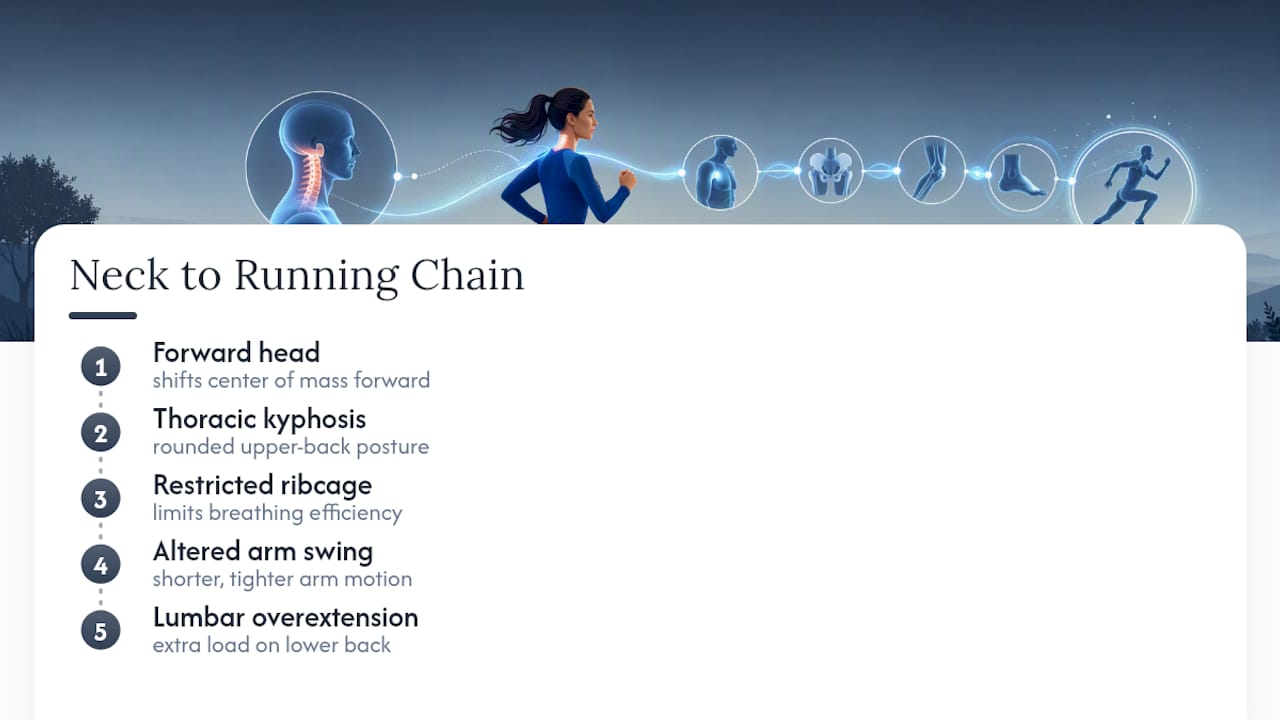
That rounding limits how far your ribcage can expand, which restricts breathing efficiency exactly when you need it most. It also changes arm swing mechanics: rounded shoulders shorten your effective stride through the upper body, forcing your arms into a tighter, less efficient swing pattern. Some runners compensate by overusing lower back extension to keep their eyes forward, adding load to the lumbar spine on every stride.
None of this means running causes permanent postural damage. It means posture and biomechanics are linked closely enough that fixing the neck in isolation, without addressing thoracic mobility and scapular strength, tends to produce shallow, temporary gains. The research on combined neck and thoracic programs backs this: multi-region work consistently outperforms neck-only correction.
Beyond the Neck: Fixing Running Form Holistically
Neck alignment improves fastest when you treat it as one output of a bigger running form, not an isolated target. Cadence is the most underrated lever here: running at a very low cadence often overstrides, landing with the foot far ahead of the hip, which forces the torso and head to lean back to compensate, then forward again on toe off. Nudging cadence up slightly, without changing pace, shortens stride length and reduces that whole-body oscillation.
Core and glute strength matter more than most runners assume. A weak core lets the pelvis tilt and rotate excessively with each stride, and that instability travels straight up the spine to the neck. Building basic hip and core endurance, planks, side planks, glute bridges, gives your torso a stable base to run from, which takes pressure off the neck to “hold everything together” through sheer muscular effort.
Arm swing deserves attention too. Tight, high, cross-body arm swing often accompanies rounded shoulders and forward head posture, since a collapsed chest limits how far the arms can swing naturally. Working on thoracic rotation and scapular retraction, the same exercises from your daily routine, tends to open up arm swing as a side benefit. Cross-training with low-impact activities like breaststroke swimming, which naturally works scapular retraction and upper back strength, can reinforce the same postural patterns you’re building on land.
Do Shoes and Gear Actually Influence Neck Posture?
Footwear’s connection to neck posture is indirect but real. Shoes with excessive heel-to-toe height differential change your landing pattern and can tip your pelvis and torso forward, which your body corrects further up the chain, sometimes at the neck. A neutral, moderate-cushion shoe that matches your natural gait tends to keep the whole kinetic chain more level, reducing the compensations that ripple upward.
GPS watches and running-focused smartphones are an underrated culprit. Constantly tilting your wrist up to check pace mid-stride, dozens of times over a long run, adds up to real cumulative neck flexion. Audio cues or a chest-mounted display reduce that repeated dropping motion. Sunglasses matter more than people expect too: squinting into low sun tends to pull the chin down and forward as a protective reflex, so proper eye protection removes one more small trigger for forward head drift.
Backpacks and hydration vests deserve a mention if you run with gear. An unevenly loaded pack pulls one shoulder down and rotates the torso, and the neck compensates to keep your eyes level. Even loading and a snug, high-riding fit keep that compensation to a minimum.
What Should You Watch for With These Exercises?
Corrective exercises are low-risk for most healthy adults, but a few precautions keep it that way. Never push a stretch or chin tuck into sharp pain. A mild pulling or stretching sensation is expected; a sharp, electric, or radiating feeling is your signal to stop immediately.
- Avoid aggressive neck rotation or extension if you have a history of vertebral artery issues, unexplained dizziness, or recent whiplash without clearance.
- Skip supine chin tucks in favor of seated versions during your first week if you have any balance or dizziness history.
- Don’t increase reps and hold times simultaneously. Progress one variable at a time so you can identify what triggers discomfort if something flares up.
- If you’re pregnant, have osteoporosis, or have had recent cervical spine surgery, get individual clearance before starting any new neck program, since standard progressions may need modification.
- Watch for compensatory overcorrection: locking your chin back rigidly all day creates a different kind of chronic tension. Aim for neutral and relaxed, not stiff.
Why Habit-First Correction Beats Quick Fixes
Most forward head posture content sells a shortcut: a brace, a pillow, a single miracle stretch. None of that addresses why the posture developed in the first place, which is usually thousands of repeated daily positions, not a single weak muscle. This guidance is built around habit change and muscle rebalancing because that’s what the evidence on therapeutic exercise programs actually supports, not because it’s a more interesting story to tell.
The honest caveat worth repeating: certainty in this research area is often rated low to moderate, and individual results vary more than confident marketing copy admits. What we specialize in is education and habit-change strategy, not selling devices or promising a fixed timeline for every reader. Progress tracking, realistic expectations, and consistency matter more than any single exercise you pick.
— Madhukar
Where to Find the Full Routines and Tracking Templates
The eight-minute routine above covers the essentials, but building lasting change usually takes more structure than a single article can hold: progression schedules, printable tracking sheets, and hourly reset templates that fit into a real workday. This site is built specifically around that gap, education-first habit change rather than a device you strap on and forget about.

The site’s full library walks through stepwise exercise progressions with demonstration cues, downloadable posture-check templates, and deeper breakdowns of ergonomic setups for people who sit or run for hours at a stretch. If you want the complete routine library, tracking templates, and habit-building guides beyond what fits here, visit Bestforwardheadposturefix and start with the section that matches your biggest pain point today.
Sources
- Cross-sectional study linking FHP and cervicogenic headache (2025)
- Critically appraised corrective exercises for FHP (2022)
- Systematic review & meta-analysis: effect of various therapeutic exercises on FHP and UCS (2024)
This article is general information, not a substitute for advice from a qualified doctor. Consult a qualified healthcare professional about your own circumstances before acting on anything here.
FAQ
How Long Does It Take to Fix Forward Head Posture?
Measurable changes in craniovertebral angle often appear within 4 weeks of consistent daily practice, with more stable, larger improvements typically showing up between 6 and 12 weeks.
Can Chin Tucks Alone Fix Forward Head Posture?
Chin tucks are a core, low-risk exercise, but research on combined therapeutic exercise programs shows better results when they’re paired with scapular retraction and thoracic mobility work rather than used alone.
Does Forward Head Posture Cause Headaches?
A 2025 study found cervicogenic headache in 53.8% of people with forward head posture, with low craniovertebral angle and poor sleep quality as independent predictors, though headaches often have more than one contributing cause.
How Do I Measure My Own Posture Progress at Home?
Take side-view photos with your phone at shoulder height weekly, tracking the visual angle between your ear and shoulder alongside pain and headache notes; Bestforwardheadposturefix’s alignment assessment guide walks through the full protocol.
When Should I Stop Doing These Exercises and See a Doctor?
Stop immediately and seek evaluation if you experience numbness, tingling, progressive weakness, or severe dizziness with neck movement, or if pain worsens after 4 to 8 weeks of consistent, correct practice.