The ideal setup keeps your arms slightly in front of your torso with elbows softly bent, not clenched against your chest. Support the top arm on a pillow or body pillow so it never dangles or presses into your ribs. This keeps the lower arm from getting trapped under your body weight and stops your shoulder from rotating too far forward. One quick check tonight: make sure your head rests on the pillow, not on your own arm.
TL;DR:
- Keeping arms supported on pillows or positioned forward with elbows bent reduces the risk of nerve compression and shoulder strain during side sleeping.
- Most numbness from sleep is temporary, but persistent tingling beyond 15 minutes or increasing weakness warrants medical consultation.
- Using a body pillow and ensuring the head pillow provides proper loft can significantly decrease arm numbness and improve overall sleep posture comfort.
- The “T-Rex” position, with arms tucked tightly against the chest, can cause nerve strain and should be avoided nightly to prevent morning symptoms.
- Nightly habits directly influence daytime posture, so small sleep adjustments can help reduce forward head and shoulder tension over time.
Table of Contents
- Best Arm Positions for Side Sleeping (And How to Set Them Up)
- Why Poor Arm Positioning Causes Numbness and the “T-Rex” Problem
- Pillow and Mattress Fixes That Actually Support Your Arms
- Does It Matter Which Side You Sleep On?
- How Nightly Arm Habits Connect to Your Daytime Posture
- A Few Honest Notes on Changing How You Sleep
- Explore Deeper Posture Fixes
- Sources
- FAQ
Best Arm Positions for Side Sleeping (And How to Set Them Up)
Most people default to whatever arm position feels natural in the moment, which is exactly how they end up waking with a dead arm at 3 a.m. Three positions consistently work better than the rest, and each solves a slightly different problem.
Arms forward, elbows bent. Both arms rest in front of your torso, roughly at chest height, elbows bent at a gentle angle rather than jammed tight. This is the position Sleep Foundation points to when discussing symmetrical side lying that keeps the spine’s natural curve intact. It works because neither arm bears your body weight directly.
The pillow hug. Wrapping both arms around a body pillow, or a firm regular pillow, gives your top arm somewhere to rest that isn’t your ribcage or your mattress. It also stops your shoulder from collapsing forward, which is the same forward roll that contributes to slouched daytime posture.
Arms at your sides, slightly bent. For people who move around a lot overnight, letting the arms rest lower, close to the body but not pinned under it, offers more freedom to shift positions without waking up compressed.
Here’s the setup routine that actually sticks, once you’ve picked a position:
- Lie on your side and set your lower elbow slightly forward before you settle your full weight down.
- Rest your head completely on a pillow with enough loft to keep your neck level, not tilted up or down.
- Let your upper arm land on the mattress in front of you or on a support pillow, never draped over your own body.
- Relax your shoulders down, away from your ears, and check that your chin is pointing straight ahead, not tucked or jutting.
- Adjust a knee pillow between your legs if your hips feel twisted.
A few posture cues make the difference between this working and not:
- Keep your chin neutral. Don’t let your head crane forward toward the mattress edge.
- Drop your top shoulder instead of hiking it toward your ear.
- Avoid gripping a pillow tightly with both arms. A loose hug beats a bear hug every time.
- Recheck your position if you wake up mid-sleep. Small resets matter more than getting it perfect once.
Why Poor Arm Positioning Causes Numbness and the “T-Rex” Problem
That tingling, dead-arm feeling has a name: nerve compression, usually involving the ulnar nerve that runs along the inside of your elbow and down into your ring and pinky fingers. When your elbow stays bent past a certain point for hours, especially with your body weight pressing down on it, blood flow and nerve signaling both slow down. Clinicians warn specifically against prolonged 90 degree elbow flexion during sleep, which describes almost exactly what happens when you curl your arm under your pillow or your own head.
The riskiest habit has a nickname: the “T-Rex” position, where both arms stay tucked tight against the chest with elbows bent close to the body, mimicking the classic dinosaur pose. This position, if repeated nightly, can strain nerves and cause tingling or numbness. It looks cozy. It is not. Doctors point out that this posture strains nerves and triggers tingling or numbness when repeated night after night, because both arms are compressed simultaneously with nowhere to release pressure.
Peer-reviewed literature on sleep posture and musculoskeletal outcomes backs up what emergency rooms see constantly: prolonged pressure during sleep contributes to nerve and shoulder symptoms that show up as morning stiffness, tingling, or a genuinely numb limb.
When it’s more than a bad night: most numbness clears up within a minute or two of moving your arm. Watch for these signs instead:
- Numbness or tingling that lingers more than 15 to 20 minutes after waking.
- Weakness in your grip or difficulty lifting the arm.
- Symptoms that get worse over weeks rather than staying occasional.
- Pain that radiates down the arm rather than staying localized to the shoulder.
Any of those warrants a conversation with a doctor rather than another pillow adjustment.
Pillow and Mattress Fixes That Actually Support Your Arms
The gear you sleep on matters as much as the position you choose. Body pillows are genuinely effective at keeping the upper arm neutral and preventing shoulder roll, and that single fix resolves more nightly numbness complaints than almost any positional cue alone.
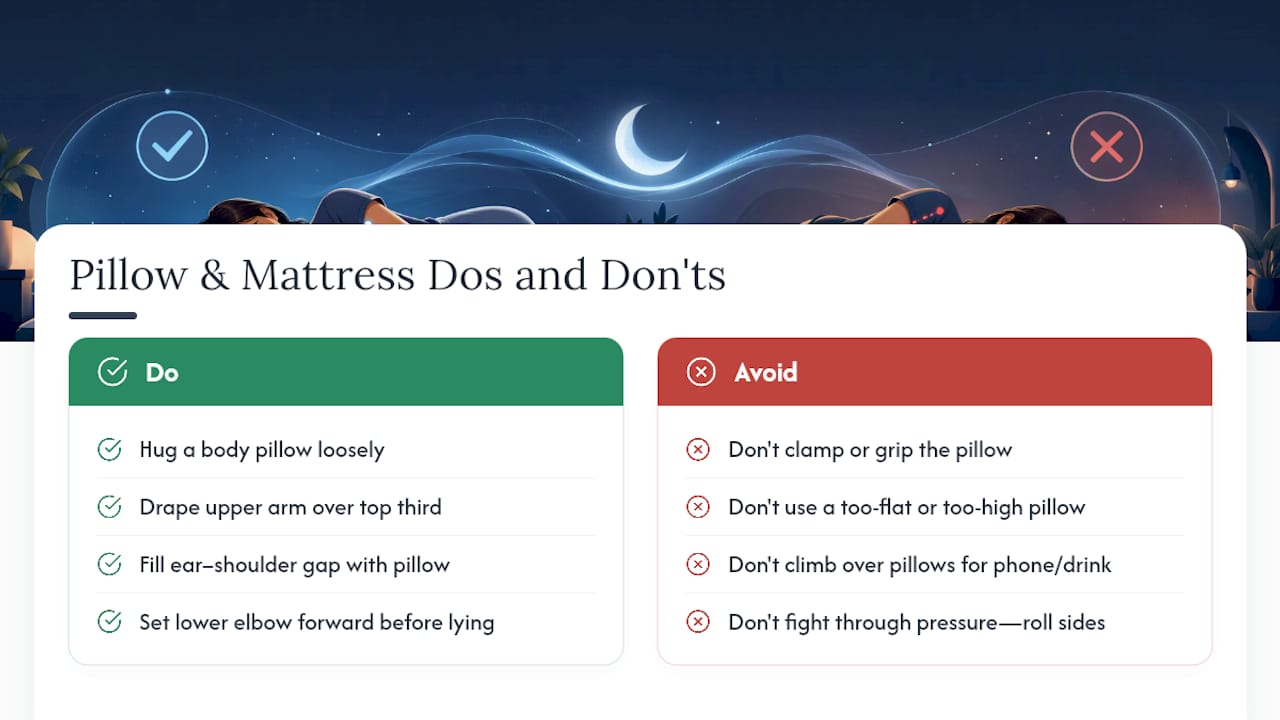
Using a body pillow correctly. Hug it loosely rather than clamping down. Your top arm should drape over the top third of the pillow, with your hand resting naturally rather than gripping. The goal is to give your arm a stable surface at roughly shoulder height so it never has to hang unsupported or fall across your ribs. Meanwhile, your lower arm needs clearance, so position the pillow far enough forward that it doesn’t crowd the space where your bottom arm naturally rests.
Getting head pillow loft right. Your head pillow should fill the gap between your ear and your shoulder completely. Too flat, and your neck bends downward toward the mattress. Too high, and it tilts upward. Either way, you’ll unconsciously reach for your arm as a prop, which is exactly the habit that causes trouble. Correct pillow support helps maintain spinal alignment and takes pressure off both the neck and the shoulder underneath you.
Small habits that add up. Consciously set your lower elbow forward before you fully commit to lying down. If pressure starts building on one side mid-sleep, roll to the other side rather than fighting through discomfort. Skip the habit of climbing over your pillows to reach a phone or glass of water. That twisting motion undoes careful positioning in seconds.
A body pillow between your knees also helps, keeping your hips level and taking indirect strain off the shoulder you’re sleeping on. If your mattress is too soft, your shoulder sinks too far in, which forces your arm into an awkward angle to compensate. A mattress with the right support helps maintain the position you just built rather than fighting it all night.
Pro Tip: Try a one week test before buying anything new: lower elbow forward, head fully on the pillow, upper arm loosely draped over a spare pillow, small pillow between your knees. Track how your arms feel each morning. Most people notice a difference within three or four nights.
For a deeper look at pillow height specifically, this guide on how pillow support fixes your neck posture breaks down loft and firmness in more detail.
Does It Matter Which Side You Sleep On?
For most people, no. Either side works fine, and more than 60% of adults already sleep on their side without any particular preference driving better or worse outcomes. Left side sleeping does carry one documented edge: it can reduce symptoms of GERD and acid reflux, since gravity keeps stomach acid from creeping back up the esophagus as easily. During pregnancy, left side sleeping is the more commonly recommended option, since it reduces pressure on major blood vessels and supports circulation.
Arm placement shifts slightly depending on which side you’re on:
- Left side: Let your right arm rest forward on a pillow or body pillow, left arm tucked more loosely beneath or slightly forward, never trapped under your ribs.
- Right side: Mirror the setup, top arm supported forward, bottom arm free enough to shift without waking you.
- Unilateral shoulder pain: If one shoulder consistently aches, switch to the opposite side for a few nights and add extra cushioning under the sore shoulder to take pressure off while it settles.
Side sleeping helps with sleep apnea and back pain in general, but the pillow and mattress choices around it determine whether you trade one pressure point for another. Nobody stays perfectly still all night anyway. Bodies shift, and trying to lock into one rigid pose usually backfires by disrupting sleep quality more than it helps.
How Nightly Arm Habits Connect to Your Daytime Posture
The way you hold your arms for eight hours a night doesn’t stay confined to bedtime. Chronic T-Rex tucking or shoulders rolled forward night after night reinforces the same forward shoulder and forward head pattern that shows up during the day at a desk or hunched over a phone. Your body learns positions through repetition, and sleep is repetition you don’t consciously control.
Keeping your head neutral on a properly sized pillow, rather than propped on your own arm or crushed into a flat one, reduces the cumulative strain that contributes to forward head posture over months and years. A few practical steps make this connection concrete:
- Do a nightly check: hand on your pillow, shoulders down, head level, not tilted toward your chest.
- Experiment with pillow height in small increments rather than buying three new pillows at once.
- Pair nighttime adjustments with daytime posture awareness. The two reinforce each other.
If neck stiffness or headaches are already part of your morning routine, this guide on fixing neck pain from side sleeping walks through targeted fixes, and this resource on adjusting your sleep position to correct forward head posture connects the dots between nightly habits and daytime alignment more thoroughly than a single article can.
A Few Honest Notes on Changing How You Sleep
Most people who write to us about arm numbness made the same mistake: they tried to force one “correct” position and gave up after two rough nights. What actually works is smaller and slower. Set your elbow forward, add one pillow, give it a week. The readers who stick with incremental changes, one pillow adjustment at a time, report steadier results than anyone chasing a perfect pose on night one. Sleep posture is a habit you build, not a switch you flip.
— Madhukar
Explore Deeper Posture Fixes
This resource is for readers who want more than a quick tip. It breaks down how nightly habits, from arm placement to pillow loft, connect to the forward head posture that causes daytime neck stiffness and headaches, without pushing a quick-fix gadget as the answer.

Unlike advice scattered across generic sleep blogs, the site walks through science-backed correction methods step by step, so you’re building a habit rather than chasing a temporary fix. If tonight’s pillow adjustment helped, the next logical move is understanding how that same alignment carries into your waking hours. Visit the full guide to posture correction and start working through the program at your own pace.
Sources
- Is your sleep position helping or hurting you? – Harvard Health
- Side sleeping: Which side should you sleep on? – Sleep Foundation
- Why some people are better off sleeping on their sides – National Geographic
- Doctors warn this healthy sleep position can cause arm tingling—how to prevent it – Tom’s Guide
FAQ
What is the healthiest side sleeping position?
Arms slightly forward with elbows softly bent, head fully supported on a properly sized pillow, and a knee pillow to keep hips level is the position most consistently linked to good spinal alignment and fewer pressure points.
How do I sleep on my side without lying on my arm?
Set your lower elbow forward before settling your full weight down, and support your top arm on a body pillow so it never has to rest across your ribs or under your head.
What is the unhealthiest position to sleep in?
The “T-Rex” position, both arms tucked tightly against the chest with elbows bent close to the body, puts sustained pressure on the nerves in both arms and is one of the more common causes of morning tingling and numbness.
What is the rarest sleep position?
Sleeping fully on your back with arms raised above your head, sometimes called the “starfish” position, is one of the least common sleep postures, though reliable figures on exactly how rare it is are hard to pin down.