Yes, targeted exercises fix most cases of scapular winging, especially the medial type caused by serratus anterior weakness. The long thoracic nerve governs that muscle, and when it’s underperforming, motor control training beats heavy lifting every time.
Start with these, in order of priority:
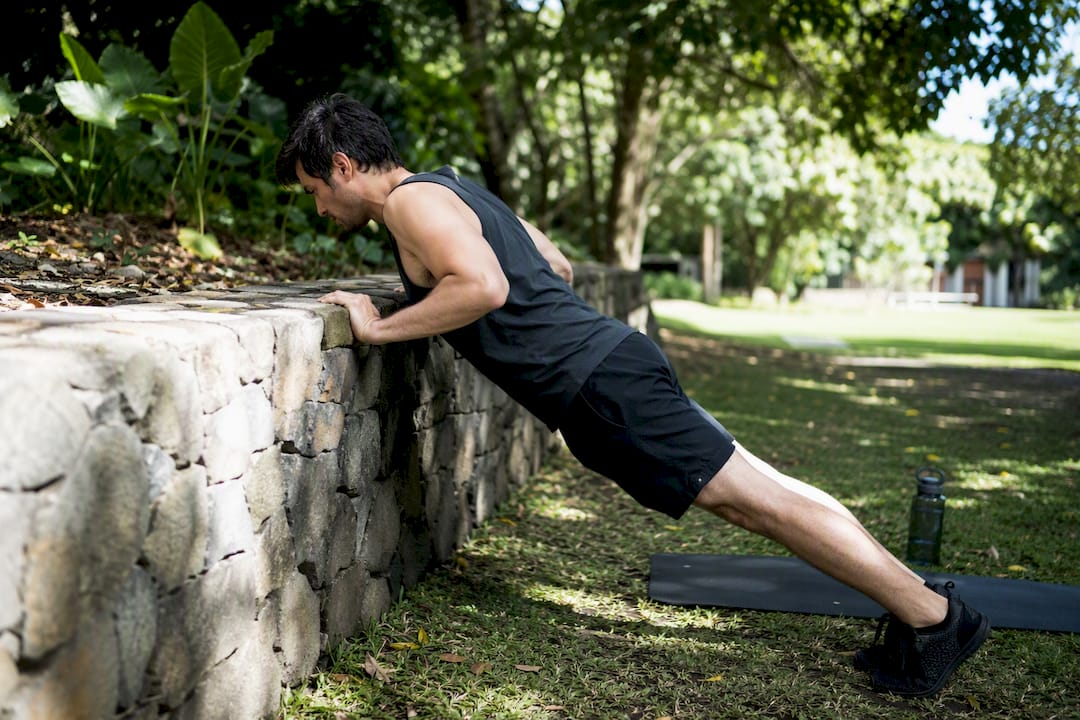
- Push-up plus, progressed from wall to table to floor
- Serratus punches to isolate protraction
- Scapular wall slides for coordinated upper-body motion
- Y/T/W (Blackburn) raises to wake up the lower trapezius
- Band rows and low rows once activation improves
Begin gently. Build control before you add resistance, and progress over several weeks. If winging appeared suddenly, or you notice numbness, tingling, or fast-progressing weakness, see a physical therapist before you do anything else.
Key Takeaways
Scapular winging improves in most cases through a motor-control-first exercise progression that matches the specific muscle deficit, whether serratus anterior or trapezius, to targeted activation and strengthening work.
| Point | Details |
|---|---|
| Identify the pattern first | Medial winging points to serratus weakness; lateral points to trapezius or rhomboid issues. |
| Master control before load | Isolate scapular movement with mirror or tactile cues before adding resistance bands. |
| Follow a phased timeline | Progress from daily activation to banded strengthening to functional tasks over 8 to 12 weeks. |
| Watch for red flags | Sudden onset, numbness, or worsening weakness means see a physical therapist promptly. |
| Be patient with nerve recovery | Neuropraxia often resolves in 6 to 9 months, though some cases take up to 2 years. |
Table of Contents
- What Causes Scapular Winging, and How Is It Diagnosed?
- Why Motor Control Matters More Than Heavy Lifting Early On
- Scapular Winging Exercises Organized by Rehab Goal
- An 8 to 12 Week Home Program for Scapular Winging
- Common Mistakes and When to See a Physical Therapist
- Adjusting Exercises for Mild, Moderate, and Severe Winging
- Manual Therapy and Other Treatments That Support Exercise
- What This Guide Gets Right That Most Advice Misses
- Sources
What Causes Scapular Winging, and How Is It Diagnosed?
Scapular winging splits into two distinct patterns, and mixing them up leads to the wrong exercises. Medial winging, the more common form, happens when the serratus anterior weakens after long thoracic nerve injury. The shoulder blade’s inner border pokes out, particularly during a wall push. Lateral winging comes from trapezius weakness (spinal accessory nerve) or rhomboid dysfunction (dorsal scapular nerve), and the shoulder blade drifts outward and rotates differently.
Common causes include:
- Trauma from a fall, direct blow, or stretch injury during sports
- Surgical complications, especially after mastectomy, axillary dissection, or thoracic procedures
- Repetitive overhead strain in swimmers, throwers, and weightlifters
- Idiopathic neuropraxia, where the nerve simply misfires with no clear cause
Clinicians confirm the pattern with three checks: the wall push-up test (push against a wall and watch which border lifts), the scapular assistance test (manually support the scapula and see if function improves), and the scapular retraction test, both documented by Cleveland Clinic as standard screening tools. Try the wall push-up test yourself for a rough read, but get a clinician to confirm before you build a program around it.
Why Motor Control Matters More Than Heavy Lifting Early On
Three muscle groups do the real work here. The serratus anterior stabilizes the scapula against the rib cage and drives protraction. The lower trapezius pulls the shoulder blade down and back. The rotator cuff keeps the humerus centered so the scapula isn’t compensating for a wobbly joint above it.
The mistake most people make is loading these muscles before they can control them. Motor control strategies, like watching yourself in a mirror or feeling for the inferior angle of the scapula with your fingers, help isolate scapular movement and stop the thoracic spine from doing the work instead. That compensation pattern, extending through the trunk rather than moving the shoulder blade, is exactly what keeps winging from resolving.
Progression should be pain-guided: low load, high repetition for activation first, then gradually add resistance once the movement looks clean without cheating.
Pro Tip: Do your activation drills in front of a mirror for the first two weeks. If you can’t see your shoulder blade move in isolation, you’re probably recruiting your spine or shoulder to fake the motion.
Scapular Winging Exercises Organized by Rehab Goal
Activation exercises
- Scapular clocks: Sit tall, trace small clock positions with your shoulder blade (up to 12, down to 6, in to 3, out to 9) without moving your arm. Do 2 sets of 10 per direction.
- Scapular protraction at 90 degrees: Lean against a wall or table with your arm at shoulder height, push your shoulder blade forward and back. 2 sets of 15.
- Isometric wall push-up plus: Hold the “plus” (protracted) position for 5 to 10 seconds against the wall. 3 sets of 8.
Common mistake: shrugging the shoulder toward the ear during any of these. Cue yourself to keep the shoulder down and the movement isolated to the blade.
Strengthening exercises
- Banded serratus punch: Loop a band around a post, punch forward and slightly upward, holding the protracted position for a beat. 3 sets of 12.
- Low rows or band rows: Pull a band toward your hip, driving the shoulder blade down and back. 3 sets of 12.
- Prone Y/T/W (Blackburn): Lying face down, raise your arms into Y, T, and W shapes, squeezing the shoulder blades together at the top. Both the PMC exercise catalog and clinical rehab guides list this as a core lower-trap builder. 2 sets of 10 per letter.
- Resisted external rotation: Elbow at your side, rotate your forearm outward against a band. 3 sets of 12.
Common mistake with the Blackburn series: arching the lower back to gain range. Keep your forehead on a rolled towel and stop the rep before your back takes over.
Functional progressions
Move from incline push-up plus (hands on a counter or bench) to knee push-up plus, then floor push-up plus. Add a resistance band across your back once floor reps feel controlled and pain-free. Each step should feel almost too easy before you advance. This site’s scapular wall slide guide walks through the wall-based version step by step if you want visual cues for the early phase.
An 8 to 12 Week Home Program for Scapular Winging
A structured phase-based approach works better than random exercise selection because it matches load to your nervous system’s actual recovery timeline. The AOA’s Protocol R3 is one of the clearest staged programs available and translates well into a home routine.
- Phase I, weeks 0 to 4: Daily activation and pain control. Scapular clocks, wall push-up plus, gentle mobility work. 1 to 2 sets of 10 to 20 reps, every day. The goal here is clean movement, not fatigue.
- Phase II, weeks 4 to 8: Add resistance bands. Low rows, Blackburn Y/T/W series. 2 to 3 sets of 8 to 15 reps, 3 to 4 times per week. This is where strength actually starts building on top of the control you established in Phase I.
- Phase III, weeks 8 to 12 and beyond: Integrate the full push-up plus progression and functional tasks tied to your sport or job. Gradually return to overhead work, carrying, or throwing.
Hold or regress a phase if you notice increased winging, new numbness, or weakness that’s getting worse rather than better. Nerve-related cases often need patience. Neuropraxic injuries commonly improve over several months, though some nerve injuries take 1 to 2 years to fully resolve. A phased plan gives you checkpoints instead of guesswork.
Common Mistakes and When to See a Physical Therapist
Loading before you have control is the single biggest error in home scapular rehab. Pushing heavy resistance before the movement pattern is clean just reinforces the compensation you’re trying to eliminate, usually by recruiting the trunk or upper trap instead of the target muscle.
Watch for these red flags:
- Sudden, traumatic onset of winging (fall, direct blow, dislocation)
- Numbness, tingling, or other sensory changes in the arm or shoulder blade area
- Weakness that’s progressing rather than staying stable or improving
- No noticeable improvement after 3 to 6 months of consistent home exercise
Set your expectations honestly. Milder neuropraxia often resolves in 6 to 9 months. Some nerve injuries take longer, up to a year or two, and a small number don’t recover enough on their own, at which point surgical options like nerve or muscle transfer, or scapulothoracic fusion, become the conversation with a specialist. That’s not a failure of your exercise plan. It’s just how peripheral nerves work.
How Bestforwardheadposturefix Supports Your Rehab
Bestforwardheadposturefix builds its programs around habit change and muscle rebalancing rather than one-off fixes, which fits scapular winging rehab well since the underlying pattern usually took months or years to develop.
For step-by-step demonstrations to pair with the exercises above, use these resources:
- Scapular retraction exercises for medial winging support
- Scapular wall slide progressions for early-phase activation
- Lower trap activation drills for lateral-pattern weakness
- Cervical retraction exercises when forward head posture is feeding the shoulder problem
These protocols suit mild-to-moderate winging or work well as a home complement alongside physical therapy visits. If you have sensory changes, sudden onset, or no progress after several months, in-person care should come first.
Written for Bestforwardheadposturefix by Madhukar, drawing on the clinical protocols and rehab literature referenced throughout this guide.
Adjusting Exercises for Mild, Moderate, and Severe Winging
Not every case of scapular winging needs the same starting point, and pushing a severe case straight into strengthening work usually backfires.
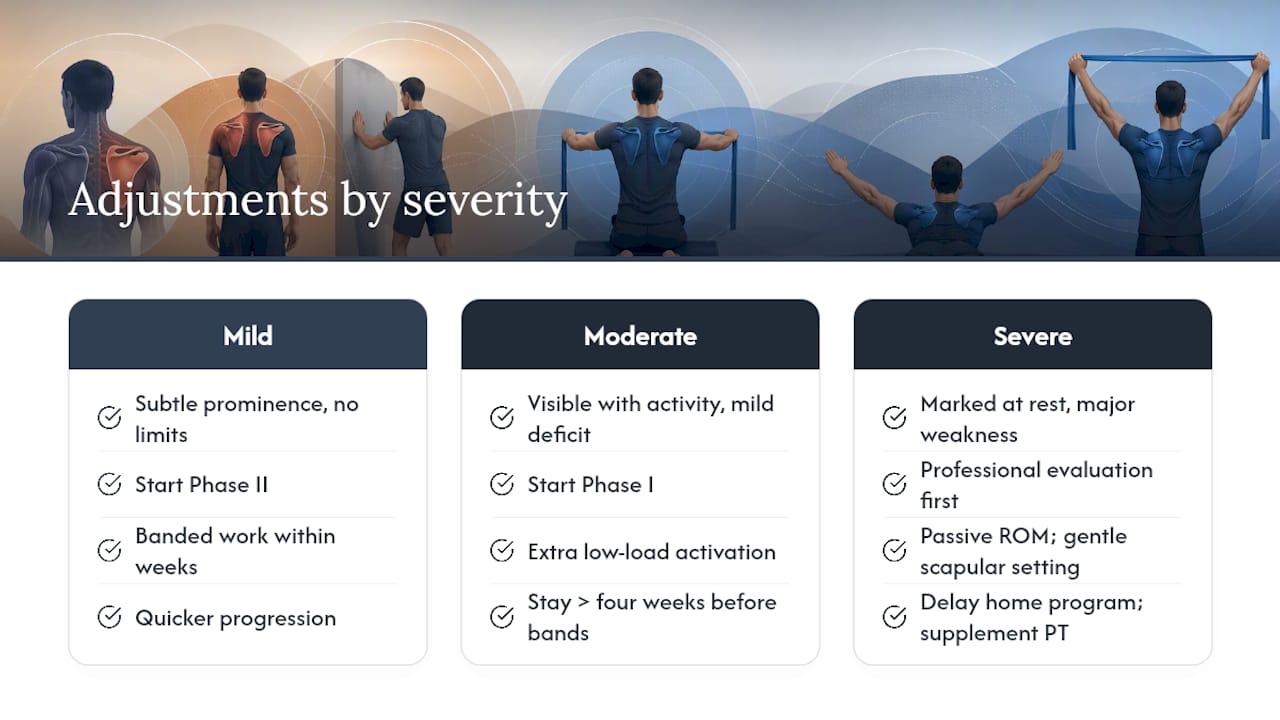
Mild winging (subtle prominence, mostly cosmetic, no functional limitation) can often start at Phase II intensity right away. If you can already perform a clean wall push-up plus without obvious compensation, spend less time on pure isometrics and move toward banded work within the first couple of weeks.
Moderate winging (visible prominence during activity, some strength deficit, maybe mild discomfort with overhead reaching) should stay in Phase I longer than the standard four weeks. Give the nervous system more repetitions at low load before introducing bands. Two to three weeks of extra activation work rarely hurts and often prevents backsliding.
Severe winging (marked prominence at rest, significant weakness, or winging present even during simple daily tasks) needs professional evaluation before any home program starts. This is where a physical therapist should map out your specific nerve or muscle deficit first. Home exercises still help here, but they work best as a supplement to hands-on treatment rather than a replacement for it, and the starting exercises may need to be even gentler than Phase I, sometimes just passive range of motion and gentle scapular setting.
The common thread across all three levels: regress a level if symptoms flare, and never chase soreness. Winging that worsens after a session means the load or complexity outpaced your control.
Manual Therapy and Other Treatments That Support Exercise
Exercise carries most of the rehab load, but a few adjunct therapies can speed things along or make the exercises themselves more effective.
Manual therapy from a physical therapist, including soft tissue work on the upper trapezius and pec minor, can loosen tight structures that are pulling the scapula out of position and masking your true range of motion. This often makes activation exercises feel more accessible right after a session.
Electrical stimulation, particularly neuromuscular electrical stimulation applied to the serratus anterior, is sometimes used in clinical settings to help patients “find” the muscle when voluntary activation is weak or inconsistent. It’s not a substitute for active exercise, but it can jump-start awareness of a muscle that feels disconnected.
Taping techniques, whether rigid athletic tape or kinesiology tape, give some patients sensory feedback that reinforces proper scapular position throughout the day, outside of dedicated exercise time. Results vary person to person, and taping works best as a reminder cue rather than a fix on its own.
Activity modification and short-term pain relief measures can also support participation in rehab, especially in the first few weeks when movement feels unfamiliar or mildly uncomfortable. None of these therapies replace the exercises themselves. They just remove friction so you can do the exercises consistently, which is what actually drives recovery.
What This Guide Gets Right That Most Advice Misses
Most articles on scapular winging jump straight to a list of exercises without explaining why sequence matters more than exercise selection. That’s backward. The research is fairly consistent: motor control has to come before load, and skipping that step is why so many people do push-up plus variations for months without real improvement.
The conventional advice also underrates patience. People want a six-week fix, but nerve recovery runs on its own clock, sometimes stretching well past a year, and no amount of extra band work speeds that up.
If you take one thing from this guide, prioritize getting the diagnosis right first: medial versus lateral, and a genuine sense of severity. Everything downstream, which exercises, how fast you progress, whether you need a PT, depends on that distinction. Skip it, and you’re just guessing with a resistance band.
— Madhukar
Sources
- Winging of the Scapula – StatPearls – NCBI Bookshelf
- Winged Scapula: Causes, Symptoms, Tests & Treatment – Cleveland Clinic
- Protocol R3 Non-Operative Strengthening Program for Scapular Winging or Dyskinesis – AOA
- PMC article listing scapular stabilization exercises