Yes. Used correctly, a footrest improves posture, takes load off your lower back, and helps circulation during long stretches of sitting. A 2021 lab study found that an angled footrest increased backrest use by roughly 10 percent among participants who used the backrest at all, and OSHA’s workstation guidance lists foot support as part of a neutral seated posture. Before you buy anything, check one thing: sit in your normal chair, feet flat on the floor. If your knees sit noticeably higher or lower than your hips, or your feet dangle, that gap is what a footrest closes.
Pro Tip: Sit sideways to a mirror or take a phone photo of your seated profile. If your thighs slope down toward your knees instead of sitting roughly level, your chair is too high for your leg length, and that’s the exact problem a footrest solves.
Key Takeaways
A footrest improves posture and circulation primarily by stabilizing the pelvis, which increases backrest contact and reduces compensatory spinal load during prolonged sitting.
| Point | Details |
|---|---|
| Angle over flat | A 5 to 15 degree tilt increases backrest use more than a flat platform for computer tasks. |
| Fix the chair first | Set elbow and knee angles before adding a footrest, don’t use one to patch a badly sized desk. |
| Move your feet | Shift foot position every 20 to 30 minutes to keep circulation benefits active. |
| Match the type to the task | Adjustable and rocking models suit shared desks and long sitting stretches better than fixed flat ones. |
| Pair it with posture habits | Bestforwardheadposturefix’s guides address the neck and upper-back habits a footrest alone can’t fix. |
Table of Contents
- Footrest Benefits for Posture, Circulation, and Comfort
- How a Footrest Actually Changes Your Posture
- Which Type of Footrest Fits Your Setup
- Setting Up Your Footrest the Right Way
- Do You Actually Need a Footrest?
- What Can Go Wrong With Footrest Use
- What I Noticed Switching to an Angled Footrest
- Where a Footrest Fits Into a Bigger Posture Fix
- Frequently Asked Questions
- Sources
Footrest Benefits for Posture, Circulation, and Comfort
The core footrest benefits fall into six categories, and each one traces back to a specific mechanical fix rather than a vague “it helps you sit better” claim.
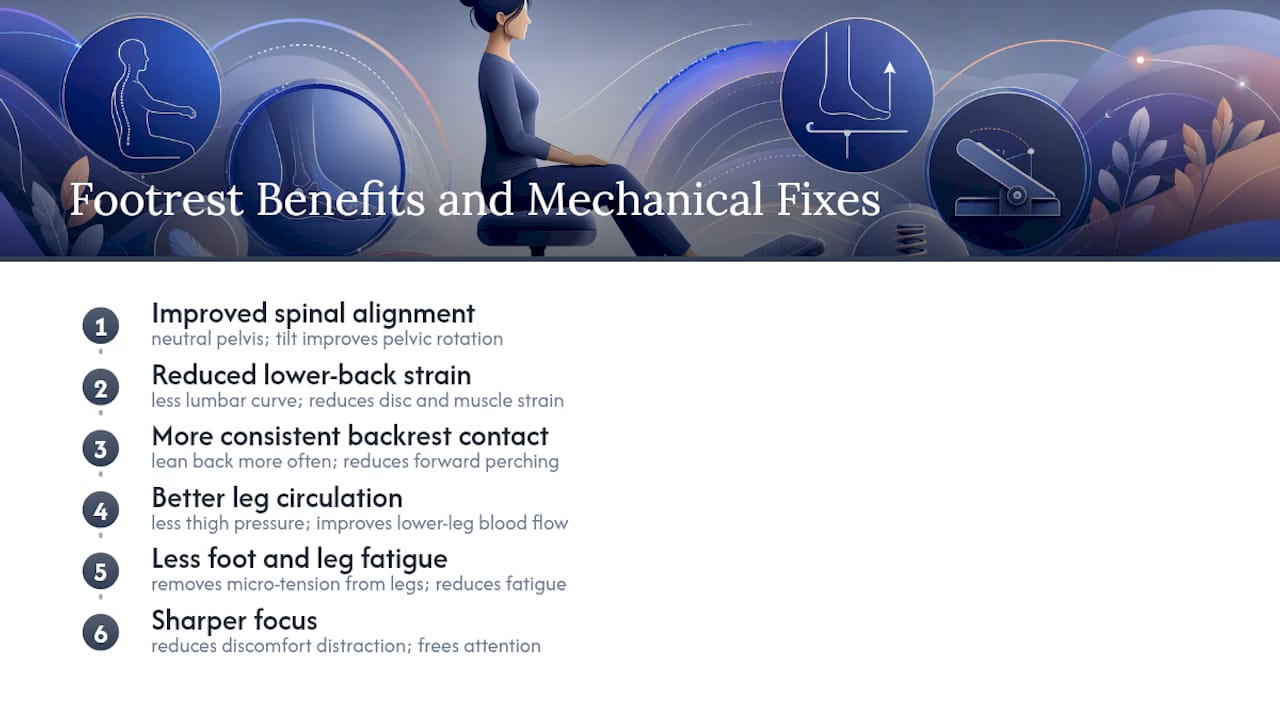
Improved spinal alignment and a neutral pelvis. When your feet hang unsupported, your pelvis tends to tilt backward and your lower spine rounds to compensate. A footrest restores a stable base under your legs, which lets your pelvis sit in a more neutral position instead of sliding forward or tipping back.
Reduced lower-back strain. Less pelvic rocking means less compensatory curve in your lumbar spine, and that translates directly into less cumulative strain on the discs and muscles doing the work of holding you upright for eight hours.
More consistent backrest contact. This is the finding that surprised researchers: when people used an angled footrest during computer tasks, they leaned back into their chair’s backrest more often instead of perching forward. Humanscale’s summary of footrest benefits lists this kind of “active sitting” as one of the main advantages of proper foot support.
Better leg circulation, less swelling. Feet flat and supported, rather than pressing into the front edge of a chair or dangling, reduces pressure on the underside of your thighs. That pressure point is exactly where blood flow to your lower legs gets restricted during long sitting stretches.
Less foot and leg fatigue. A stable platform removes the constant micro-tension of stabilizing your legs mid-air, which is more tiring than most people realize until they stop doing it.
Sharper focus. This one is indirect but real: physical discomfort is a constant low-grade distraction, and removing it frees up attention you didn’t know you were spending on shifting in your seat.
A footrest with a slight tilt did more than a flat one in the same lab study: it specifically changed pelvic rotation and spine flexion measurements, not just subjective comfort ratings, which is why angle matters as much as presence.
How a Footrest Actually Changes Your Posture
The mechanism is simpler than it sounds. Your pelvis is the foundation your entire spine sits on. When your feet are unsupported, your pelvis has nothing stable to push against, so it rotates backward, your lumbar spine flattens or rounds, and your upper back and neck compensate by drifting forward. That’s the same forward drift pattern behind tech neck and poor typing posture.
Add a stable, slightly angled surface under your feet and the chain reverses. Your pelvis has something to brace against, it rotates into a more neutral position, your lumbar curve holds its natural shape, and less compressive load lands on the spinal discs.
The lab study behind this used electromyographic sensors, not just surveys, and found that an angled footrest increased backrest contact by about 10 percent among users who leaned back at all, while measurably altering pelvic rotation and spine flexion during computer tasks.
There’s a cognitive piece too. Research on mentally demanding computer tasks found people tend to lean forward and abandon their backrest entirely when concentrating hard, which undoes any ergonomic setup you started with. A footrest acts as a physical anchor point that makes leaning back the path of least resistance, even when your brain is fully absorbed in a task. Mayo Clinic’s office ergonomics guide frames foot support the same way: a piece of a larger neutral-posture system, not a standalone fix.
Picture it as a tripod. Your feet, seat, and backrest are the three legs. Remove one, and the other two have to work harder to keep you stable.
Which Type of Footrest Fits Your Setup
Not every footrest does the same job, and picking the wrong shape can leave you no better off than sitting without one.
- Flat platform: the simplest option, good for anyone who just needs a stable surface to close a height gap and doesn’t need dynamic movement.
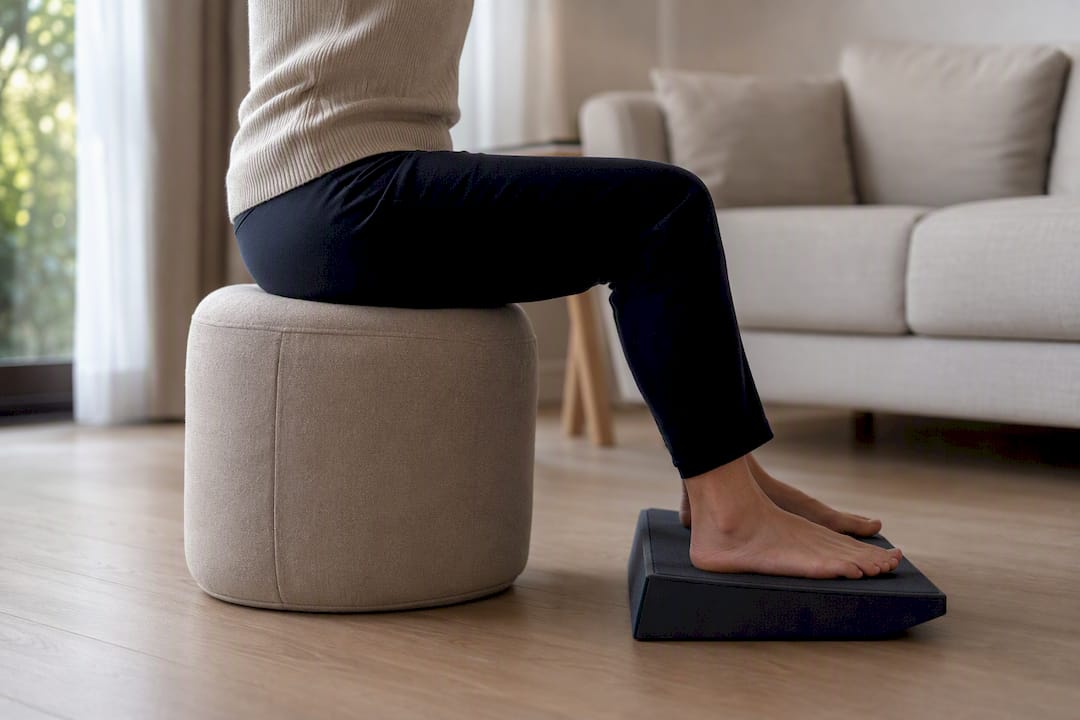
- Angled/tilted: the type behind the backrest-use findings above; a slight upward tilt of 5 to 15 degrees encourages the pelvic shift that reduces spinal load, making it the better default for computer-heavy desk work.
- Rocking or rocker footrests: let you shift your feet in small motions throughout the day, which helps stimulate circulation more than a static surface.
- Adjustable-height models: worth the extra cost if you share a desk, switch between shoes and socks, or have anthropometric proportions that don’t match standard chair sizing.
- Cushioned or heated versions: softer surfaces reduce pressure points for barefoot or sock use, and heating can ease tension in cold offices, an option supported by design research on anthropometric footrest sizing.
Look for a non-slip base, a surface wide enough for both feet at once, and adjustability if more than one person uses the desk.
Pro Tip: If you switch between sneakers and dress shoes during the week, an adjustable-height model saves you from recalibrating your whole seated posture every time your heel height changes.
Setting Up Your Footrest the Right Way
Get your chair and desk right first. A footrest compensates for leftover gaps, it doesn’t replace correct chair height.
- Adjust your chair so your elbows sit at roughly 90 degrees at your keyboard, ignoring your feet for now.
- Check your knee angle. You want somewhere between 90 and 110 degrees, with your thighs supported but not pressed hard into the seat edge.
- If your feet don’t reach the floor comfortably at that chair height, place a footrest under them and adjust it until your knees hit that same 90 to 110 degree range.
- Set the tilt. A slight upward angle of 5 to 15 degrees works best for typing and computer tasks; a flat surface suits standing-to-sit transitions or tasks where you shift positions often.
- Recheck your lower back against the chair’s backrest. If a proper footrest setup is working, you should notice yourself leaning back more, not less.
Don’t lock your feet into one position and forget about them. Shift your foot placement every 20 to 30 minutes: flatten both feet, then try a staggered stance, then lift your heels briefly. Static pressure anywhere for hours is the enemy, footrest or not.
- Chair height set for elbow angle first, footrest added second.
- Knees at 90 to 110 degrees, thighs lightly supported.
- Footrest tilted 5 to 15 degrees for typing tasks.
- Foot position changed at least every half hour.
Pro Tip: Pair foot position changes with whatever microbreak reminder you already use for eye strain or stretching. Piggybacking the habit onto an existing routine makes it stick far faster than a separate reminder.
Do You Actually Need a Footrest?
Footrests solve a specific mismatch, not a universal sitting problem. You’re a strong candidate if you’re shorter than average and your feet don’t reach the floor at a properly adjusted chair height, if you’ve raised your chair for desk or keyboard clearance and lost floor contact as a result, if you work from a couch, dining chair, or other nonstandard remote setup, or if you notice leg swelling, numbness, or thigh pressure by midafternoon.
You likely don’t need one if your feet already rest flat on the floor once your chair and desk are correctly adjusted. Adding a footrest on top of an already-neutral posture doesn’t add benefit and can occasionally push your knees too high if you overcorrect.
Warning: a footrest cannot fix a chair that’s fundamentally wrong for your desk height, a monitor at the wrong eye level, or a keyboard placed too far away. Using one to patch around those issues just adds a new variable on top of the real problem. Fix your overall desk ergonomics first.
What Can Go Wrong With Footrest Use
A footrest that’s too high pushes your knees above your hips, which increases pressure under your thighs instead of relieving it. That’s the most common mistake, and it’s easy to make if you grab a stack of books or a box as a makeshift solution instead of an adjustable unit.
Static, fixed foot placement all day defeats much of the circulation benefit, even on a well-chosen footrest. Movement is part of what makes foot support effective, not incidental to it.
- Wobbly or unstable footrests can shift under load and create new instability instead of removing it.
- Hard plastic surfaces with no grip can slide on smooth flooring, so check for a non-slip base before buying.
- Stop and consult a clinician if you notice numbness, tingling, worsening pain, or visible swelling that doesn’t resolve after adjusting your setup, since those can signal circulatory issues beyond what ergonomic tools address.
What I Noticed Switching to an Angled Footrest
Adding a slightly angled footrest changed one habit more than any other: I started actually using my chair’s backrest instead of perched forward toward the screen. That single shift eased a knot of tension at the base of my neck that no amount of stretching had touched, because the tension was coming from posture, not tight muscles alone.
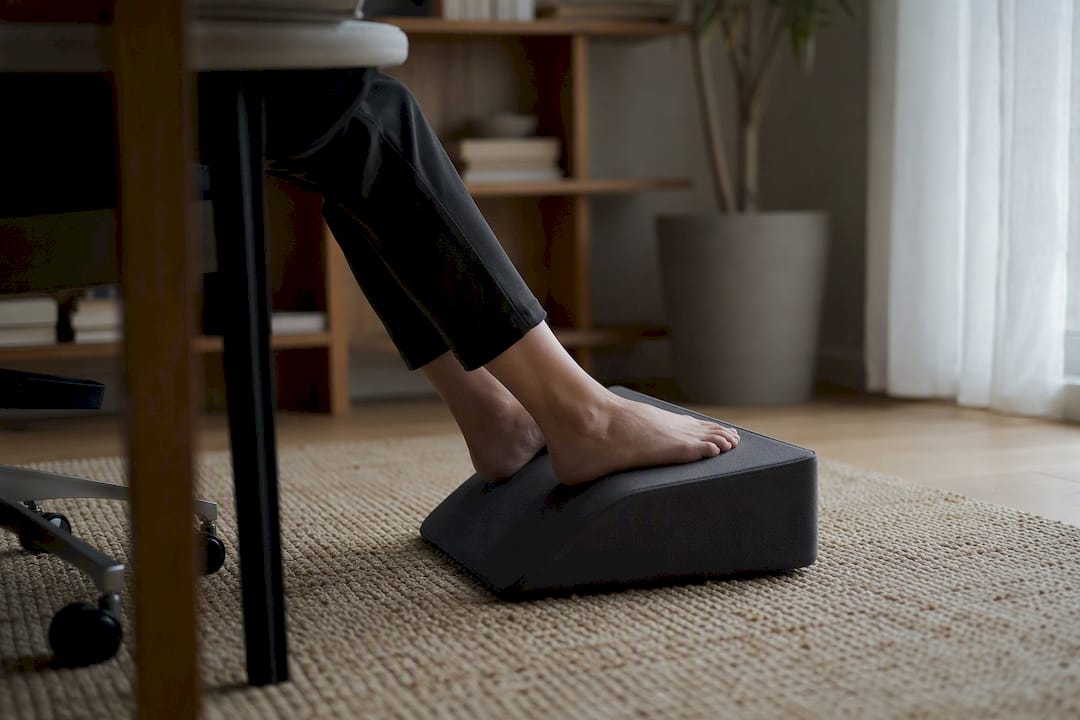
The change that mattered most wasn’t the footrest itself, it was pairing it with a simple cue: every time I noticed myself leaning forward off the backrest, I’d glance down and reset my foot position too. The two habits reinforced each other.
Pro Tip: Don’t expect an angled footrest to fix posture on its own the first day. Give it a week of noticing when you lean forward before the backrest habit becomes automatic.
Where a Footrest Fits Into a Bigger Posture Fix
A footrest changes what happens below your hips. It doesn’t retrain the muscles holding your head and neck forward after years of screen work, and it won’t undo forward head posture on its own. Think of it as one piece of a setup that also includes chair height, monitor placement, and the habit changes that actually rebalance the muscles pulling your head out of alignment.

Bestforwardheadposturefix builds the other half of that equation: structured, science-backed guides for correcting forward head posture through habit changes and muscle rebalancing, not quick fixes that fade in a week. If you’ve fixed your foot support and chair height but still deal with neck stiffness, headaches, or that forward-leaning feeling by 3pm, the next step is addressing the muscular imbalance directly. Start with the full ergonomic desk setup guide to see how foot support, chair height, and monitor position work together, then explore the posture correction programs on the site for the habit-level changes a footrest can’t provide on its own. This is educational content meant to complement, not replace, individualized medical advice.
Frequently Asked Questions
Is using a footrest actually healthy, or just more comfortable?
Both. Comfort is a real benefit, but the posture and circulation changes are measurable, not just subjective. Studies tie footrest use to more backrest contact and reduced pressure under the thighs, not just a “feels better” effect.
Should a footrest be angled or flat?
Angled, in most cases, for desk and computer work. A slight upward tilt of 5 to 15 degrees produced the backrest-use increase seen in lab testing, while flat surfaces suit tasks involving frequent standing and sitting transitions.
Can a footrest help with leg swelling from sitting all day?
It can reduce the pressure under your thighs that contributes to swelling and sluggish circulation, particularly with a rocking or dynamic design that encourages small foot movements throughout the day.
Do tall people ever need a footrest?
Rarely, but it happens. Anyone who raises their chair for desk clearance, regardless of height, can lose floor contact and benefit from foot support to restore a neutral knee angle.
This article is general information, not a substitute for advice from a qualified doctor. Consult a qualified healthcare professional about your own circumstances before acting on anything here.
Sources
- The effects of using a footrest during computer tasks varying in complexity and temporal demands: A postural and electromyographic analysis
- Computer workstation positions | OSHA eTools
- Office ergonomics: Your how-to guide
- Seven Health Benefits of Using a Footrest at Your Workstation | Humanscale