Start today with three things: gentle chin tucks to wake up your deep neck flexors, a thoracic roll or extension over a chair back to open your upper spine, and scapular squeezes to stop your shoulders from rounding forward. That combination, done several times a week, is what the research behind thoracic kyphosis exercises actually supports, not isolated neck stretches or a single “posture fix” move.
The reason a single-target approach usually stalls is simple: your neck doesn’t sit in isolation. It rests on your thoracic spine, and if that platform is stiff and rounded, your head drifts forward no matter how many neck stretches you do.
An effective program needs three components working together:
- Deep cervical flexor training — craniocervical flexion (a gentle chin nod, not a hard tuck) to reactivate the longus colli and longus capitis
- Thoracic mobility and extension work — self-mobilization drills that restore upper back extension
- Scapular stabilization — retraction and lower trapezius work that keeps your shoulder blades from dragging your neck forward
Do a five-second chin tuck hold, ten times, right now. Follow it with a slow thoracic extension over the back of a sturdy chair, ten reps. That’s the entire program in miniature. Bestforwardheadposturefix builds full routines around this exact structure, and clinical trials back the logic: one randomized trial found 68.8% of participants doing thoracic-focused work hit a meaningful recovery score at four weeks, compared to 50% doing cervical work alone.
Key Takeaways
An integrated thoracic-first program combining deep cervical flexor training, thoracic mobility, and scapular stabilization corrects forward head posture faster than cervical-only exercises.
| Point | Details |
|---|---|
| Train three areas, not one | Combine deep neck flexor work, thoracic mobility, and scapular stabilization in every session. |
| Follow exact dosages | Use a moderate number of reps for chin tucks and regular sessions weekly for scapular work, per clinical protocols. |
| Watch for red flags | Numbness, progressive weakness, or dizziness on neck movement means see a clinician promptly. |
| Expect a 4 to 6 week timeline | Early changes often appear by week 4, with clearer gains between weeks 6 and 12. |
| Use structured resources to refine form | Bestforwardheadposturefix offers drill-specific pages and video demos to correct technique errors early. |
This article is general information, not a substitute for advice from a qualified doctor. Consult a qualified healthcare professional about your own circumstances before acting on anything here.
Table of Contents
- Who Should Try Thoracic Kyphosis Exercises Safely?
- What Are the Best Exercises for Thoracic Kyphosis and Forward Head Posture?
- How Do You Build a 4 to 6 Week Kyphosis Posture Program?
- Why Do Thoracic and Scapular Exercises Work Better Than Neck Stretches Alone?
- Which Daily Habits Reinforce Your Posture Exercises?
- How Do You Track Progress and Know the Program Is Working?
- An Editorial Note on Consistency Over Perfection
- Where to Find Guided Routines and Progress Tools
- Sources
Who Should Try Thoracic Kyphosis Exercises Safely?
Most people with mechanical neck stiffness, rounded shoulders, or tension headaches from screen time are good candidates. You’re a reasonable fit if your pain is dull, positional, and doesn’t radiate, and you can move your neck through a comfortable range without alarm.
Stop and see a clinician if you notice any of these:
- Numbness, tingling, or weakness running down an arm
- Pain that worsens rapidly or wakes you at night
- Dizziness triggered specifically by turning or extending your neck
- A history of cancer, unexplained weight loss, or recent trauma to the neck or head
On days when things feel irritated, dial back range of motion and lean on mobility work instead of strengthening. A five-minute physiotherapy evaluation can rule out red flags before you commit to a home program, especially if pain has lasted more than a few weeks; for safe exercise recommendations, see Osteoporosis Exercise Guidelines: Safe Moves That Work.
Pro Tip: Use a simple rule: if an exercise causes sharp pain or symptoms that linger more than an hour afterward, stop that movement and substitute a gentler mobility drill until you can get it checked.
What Are the Best Exercises for Thoracic Kyphosis and Forward Head Posture?
Here’s the actual exercise library, broken into the three categories that matter.
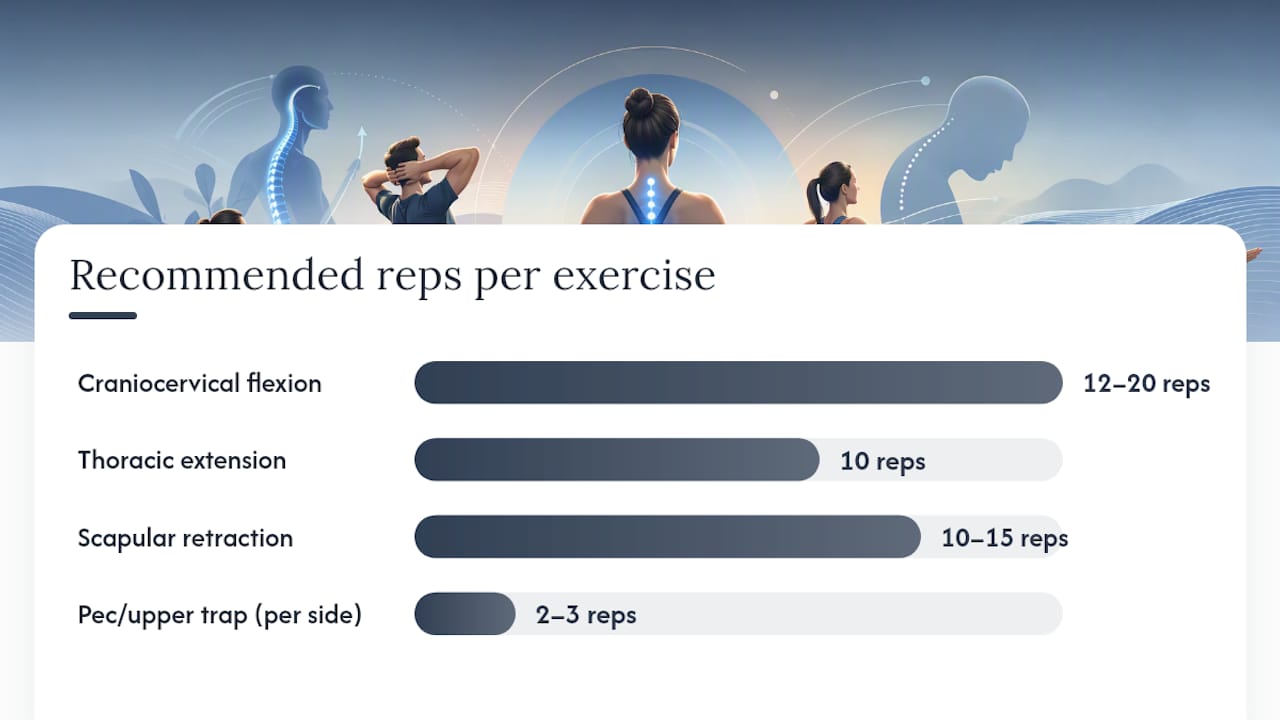
Deep cervical flexor training (craniocervical flexion). Lie on your back, chin tucked slightly, and gently nod your head as if saying “yes” in a tiny range, without pressing your head hard into the floor. Watch yourself in a mirror or phone camera if you can. The Physiopedia deep neck flexor protocol recommends 12 to 20 reps, one to three sets, with roughly five-second holds. The most common mistake is letting the sternocleidomastoid muscle take over, which shows up as your chin jutting or your throat visibly straining. If that happens, shrink the range until the movement feels almost invisible.
Thoracic mobility and extension. A thoracic roll over a foam roller, or simple extension over the back of a firm chair, opens the mid back that forward head posture tends to lock down. Ten slow reps, held two to three seconds at end range, once or twice daily. If a foam roller feels too intense early on, the chair-back version is a safe regression. Bestforwardheadposturefix’s thoracic mobility guide walks through both versions step by step, and the upper back rolling technique is worth bookmarking for text neck specifically.
Scapular stabilization. Squeezes, prone T/Y/W raises, serratus punches, and wall slides retrain the lower trapezius and serratus anterior, the muscles that keep your shoulder blades down and back instead of collapsed forward. Start with bodyweight, then add light resistance bands as form holds up. Research on scapular stabilization shows this work specifically reduces compensatory overactivity in the upper traps, the muscle that tends to scream when your posture is off.
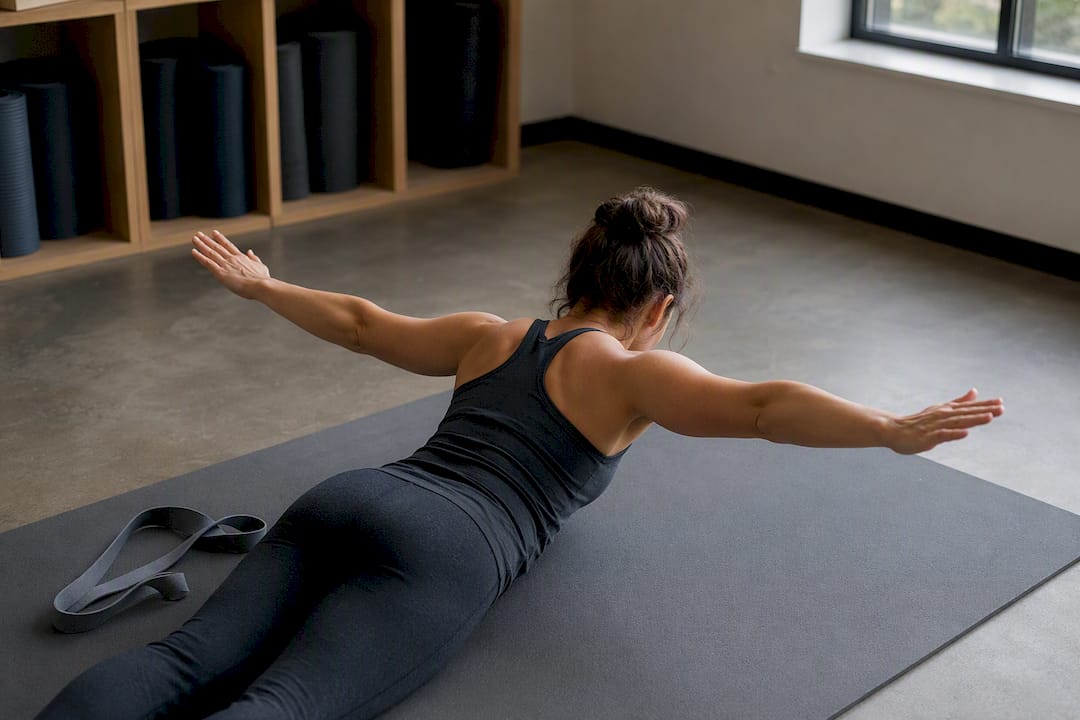
Stretching the tight side. Pec stretches in a doorway, upper trap side-bends, and gentle levator/scalene stretches, held 20 to 30 seconds, once or twice a day.
| Exercise Category | Reps/Sets | Hold Time | Frequency |
|---|---|---|---|
| Craniocervical flexion | 12–20 reps, 1–3 sets | five seconds | Daily |
| Thoracic extension/roll | 10 reps | 2–3 seconds | 1–2x daily |
| Scapular retraction/T-Y-W | 10–15 reps, 2–3 sets | 2 seconds | 3x/week |
| Pec/upper trap stretch | 2–3 reps per side | 20–30 seconds | 1–2x daily |
Pro Tip: If your neck feels more tired than your upper back after a session, you’re likely over-recruiting superficial neck extensors instead of the deep stabilizers. Slow down the chin tuck and shrink the range until the movement feels almost too easy.
How Do You Build a 4 to 6 Week Kyphosis Posture Program?
A full session runs 15 to 30 minutes: two minutes of easy movement to warm up, five minutes of thoracic mobility, ten minutes of targeted strengthening (deep flexors plus scapular work), and five minutes of stretching. Aim for three dedicated sessions a week, plus brief daily habit work like a single chin tuck set and one thoracic roll.
- Week 1: Focus on technique. Light reps, shorter holds, get the movement pattern right before loading anything.
- Week 2: Add a set to strengthening exercises. Extend thoracic extension holds to three seconds.
- Week 3: Introduce light resistance bands to scapular work. Increase chin tuck holds toward eight to ten seconds.
- Week 4: Hold volume steady, assess progress, and either continue the plan another two weeks or shift to a maintenance schedule of two sessions weekly.
On rough pain days, deload: skip strengthening, keep mobility and stretching, and resume progression once symptoms settle. If a full session feels like too much on a busy day, a 10-minute express version, five chin tucks, five thoracic extensions, ten scapular squeezes, still counts.
Pro Tip: Consistency across four weeks beats intensity in any single session. Missing one day matters far less than skipping an entire week.
Why Do Thoracic and Scapular Exercises Work Better Than Neck Stretches Alone?
The evidence is fairly direct on this. A randomized trial comparing upper thoracic mobilization against an upper cervical mobilization and stabilization protocol found the thoracic group came out ahead on craniovertebral angle, cervical extension, pain, and neck disability scores. That’s not a marginal edge, it’s a meaningfully different recovery trajectory.
The mechanism makes sense once you think about it mechanically. Forward head posture usually pairs inhibited deep cervical flexors with a stiff, rounded thoracic spine. Fixing the neck without fixing the platform it sits on is like straightening a lamp on a warped table. Research combining thoracic mobility and scapular stabilization confirms that pairing the two produces better forward head posture outcomes than isolated cervical work.
Adding scapular stabilization to a postural correction program produces greater gains in craniovertebral angle, pain threshold, and disability scores than postural correction on its own, according to a randomized trial in the European Journal of Physical and Rehabilitation Medicine.
68.8% of participants doing thoracic-focused work reached a clinically meaningful recovery rating at four weeks, versus 50% doing cervical-only exercises, based on the PubMed trial data. That gap is the strongest single argument for training the thoracic spine, not just the neck.
Which Daily Habits Reinforce Your Posture Exercises?
Exercises undo the damage. Habits stop you from redoing it. Hold your phone at eye level instead of tilting your chin down into it. Set a timer for a 20 minute micro-break with a thirty second thoracic extension stretched over your chair. If you work standing occasionally, alternate positions rather than locking into one all day.
For your desk setup: raise your laptop screen to eye height using a stand or stack of books, and use an external keyboard so your neck doesn’t crane downward. For your chair, check that your lower back is supported and your knees sit level with your hips. For your phone, prop it up rather than cradling it in your lap.
Pro Tip: Habit stacking works better than willpower. Attach a single chin tuck set to something you already do daily, like right after your morning coffee, and it becomes automatic within two weeks.
How Do You Track Progress and Know the Program Is Working?
Take a side-view photo weekly in the same spot, same lighting, and watch your ear position relative to your shoulder. Rate your pain 0 to 10 weekly, and note stiffness or headache frequency as a simple functional check.
Most people notice early changes by week four. Clearer, more durable improvement tends to show up between six and twelve weeks, and individual timelines vary based on how long the posture pattern has been in place. If you see no change after eight to twelve weeks of consistent work, or symptoms worsen, that’s your signal to get reassessed rather than push harder on the same routine.
An Editorial Note on Consistency Over Perfection
An integrated program beats a single-exercise fix because forward head posture is never really a neck-only problem. Expect gradual, uneven progress, not a dramatic before-and-after in week one. Small daily wins, a chin tuck here, a thoracic roll there, compound faster than occasional perfect sessions ever will.
Where to Find Guided Routines and Progress Tools
Reading the exercise list is one thing. Actually holding a five-second chin tuck correctly, or knowing whether your thoracic roll is deep enough, is another. That’s where having video demonstrations and drill-specific breakdowns saves you from guessing at form for weeks.

Bestforwardheadposturefix built its library specifically around this gap: detailed drill pages that break down cues you can’t get from a written rep count alone, printable progress logs to track your craniovertebral angle proxy and pain scores week over week, and video demos for the trickier movements like craniocervical flexion, where subtle form errors are easy to miss on your own. The site’s forward head posture exercise guide expands on everything covered here with more variations and progressions.
This is education and self-management content, not urgent medical care. If you’re dealing with red-flag symptoms like numbness or worsening pain, see a clinician first. For everyone else building a steady home routine, start by browsing the main guide and picking the drill page that matches where you are this week.
Sources
- Upper thoracic spine mobilization and mobility exercise versus upper cervical spine mobilization and stabilization exercise (PubMed)
- Interventions combining thoracic mobility and scapular stabilization are effective for forward head posture (Springer article)
- Impact of adding scapular stabilization to postural correctional exercises on symptomatic forward head posture (Eur J Phys Rehabil Med, 2022)
- Deep Neck Flexor Stabilisation Protocol – Physiopedia