Yes, if your head sits forward of your shoulders, one-sided neck pain is almost always mechanical and treatable.
Unilateral neck pain is frequently the result of cumulative postural overload rather than a sudden injury — your tissue tolerance finally ran out. The average head weighs roughly 10 pounds, and when it drifts forward, the effective load on your cervical muscles multiplies.
That load rarely distributes evenly, which is exactly why one side gives out first.
Three things to do right now:
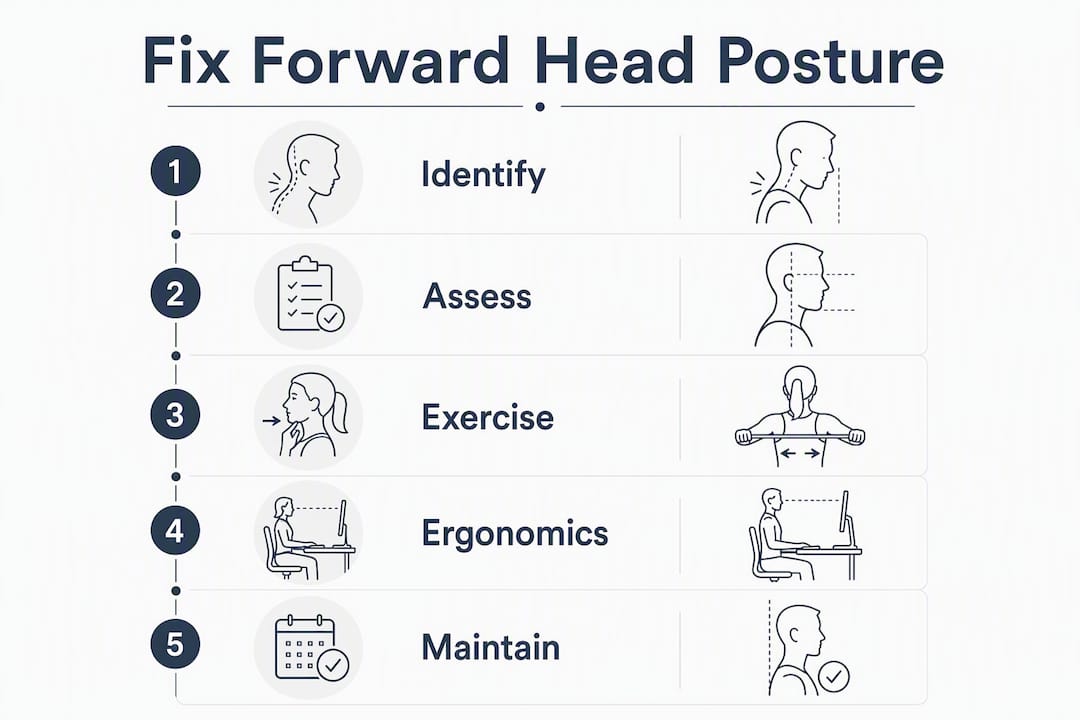
- Self-check: Stand sideways in a mirror. If your ear sits noticeably in front of your shoulder, forward head posture (FHP) is a likely driver.
- Short-term relief: Apply ice for the first 24–48 hours, then switch to heat. Keep moving gently — prolonged rest makes it worse.
- Start rebalancing: Muscle rebalancing, not just pain management, is what physical therapy frameworks consistently recommend for lasting relief. Bestforwardheadposturefix is built around exactly this approach.
Pro Tip:
Don’t reach for a soft cervical collar. Wearing one for more than a day or two trains your neck muscles to switch off, which deepens the imbalance you’re trying to fix.
Table of Contents
- Does your pain pattern point to forward head posture?
- What actually helps in the first 48–72 hours
- The muscle rebalancing plan that removes one-sided strain
- Ergonomic fixes that stop reloading the painful side
- How to make posture correction stick as a daily habit
- What to expect: realistic timeline and common mistakes
- When self-care isn’t enough: red flags and which clinician to see
- How Bestforwardheadposturefix approaches one-sided neck pain
- Key Takeaways
- The part most guides skip
- A structured plan makes the difference
- Sources and further reading
Does your pain pattern point to forward head posture?
A few quick checks can tell you whether your left neck pain or right neck stiffness is likely postural before you spend money on imaging.
- Mirror test. Stand naturally (don’t correct yourself first). Does your ear sit in front of your shoulder? Does one shoulder sit higher than the other?
- Screen posture check. Sit at your desk for 10 minutes without thinking about it, then glance sideways in a window reflection. Head forward, chin jutting? That’s FHP in action.
- Range-of-motion asymmetry. Slowly rotate your head left and right. If one direction stops noticeably earlier or reproduces your pain, the restricted side is under load.
- Resisted isometric test. Place your palm against the side of your head and gently push while resisting with your neck. If this reproduces the familiar ache on one side, the muscles there are already sensitized.
- Morning pattern check. Waking with stiffness on one side after sleeping in a rotated or prone position is a classic sign of asymmetric nocturnal loading, not structural damage.
Red flags that skip self-care entirely: fever with neck stiffness, progressive arm weakness or numbness, bowel or bladder changes, or pain that wakes you from sleep and won’t settle. Those need same-day medical attention.
Pro Tip:
For a valid posture photo, prop your phone against a wall at shoulder height, set a 10-second timer, and stand naturally 6 feet away in profile. Take it weekly at the same spot. Tracking neck alignment with side-profile photos gives you objective evidence of progress that you simply can’t feel in the moment.
What actually helps in the first 48–72 hours
Short-term relief is about calming the tissue, not fixing the posture. That comes later.
Do these:
- Ice for 15–20 minutes every 2 hours during the first 24–48 hours, then switch to moist heat.
- Keep moving. Gentle, controlled movement prevents the stiffness from compounding — slow head nods and small rotations within a pain-free range.
- Take over-the-counter NSAIDs (ibuprofen, naproxen) per label directions if inflammation is present.
- Set a timer for a micro-movement break every 30–45 minutes.
Avoid these:
- Wearing a soft collar beyond 24 hours.
- Aggressive stretching into sharp or shooting pain.
- Sleeping face-down or with your head sharply rotated toward the painful side.
- Sitting completely still for hours because it “feels safer.”
Pro Tip:
Try this breathing reset when the spasm tightens: inhale slowly for 4 counts through your nose, exhale for 6 counts through pursed lips, and consciously drop your shoulders on the exhale. Stress-related muscle bracing keeps the pain-spasm cycle running — this cue interrupts it in under a minute.
The muscle rebalancing plan that removes one-sided strain
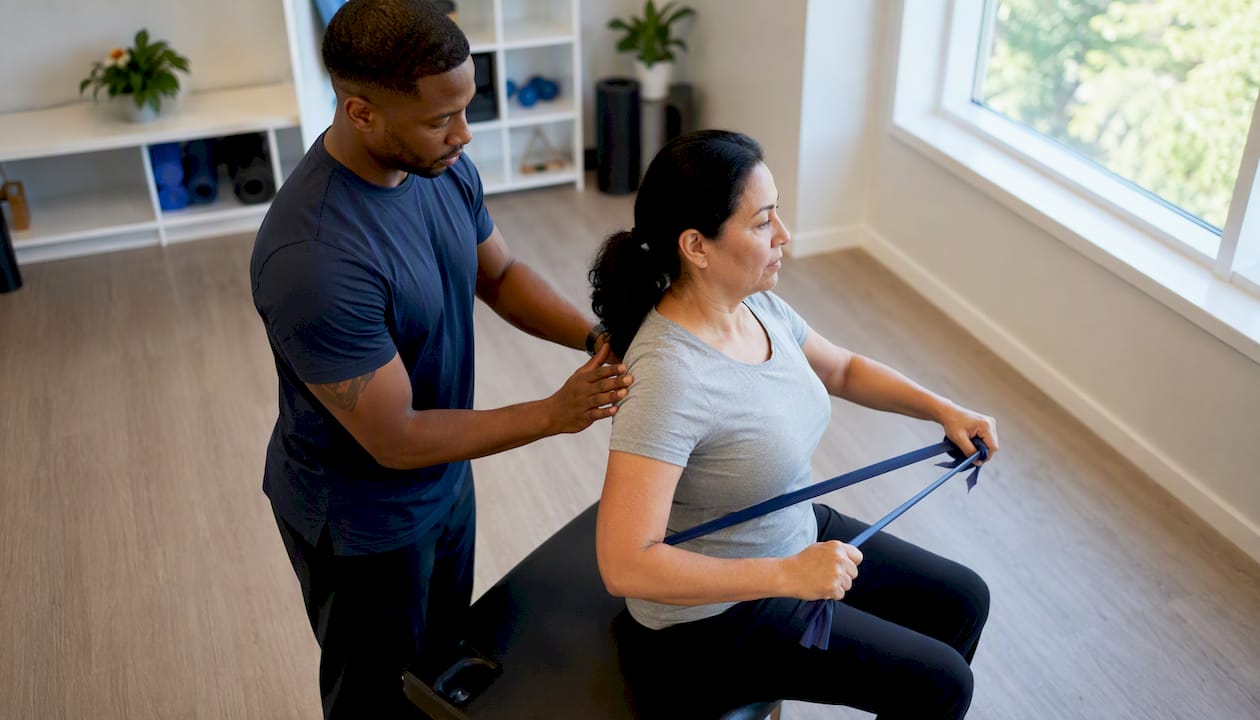
This is where the actual fix lives. Physical therapy frameworks target weak deep neck flexors and scapular stabilizers, not just the painful spot. Here’s a structured 6-week plan.
Exercise prescription table
| Exercise | Sets × Reps / Hold | Frequency | Notes |
|---|---|---|---|
| Chin tuck (deep neck flexor activation) | 3 × 10 reps, 5-sec hold | Daily | No chin jutting; keep gaze level |
| Cervical rotation (mobility) | 2 × 10 each side | Daily | Slow, pain-free range only |
| Lateral flexion stretch | 3 × 30-sec hold | Daily | Gentle overpressure with hand |
| Scapular retraction / wall angel | 3 × 12 reps | 5×/week | Squeeze shoulder blades together |
| Band row (scapular stabilizer strength) | 3 × 12 reps | 3×/week | Light resistance; full retraction |
| Levator scapulae stretch | 3 × 30-sec hold each side | Daily | Chin to chest, rotate away from pain |
Weekly progression (weeks 1–6)
- Weeks 1–2: Mobility and isometrics only. Chin tucks, gentle rotations, lateral flexion holds. No resistance.
- Week 3: Add scapular retractions and wall angels. Still no external load.
- Week 4: Introduce band rows at light resistance. Drop back if pain increases.
- Week 5: Progress band resistance one level. Add a second daily mobility session.
- Week 6: Full program at moderate resistance. Assess range-of-motion symmetry against your week-1 photos.
Stop or scale back if any exercise produces shooting pain, tingling into the arm, or dizziness. Those are signals to see a clinician before continuing.
For readers considering a clinician-guided approach, physical therapy for neck pain combines manual techniques with progressive exercise for faster outcomes.
Pro Tip:
Pair your chin tucks with something you already do — every time you stop at a red light, or every time your email loads.
Habit stacking is the fastest way to hit daily frequency without adding a separate “exercise session” to your schedule.
Ergonomic fixes that stop reloading the painful side
Exercises only work if you stop recreating the problem between sessions. Here’s a one-minute audit you can run right now.
Workstation and device checklist
| Area | Problem | Fix |
|---|---|---|
| Monitor height | Screen below eye level pulls head forward | Top of screen at or just below eye level |
| Keyboard position | Arms reaching forward rounds shoulders | Elbows bent, keyboard close to body |
| Chair | No lumbar support collapses posture | Add a small lumbar roll or adjust chair back |
| Phone use | Cradling phone between ear and shoulder | Use speakerphone or a headset |
| Bag carrying | Single-shoulder bag loads one side | Alternate shoulders or use a backpack |
| Sleep position | Prone or rotated sleeping strains one side | Side or back sleeping; pillow alignment matters |
Quick daily habit shifts:
- Hold your phone at eye level with both hands instead of looking down.
- When carrying groceries, split the weight evenly between both hands.
- Set your monitor so you don’t need to turn your head to see it — asymmetric screen placement is a surprisingly common driver of one-sided neck tension.
- Check your ergonomic desk setup once a week; chairs and monitors drift out of position.
How to make posture correction stick as a daily habit?
Knowing what to do and actually doing it every day are two different problems.
- Morning micro-session (2–3 minutes): Chin tucks, lateral flexion stretches, and one set of scapular retractions before you sit down at your desk.
- 20/20 rule: Every 20 minutes of screen time, spend 20 seconds doing a posture reset — head back over shoulders, shoulder blades gently together, deep breath.
- Habit stacking: Attach posture cues to existing triggers (coffee brewing, browser loading, walking to the printer).
- Phone reminders: Set two daily alarms labeled “posture check” — one mid-morning, one mid-afternoon.
- Weekly photo check: Same wall, same profile angle, same time of day. Compare to your baseline. Progress is slow enough that you won’t feel it — you need to see it.
- Progress notes: Jot down your pain level (0–10) and your rotation range each Monday. When both improve consistently for two weeks, increase exercise resistance by one level.
What to expect: realistic timeline and common mistakes
Most mild to moderate neck pain improves within 2–3 weeks with self-care. Meaningful posture-driven change typically takes 6–12 weeks. Structural remodeling takes 3 or more months.
Common mistakes that stall recovery:
- Treating only the painful spot. Rubbing the sore muscle without addressing the posture that overloads it is like mopping around a running tap.
- Stopping exercises when pain fades. Pain disappears before the muscle imbalance is corrected. Stopping early guarantees a relapse.
- Persistent poor ergonomics. Doing 15 minutes of exercises and then sitting in a forward-head position for 8 hours cancels the work.
- Overusing rest or a collar. Immobilization prolongs stiffness and weakens the muscles you need to retrain.
- Expecting linear progress. Flare-ups are normal, especially in weeks 2–4. Scale back intensity for 2–3 days, then resume.
When self-care isn’t enough: red flags and which clinician to see
Seek same-day emergency care for: fever with a stiff neck (possible meningitis), progressive arm or leg weakness, bowel or bladder changes, or severe unremitting pain after trauma.
Schedule a clinician visit within a week for:
- Numbness or tingling that runs into the hand.
- Pain that hasn’t improved after 2–3 weeks of consistent self-care.
- Headaches that worsen with neck movement.
- Any symptom that’s getting worse, not better.
Which clinician fits which situation:
- Primary care physician: First stop for ruling out infection, fracture, or systemic causes. Can order imaging and refer.
- Physical therapist: Best for mechanical neck pain. Expect manual therapy combined with exercise and a home program.
- Physiatrist: Specialist in musculoskeletal rehab when PT alone isn’t resolving it.
- Neurologist: When radicular symptoms (arm numbness, weakness) suggest nerve compression.
Bring to your appointment: onset date, what makes it better or worse, prior treatments tried, and your weekly posture photos. That information cuts diagnostic time significantly.
A chiropractor addressing FHP can also be a useful adjunct for manual mobilization alongside your exercise program.
How Bestforwardheadposturefix approaches one-sided neck pain?
Bestforwardheadposturefix is built on one core premise: symptoms are downstream of mechanics. Treating the painful spot without correcting the posture pattern that created it is why so many people cycle through short-term relief and back into pain.
The site’s approach combines posture mechanics education, progressive muscle rebalancing, and ergonomic habit change into a structured program readers can follow at home. For severe or neurological symptoms, clinician review always comes first.
Key Takeaways:
One-sided neck pain driven by forward head posture responds to muscle rebalancing, ergonomic correction, and consistent daily habits — not rest alone.
| Point | Details |
|---|---|
| FHP is the likely cause | If your ear sits forward of your shoulder, cumulative postural overload is the probable driver of your unilateral pain. |
| First 48–72 hours | Use ice then heat, keep moving gently, and avoid prolonged immobilization or aggressive stretching. |
| Core daily exercises | Chin tucks, scapular retractions, and levator stretches daily; add band rows 3×/week from week 3 onward. |
| Fix the ergonomics | Monitor at eye level, phone at eye level, and alternate bag shoulders — exercises won’t hold if the load keeps returning. |
| Red flags need a clinician | Fever with stiff neck, progressive arm weakness, or bowel/bladder changes require same-day medical attention. |
| Bestforwardheadposturefix | Provides structured posture correction guides, ergonomic checklists, and progressive exercise programs for lasting FHP relief. |
The part most guides skip
The framing of one-sided neck pain as a “local muscle problem” is the single biggest reason people stay stuck. Every guide tells you to stretch your levator scapulae.
Almost none explain that the levator is overloaded because your deep neck flexors stopped doing their job, your scapular stabilizers are weak, and your head has been sitting two inches forward of center for years.
The pain is the last thing that shows up and the first thing that goes away. That sequence fools people into stopping treatment too early, every time.
The muscle imbalance that caused the pain is still there when the pain disappears — it just hasn’t crossed your threshold again yet.
What actually changes outcomes is treating the posture pattern as a whole-system habit problem, not a tissue problem. That means ergonomics, daily movement cues, and progressive strengthening running simultaneously, not sequentially.
Posture correction for neck pain works when it’s applied as a system, not a spot treatment.
A structured plan makes the difference

If you’ve been managing symptoms without a clear progression plan, Bestforwardheadposturefix gives you the structured next step.
The site’s guides cover ergonomic desk setup, pillow alignment, progressive exercise programs, and self-assessment tools — all organized so you’re not piecing together advice from a dozen different sources.
The posture correction program walks you through the same muscle rebalancing framework covered in this article, with step-by-step progressions, habit cues, and weekly checkpoints.
Start with the self-assessment guide, then follow the structured program at your own pace. For readers who want clinician-guided support alongside self-directed work, physical therapy for posture is a strong complement to the home program.
This article is for general informational purposes only and is not a substitute for professional medical advice. Confirm any treatment decisions with a qualified clinician for your specific situation.
Sources and further reading
The following resources informed this guide and are worth bookmarking for deeper reading:
- Neck Pain: Causes and Treatments — Cleveland Clinic overview of mechanical neck pain, head weight mechanics, and stress-related tension.
- Neck Pain: Diagnosis and Treatment — Mayo Clinic guidance on recovery timelines and conservative care.
- Neck Pain: MedlinePlus Medical Encyclopedia — National Library of Medicine overview of causes, red flags, and when to seek care.
- Stiff Neck: Causes, Relief, and Remedies — Cleveland Clinic on stiffness patterns, meningitis red flags, and at-home treatment.
- Neck Pain on the Left Side — Medical News Today on left neck pain causes and the case for early gentle movement.
- Morning Stiff Neck: Why It Happens — Biomedicus on nocturnal asymmetric loading and sleep-related spasm.
- How to Assess Neck Alignment for FHP — Bestforwardheadposturefix self-assessment and photo documentation guide.