The most effective way to achieve lower trap activation is to move your arms overhead at roughly 135 degrees from your spine, matching the direction the muscle fibers actually run, while actively depressing your shoulder blades rather than letting them shrug upward.
That single mechanical detail separates exercises that genuinely recruit the lower trapezius from the ones that just load the upper traps instead.
Here is what that looks like in practice:
- Arm angle matters most. Muscle fibers run at 135° from the spine, corresponding to the 10:00 and 2:00 clock positions. Exercises performed below shoulder height consistently underload the lower trap.
- Depress before you move. Pulling the shoulder blades down and slightly together before initiating any lift primes the lower trap and reduces the chance the upper trap takes over.
- Use reciprocal inhibition. Scapular depression combined with adduction actively shuts off overactive upper trapezius fibers, creating a window for the lower trap to fire.
- Go slow. A controlled tempo of 3–4 seconds on the lifting phase gives the nervous system time to recruit the right motor units instead of defaulting to the dominant upper trap.
- EMG evidence backs prone Y-raises. Electromyographic studies consistently show the prone Y-raise produces the highest lower trapezius activation among commonly studied exercises.
Physical therapy guidelines and the research reviewed at Bestforwardheadposturefix both point to the same conclusion: lower trapezius activation is a skill before it is a strength exercise. You have to teach the muscle to fire correctly before you load it.
PT-Recommended Lower Trapezius Exercises You should Actually Do
Physical therapists consistently recommend a small set of exercises that check every biomechanical box: correct arm angle, scapular depression, and minimal upper trap involvement. The ten below are ordered from foundational to more demanding, so you can progress logically.
1. Prone Y-raise
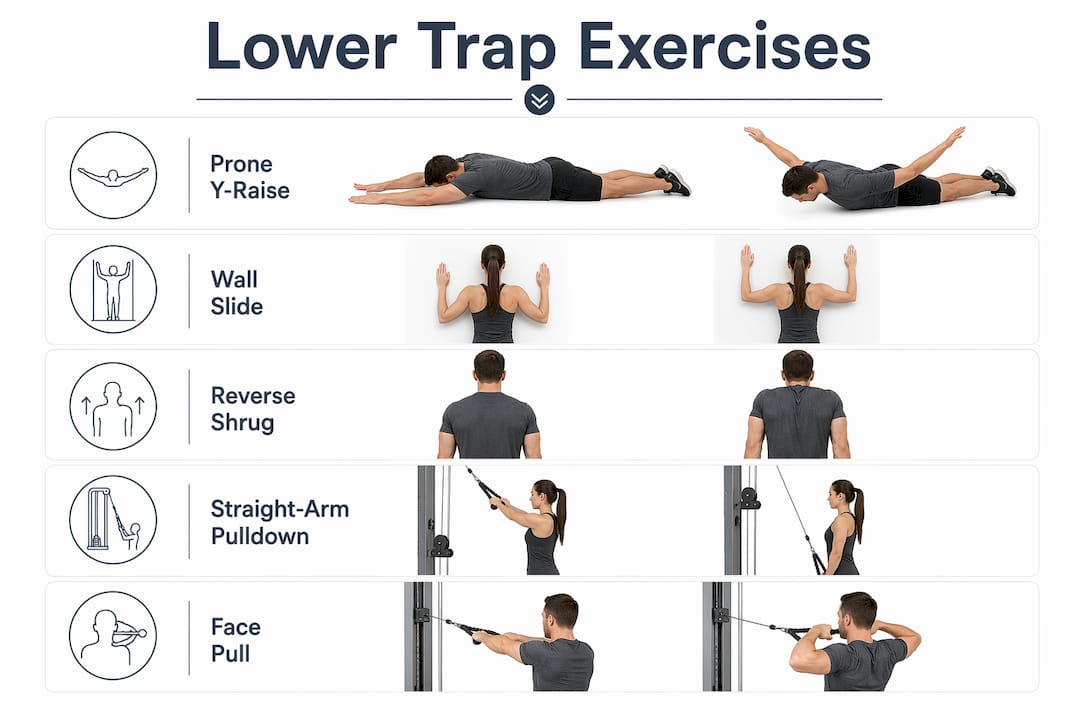
Lie face down on a flat surface or an incline bench set to about 30 degrees. Extend both arms overhead in a Y shape, thumbs pointing up, so your arms form roughly a 135-degree angle with your spine. From there, lift your arms a few inches off the surface by squeezing your shoulder blades down and together, not by shrugging. Hold for 2 seconds at the top, then lower slowly over 3 seconds.
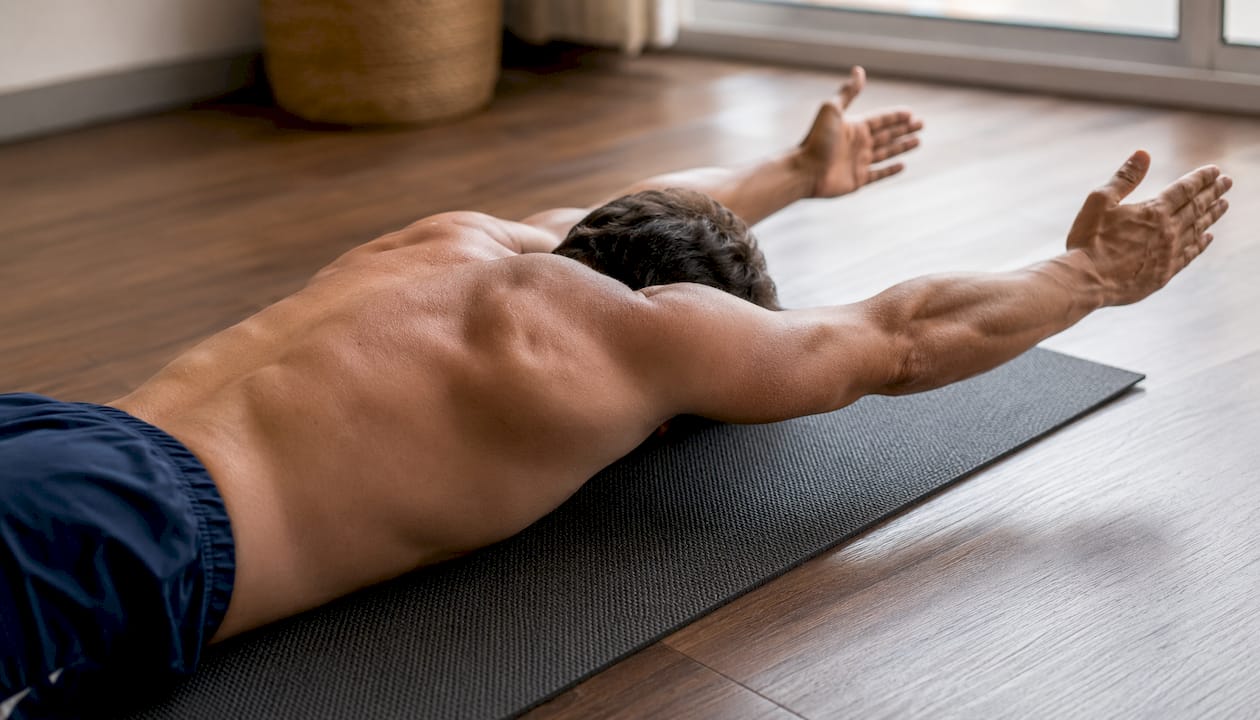
EMG studies confirm the prone Y-raise produces the highest lower trap activation of any commonly tested exercise. Start with bodyweight only; even that is challenging when done correctly.
Pro Tip: Before lifting, imagine you are trying to put your shoulder blades into your back pockets. That cue alone shifts activation away from the upper trap.
2. Wall slide at 135 degrees
Stand facing a wall with your forearms resting against it, elbows bent at 90 degrees and positioned just below shoulder height. Slowly slide your arms upward into a Y position while keeping your lower back flat and your shoulder blades moving down, not up. The wall provides feedback: if your forearms lose contact, you are compensating with your upper trap or lumbar extension.

This exercise is particularly useful for people who struggle to feel the lower trap working in prone positions, since the wall gives constant tactile cues.
3. Reverse shrug (scapular depression)
Sit or stand with your arms hanging at your sides. Without bending your elbows, pull both shoulder blades straight down as far as possible, as if you are trying to make your shoulders as far from your ears as you can. Hold for 3 seconds, release slowly. This is the foundational movement pattern behind every lower trap exercise on this list.
It looks almost too simple, but for people with chronic upper trap tightness, this is often the first exercise where they actually feel the lower trap engage.
4. One-arm straight-arm pulldown
Attach a resistance band or cable to an anchor point above your head. Stand facing the anchor, grip the band with one hand, and keep your arm straight. Pull the band down and slightly across your body by depressing your shoulder blade, not by bending your elbow. The movement is small, maybe 6–8 inches of travel, but the muscle demand is high when done correctly.
This exercise trains the lower trap through its primary function: pulling the scapula downward against resistance.
5. Face pull with external rotation
Attach a resistance band at face height. Grip both ends with palms facing down, step back to create tension, and pull the band toward your face while rotating your hands so your palms face forward at the end of the movement. Your elbows should finish above shoulder height. The external rotation component recruits the lower trap alongside the posterior deltoid and rotator cuff.
Keep the movement controlled on the return. Letting the band snap back removes the eccentric load, which is where a lot of the motor learning happens.
6. Prone T-raise
Similar setup to the Y-raise, but your arms extend straight out to the sides at shoulder height, forming a T. Thumbs point up. Lift by depressing and retracting the scapulae, hold 2 seconds, lower slowly. The T-raise targets the middle and lower trapezius together, making it a good complement to the Y-raise rather than a replacement.
Pro Tip: Alternate Y and T raises within the same session. The slight angle change challenges the lower trap from two slightly different fiber directions, improving overall recruitment.
7. Scapular wall angel
Stand with your back flat against a wall, feet about 6 inches out from the baseboard. Press your lower back, upper back, and the backs of your arms against the wall. Slide your arms up into a Y position while keeping every contact point pressed against the wall. This is harder than it sounds for anyone with forward head posture or a tight pectoralis minor.
The wall angel is one of the best posture correction exercises for people whose scapulae have drifted into anterior tilt.
8. Band pull-apart with depression
Hold a resistance band in front of you at chest height, arms straight, hands shoulder-width apart. Before pulling, actively depress your shoulder blades. Then pull the band apart until your arms are fully extended to each side, squeezing the shoulder blades together at the end. The depression cue at the start is what keeps this exercise in lower trap territory rather than turning it into a pure middle trap drill.
9. Incline prone Y-raise with pause
This is the loaded progression of exercise 1. Use a bench set to 30–45 degrees and hold light dumbbells, 2–5 lbs to start. The incline reduces the effect of gravity at the bottom of the movement, making the top portion, where the lower trap works hardest, more demanding. Pause for 3 seconds at the top of each rep.
Most people overestimate how much weight they need here. The lower trap is a postural muscle built for endurance, not max force, so light loads with long pauses outperform heavy loads with sloppy form.
10. Seated cable row with scapular focus
Sit at a cable row station with a straight bar or rope attachment. Before pulling, set your shoulder blades down and back. Row the cable toward your lower chest rather than your upper abdomen, finishing with the elbows close to your sides and the shoulder blades fully retracted and depressed. The key difference from a standard row is the intentional depression cue at both the start and finish of each rep.
This exercise bridges lower trap training and functional pulling strength, making it a practical addition to any general fitness program.
How to Avoid Upper Trap Dominance during Lower Trap Exercises?
Shoulder pain often stems from an overactive upper trapezius paired with a weak lower trapezius. The upper trap is a strong, dominant muscle that loves to take over whenever the movement pattern gets sloppy or the load gets too heavy. Recognizing its compensation patterns is the first step to stopping them.
The most common errors that trigger upper trap dominance:
- Shrugging at the start of a lift. Shrugs primarily activate the upper trap and are counterproductive for lower trap training. If your shoulders rise toward your ears at any point, reset and depress before continuing.
- Arms positioned too low. Exercises performed below shoulder height shift the mechanical advantage away from the lower trap. Keep arms at or above shoulder level, aiming for that 135-degree angle.
- Moving too fast. Speed lets the upper trap compensate before the lower trap has time to engage. A slow tempo, 3 seconds up and 3 seconds down, forces the nervous system to recruit the correct muscle.
- Too much load, too soon. Heavy resistance amplifies whatever compensation pattern already exists. Start lighter than you think you need to.
- Holding your breath. Breath-holding increases overall muscle tension and tends to drive the shoulders upward. Exhale during the effort phase of each rep.
Corrective strategies that actually work:
- Depress first, always. Make scapular depression the first movement of every rep, before any arm motion begins.
- Use a mirror or video. Visual feedback catches shrugging that you cannot feel in the moment.
- Palpate the upper trap. Place two fingers on the upper trap muscle belly during a set. If it hardens significantly, you are compensating.
- Practice the reverse shrug in isolation before adding it to compound movements. It trains the neural pathway for depression without any distracting load.
Pro Tip: If you consistently feel the upper trap firing instead of the lower trap, try performing scapular depression isometrics for 30 seconds before your working sets. This pre-activates the lower trap and makes it easier to maintain correct recruitment throughout the exercise.
The forward neck posture connection is worth noting here. Chronic forward head posture tends to lock the upper trap in a shortened, overactive state, which makes lower trap recruitment even harder. Addressing both simultaneously produces faster results than targeting either muscle in isolation.
How to Program Lower Trapezius Exercises for Real Strength Gains?
Frequency, load, and progression all matter, but the biggest mistake people make with lower trap training is treating it like a heavy strength exercise when it is fundamentally a motor control and endurance challenge.
Physical therapy protocols recommend multiple sessions per week with slow, controlled tempos to build motor control and avoid compensatory recruitment. Here is how to structure that in practice:
- Frequency: 3–4 sessions per week. The lower trap responds well to frequent, low-fatigue practice rather than infrequent heavy sessions.
- Sets and reps: 2–3 sets of 12–20 reps per exercise. Higher rep ranges build the endurance capacity this postural muscle needs.
- Tempo: 3 seconds concentric, 1 second hold at peak contraction, 3 seconds eccentric. This tempo is non-negotiable for motor learning.
- Load: Start with bodyweight or very light resistance. Progress by adding 1–2 lbs only when you can complete all reps with zero upper trap compensation.
- Rest: 60–90 seconds between sets. Longer rest periods are not needed because the loads are light; shorter rest periods risk fatigue-driven compensation.
- Progression: Add one set before adding weight. Once you reach 3 sets of 20 reps with clean form, increase resistance by the smallest increment available.
- Integration: Pair lower trap work with chin tuck exercises and pectoralis minor stretching for a complete postural rebalancing program.
One practical note on scheduling: lower trap exercises work well as a warm-up before upper body training, not as a finisher. Performing them when you are fresh means better motor control and cleaner movement patterns. Doing them last, when the upper trap is already fatigued from other work, tends to produce more compensation, not less.
What the Latest Research says about Maximizing Lower Trap Recruitment?
A 2026 study published in the Journal of the Korean Electro-Myography Association examined whether combining pectoralis minor stretching with lower trapezius taping during the Y-raise exercise produced better results than the standard Y-raise alone. The findings were clear.
“The muscle activity of the lower trapezius was significantly higher during the Y-raise with lower trapezius taping after pectoralis minor stretching (YLTPS) compared to the standard Y-raise (23.33% increase), while upper trapezius activity was significantly lower (31.35% decrease). The YLTPS can be recommended as an effective method for the selective activation of the lower trapezius in healthy subjects.” — Journal of the Korean Electro-Myography Association, 2026
The mechanism behind these numbers is worth understanding. The pectoralis minor is a small muscle on the front of the chest that, when tight, pulls the scapula into anterior tilt, a position that mechanically disadvantages the lower trap before the exercise even begins.
Stretching it first restores a more neutral scapular position, which improves the length-tension relationship of the lower trap and allows it to generate more force through its full range.
The taping component adds a different layer. Dynamic taping applied along the lower trapezius provides continuous tactile feedback during the movement, essentially cueing the muscle to stay engaged.
The combination of structural preparation through stretching and functional facilitation through taping produced a LT/UT activation ratio of 3.26 in the YLTPS condition versus 1.82 in the standard Y-raise, a 79.12% improvement in selective lower trap recruitment.
For clinical practice, this suggests a straightforward pre-exercise protocol: spend 2–3 minutes stretching the pectoralis minor on each side before performing Y-raises.
If you have access to a physical therapist, ask about dynamic taping as an adjunct during early rehabilitation phases. The research supports it as a practical, time-efficient method for retraining the scapular force couple, particularly for people recovering from subacromial impingement or scapular dyskinesis.
Key Takeaways:
Effective lower trap activation requires arm positioning at 135 degrees, active scapular depression before every rep, and a slow tempo that prevents upper trapezius compensation from hijacking the movement.
| Point | Details |
|---|---|
| Arm angle is non-negotiable | Position arms at 135° from the spine (10:00/2:00 clock positions) to align with lower trap fiber direction. |
| Depress before you lift | Pulling shoulder blades down before any arm movement primes the lower trap and blocks upper trap compensation. |
| Prone Y-raise leads the evidence | EMG studies show the prone Y-raise produces the highest lower trapezius activation among commonly studied exercises. |
| Combined stretching and taping works | Adding pectoralis minor stretching and lower trapezius taping to the Y-raise improves lower trap activation and reduces upper trap activity, enhancing selective muscle recruitment. |
| Program for endurance, not max strength | 2–3 sets of 12–20 reps at a 3-second tempo, 3–4 times per week, builds the motor control and postural endurance the lower trap actually needs. |
Recommended
- How Forward Neck Syndrome Affects Thigh Muscle Activation During Exercise? – Home
- How Trigger Point Therapy Alleviates Neck Strain? – Home
- How to Integrate Chin Tucks into a Rehabilitation Routine? – Home
- How Tension Fuels Forward Head Posture: Unraveling the Hidden Link – Home
- why trust us?
- for educational purpose only