Strength training for posture works better than stretching, and the size of the effect isn’t close. Start with several sessions a week focused on rows, band pull-aparts, glute bridges, and front planks, and let cervical extensor and deep neck flexor work handle the forward head piece. A 2024 systematic review backs this up directly, and it follows a framework that guides readers toward muscle rebalancing instead of quick fixes.
TL;DR:
- Strengthening exercises produce large improvements in thoracic and cervical posture, with an effect size around d = -1.04, while stretching shows no significant benefit.
- Gains in targeted muscles appear within two to four weeks, but visible postural changes generally take around eight to twelve weeks of consistent training.
- Correcting common posture issues involves focusing on specific muscle groups, such as scapular retractors for rounded shoulders or deep neck flexors for forward head posture.
- Exercises like band face pulls, pull-aparts, and face pulls should be performed with proper form, emphasizing muscle activation rather than momentum or wrong muscles.
- Progress tracking methods include biweekly photos, plank hold times, and pendant carry loads, with adjustments made if no improvement occurs after six weeks.
Table of Contents
- Why Strength Training Beats Stretching for Posture
- Which Muscle Groups Control Your Posture Problems
- The Exercise Library: What to Do and How
- An 8 to 12 Week Posture Program You Can Start Today
- How to Track Whether Your Posture Is Actually Improving
- Mistakes That Stall or Worsen Posture Work
- Behind This Guide: Site Approach and Further Resources
- What I’d Tell a Friend Starting This Today
- Where to Find Structured Plans and Deeper Guides
- Sources
Why Strength Training Beats Stretching for Posture
The evidence isn’t subtle. A 2024 systematic review and meta-analysis pooled 23 studies covering 969 participants and found that chronic strengthening produced large improvements in thoracic and cervical posture, with an effect size around d = -1.04. Stretching alone, by comparison, showed no significant effect on spinal alignment.
That gap matters because it contradicts a lot of casual posture advice built around loosening tight muscles first.
The muscles holding your head and shoulders forward aren’t usually “tight” in a way stretching fixes. They’re often just outmatched by gravity and hours of sitting, and the fix is building enough strength and endurance in the opposing muscles to win that fight.
The numbers: 23 studies, 969 participants, large effect size (d ≈ -1.04) for chronic strengthening on thoracic and cervical posture. Stretching alone: no measurable benefit.
Strengthening works through three mechanisms. First, it increases raw force output in postural muscles like the rhomboids, mid-trapezius, and deep neck flexors, so they can hold your shoulders and head in a better position against gravity for longer. Second, it builds muscular endurance, which matters more than peak strength for posture since you need these muscles firing for hours, not seconds. Third, repeated loaded practice improves motor control, meaning your nervous system gets better at recruiting the right muscles automatically instead of you consciously thinking about it every few minutes.
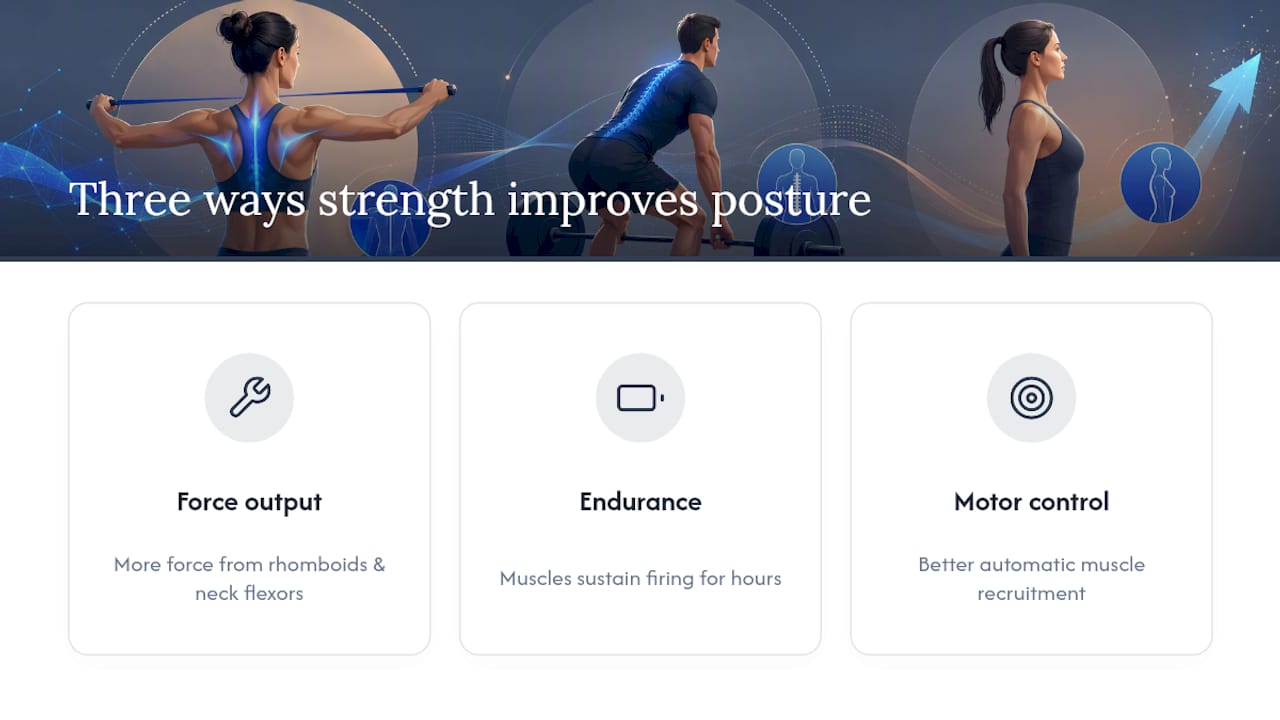
Set your expectations accordingly. Strength gains in the target muscles show up within two to four weeks of consistent training. Visible postural shifts, the kind you’d notice in a photo or a mirror, tend to take longer: Harvard Health notes that posture reflects habitual positioning built up over years, and reversing that habit takes sustained work, typically eight to twelve weeks before changes are obvious to other people.
Which Muscle Groups Control Your Posture Problems
Every common posture complaint traces back to a specific, identifiable weakness. Matching the problem to the muscle group is the fastest way to stop wasting time on exercises that don’t address your actual issue.
- Rounded shoulders and thoracic kyphosis come from underactive scapular retractors, mainly the mid and lower trapezius and rhomboids, overpowered by a tight, dominant chest.
- Forward head posture ties to weak deep neck flexors and overworked upper trapezius and levator scapulae, which strain to hold the head up when it drifts forward of the shoulders.
- Anterior pelvic tilt and lumbar strain usually point to weak glutes and hip extensors failing to counterbalance tight hip flexors.
- Poor alignment during daily tasks (standing at a counter, carrying groceries, sitting through a meeting) comes down to core endurance, not core strength in the gym-lift sense.
- Lateral tilt or one-sided slouching often signals a side-to-side imbalance, something unilateral carries and half-kneeling rows expose better than any bilateral exercise, according to posture-focused strength coaching.
A few quick self-checks help you find your weakest link before you build a program. Hold a front plank and time it. A shorter hold time may indicate core endurance is your limiting factor. Stand sideways in front of a mirror. If your ears sit noticeably forward of your shoulders, prioritize deep neck flexor and upper-back work. If one hip sits higher than the other in a relaxed stance, add unilateral loaded carries before anything else.
The Exercise Library: What to Do and How
This is the working list. Each exercise below targets one of the weak points above, with cues to get it right and a note on the most common way people mess it up.
1. Band face pulls. Anchor a band at chest height, pull toward your face while flaring your elbows out, and squeeze your shoulder blades together at the end. Keep your elbows above your wrists, drive the pull from your upper back rather than your arms, and pause for a full second at the finish. The most common fault is using the biceps to yank the band instead of retracting the shoulder blades, which trains the wrong muscles entirely.
2. Band pull-aparts. Hold a light band at chest height with arms extended, then pull it apart by driving your shoulder blades together. Keep your ribs down, don’t let your lower back arch, and control the return instead of letting the band snap back. This one is a warm-up staple precisely because it’s nearly impossible to cheat.
3. Seated cable or dumbbell rows. Row toward your torso, lead with the elbow, and finish with a scapular squeeze rather than just bending the arm. Regression: do the movement seated with back support to isolate the pull. Progression: move to chest-supported rows with heavier load once form is solid.
4. Wall angels. Stand with your back, head, and arms against a wall, then slide your arms up and down while keeping contact at all three points. This drill is really a diagnostic and a mobility primer, not a strength builder on its own. Regression: do it lying on the floor if wall contact is impossible at first.
5. Chin tucks. Pull your chin straight back, creating a “double chin,” without tilting your head down. This trains the deep neck flexors directly, the muscles most posture routines skip. Hold for 3 to 5 seconds, repeat 10 times.
6. Front plank progressions. Start on forearms with a straight line from head to heels. Regression: elevate hands on a bench. Progression: add a shoulder tap or extend hold time past 60 seconds.
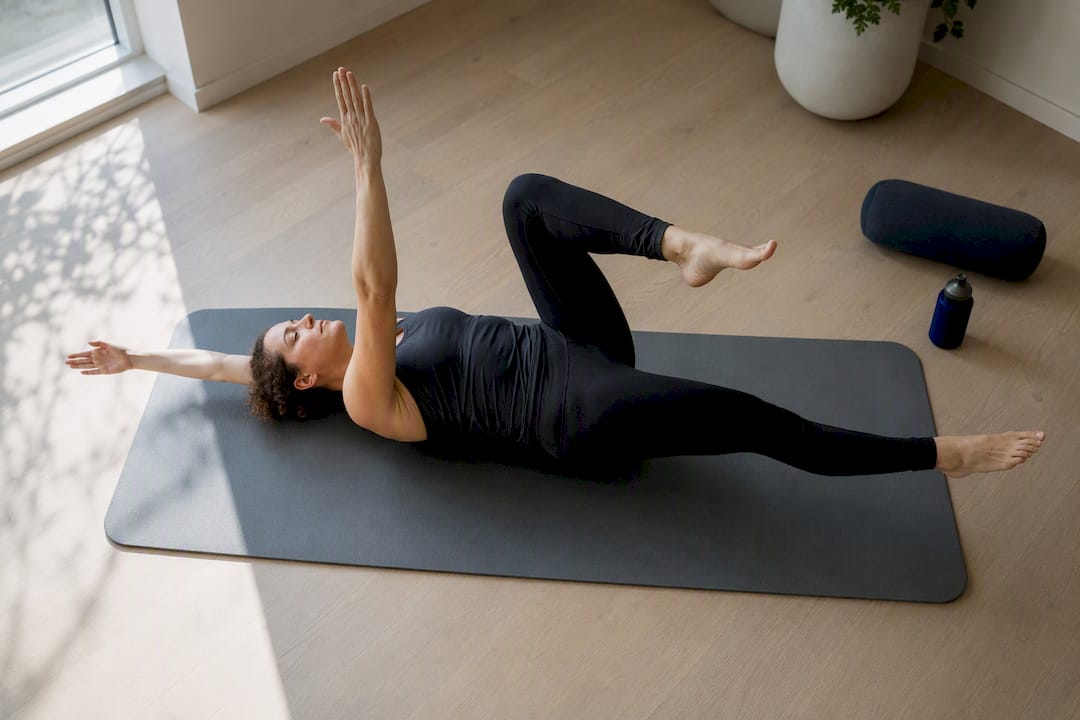
7. Dead bug. Lying on your back, extend opposite arm and leg while keeping your lower back flat against the floor. This teaches anti-extension core control, which is exactly what stops your ribs from flaring forward under load.
8. Pallof press. Anchor a band at chest height, hold it at your sternum, and press straight out while resisting rotation. Regression: use a lighter band. Progression: press from a half-kneeling position.
9. Glute bridges. Drive through your heels, squeeze your glutes at the top, and avoid overextending your lower back to get there.
10. Romanian deadlifts. Hinge at the hips with a slight knee bend, keep the bar or dumbbells close to your legs, and stop when you feel a hamstring stretch, not when your back rounds.
11. Split squats. Load one leg at a time to expose and correct side-to-side imbalances that plain squats hide.
12. Farmer’s carries. Walk holding heavy weight at your sides, shoulders back, ribs stacked over your pelvis. HSS’s posture program recommends loaded carries as a bridge between mobility work and full strength training, since they force postural control under real load rather than in a controlled lift.
Pro Tip: Breathe out on the effort phase of every pull and press, and slow your tempo on the way back to the start. A rushed eccentric phase is where most people leak the tension that’s supposed to be training the muscle.
An 8 to 12 Week Posture Program You Can Start Today
Pick the template that matches your current activity level, not your ambition. Consistency at the easier template beats sporadic effort at the harder one.
- Beginner, 2 days a week: Wall angels (2 sets of 10), chin tucks (2 sets of 10), seated rows (3 sets of 12), glute bridges (3 sets of 15), front plank (3 sets, hold to failure), farmer’s carry (2 sets of 40 yards). Rest 60 to 90 seconds between sets.
- Intermediate, 3 days a week: Split the week into a pull-focused day (rows, face pulls, chin tucks), a hip and core day (Romanian deadlifts, split squats, Pallof press, dead bug), and a full-body carry day (farmer’s carries, front plank progressions, band pull-aparts). Aim for 3 sets of 8 to 12 reps on loaded moves.
- Progression rules: Add weight once you complete all reps with clean form for two sessions in a row. Add reps before adding weight if form is still shaky. Slow the tempo (a 3 second lowering phase) before adding load if joints feel stressed. Deload by cutting volume in half every 5th or 6th week to let tissue recover.
How to Track Whether Your Posture Is Actually Improving
Photos beat memory every time. Take a side profile shot every two weeks in the same lighting and same relaxed stance, and compare ear position relative to your shoulder over time.
- Time your front plank hold weekly. An improving hold time tracks core endurance gains directly.
- Note your farmer’s carry distance or load. Longer carries with stable shoulders signal better postural endurance under load.
- Run a simple wall test monthly: stand with heels, glutes, and shoulder blades against a wall and see how far your head sits from the wall without straining.
Expect strength gains in the target muscles within two to four weeks. Visible postural change, the kind a friend would notice, generally takes eight to twelve weeks of consistent training, matching the timeline Harvard Health describes for reversing habitual positioning.
If progress stalls past six weeks, don’t just add more of the same. Increase frequency by one session, swap in a different pulling variation to hit the muscle from a new angle, or consult a physical therapist if pain accompanies the plateau rather than just slow progress.
Mistakes That Stall or Worsen Posture Work
- Overloading chest presses while under-training pulling movements reinforces the exact imbalance causing rounded shoulders in the first place. Keep pulling volume higher than pressing volume.
- Rounding the lower back during rows or deadlifts to move more weight trains poor mechanics under load, not good posture.
- Stretching pecs and hip flexors without strengthening the opposing muscles rarely produces lasting change. The systematic review found stretching alone had no significant effect on spinal posture.
- Stop and get evaluated if you notice numbness, tingling, progressive weakness, or pain that wakes you at night. Those are signs for a professional, not a program adjustment.
Behind This Guide: Site Approach and Further Resources
This guide comes from Madhukar, a contributor to Bestforwardheadposturefix, drawing on physical therapy literature and clinical posture research. The site’s approach centers on habit change, body awareness, and muscle rebalancing rather than quick fixes or single-stretch solutions.
For readers who want to go deeper on specific problem areas, these resources build directly on what’s covered here:
- How physiotherapy helps correct forward head posture for cases that may need clinician input
- Thoracic kyphosis exercises for deeper upper-back mobility work
- Forward head posture exercises for neck-specific drills
- A sports-performance physiotherapy resource like Zest Clinic for readers who want a professional movement assessment
What I’d Tell a Friend Starting This Today
Small cues compound faster than big workouts. Set your phone at eye level instead of looking down, pause mid carry to check your shoulders are back, and take a 30 second posture break every hour at your desk. None of that replaces the strength work, but it keeps the gains you’re building.
Patience matters more than intensity here. Give it the full eight weeks before judging results, and lean on the sample program above rather than improvising.
— Madhukar
Where to Find Structured Plans and Deeper Guides
This site’s library is built around one idea: posture correction sticks when you understand the mechanics behind it, not when you chase a viral stretch. That’s the real advantage here over scattered exercise lists you find elsewhere. Every guide connects habit change, awareness, and the muscle rebalancing work covered above into something you can actually follow week to week.

If the program in this guide is your starting point, the site’s deeper resources are the next step. The ergonomic desk setup guide pairs directly with your strength work by fixing the daily positioning that undoes it, and the forward head posture exercise library expands on the neck-specific drills covered here. Visit Bestforwardheadposturefix to browse the full set of structured plans and start applying them today.
Sources
- Effects of Stretching or Strengthening Exercise on Spinal and Lumbopelvic Posture: A Systematic Review with Meta-Analysis | Sports Medicine – Open
- The Better Posture Workout: 5 Moves to Try | HSS
- Is it too late to save your posture? | Harvard Health