Yes: repetitive breastfeeding and holding postures commonly cause postpartum “nursing neck,” a form of forward head posture from hours spent looking down at your baby. The fastest fix is supportive setup, bringing your baby to breast level with a pillow or armrest, paired with a 60-second chin-tuck micro-set after each feed. Daily strengthening and small posture adjustments resolve most cases within weeks, though progressive numbness, tingling, or pain that won’t budge deserves a clinician’s attention.
TL;DR:
- Bringing the baby to breast level using support can significantly reduce forward head posture during feeds, minimizing strain on neck muscles.
- Short, targeted micro-sets of chin tucks, thoracic extension, and scapular squeezes done three to four times daily can improve posture within weeks.
- Alternating breastfeeding holds and carrying sides prevents repetitive strain on the same muscles, reducing the risk of persistent pain.
- Supportive feeding setups and regular micro-movements help correct postural habits, with most women experiencing relief after a few weeks of consistent effort.
- Signs like numbness, severe pain, or no improvement after several weeks indicate the need for professional evaluation and personalized treatment.
Table of Contents
- Why Postpartum Neck and Upper-Back Pain Happens
- Fast Relief and a Daily Exercise Routine
- Feeding and Holding Setup That Protects Your Neck
- Small Habits That Fit a New Mom’s Day
- When to See a Physical Therapist or Provider
- The Research Behind These Recommendations
- A Realistic Word for Exhausted New Mothers
- Get a Structured Routine Instead of Guessing at Exercises
- Sources
- FAQ
Why Postpartum Neck and Upper-Back Pain Happens
Every time you look down to latch, burp, or check on a sleeping baby, your head tips forward and your chest rounds inward. Do that dozens of times a day, for months, and your body adapts to the position rather than fighting it. The deep neck flexors that should hold your head upright weaken, while the muscles at the base of your skull and across your upper traps stay in a constant, low-grade contraction. Research on postpartum women confirms a direct relationship between a reduced craniovertebral angle, the clinical measure of forward head posture, and higher pain and disability scores.
Your body isn’t fighting this fair, either. Postpartum hormones like relaxin keep joint ligaments looser than usual for months after delivery, which means your spine has less passive stability to lean on while those postural muscles relearn their job. Add in a core that’s still reconnecting after pregnancy, and you’ve got a spine with less support at both ends.
A few everyday habits tend to make it worse:
- Cradling your baby in the same arm for every feed, which loads one side of your neck and shoulder repeatedly
- Cross-cradle holds during early breastfeeding, when latch struggles keep your head tilted down for extended periods
- Side-lying feeds where the neck stays rotated and unsupported for long stretches
- Carrying your baby on the same hip constantly instead of alternating sides
- Scrolling your phone or watching your baby’s face during feeds, both of which pull your chin down and forward
None of this means damage. It means your posture has adapted to a repetitive demand, and it can adapt back with the right counter-movements.
Fast Relief and a Daily Exercise Routine
You don’t need a gym membership or thirty free minutes to fix this. You need short, targeted movements that undo the forward pull, done consistently enough that your body relearns a better default position.
The structure that works best for new mothers is a micro-set: roughly 60 seconds of focused movement, done three to four times a day, ideally tucked right after a feeding session while your baby is content or dozing.
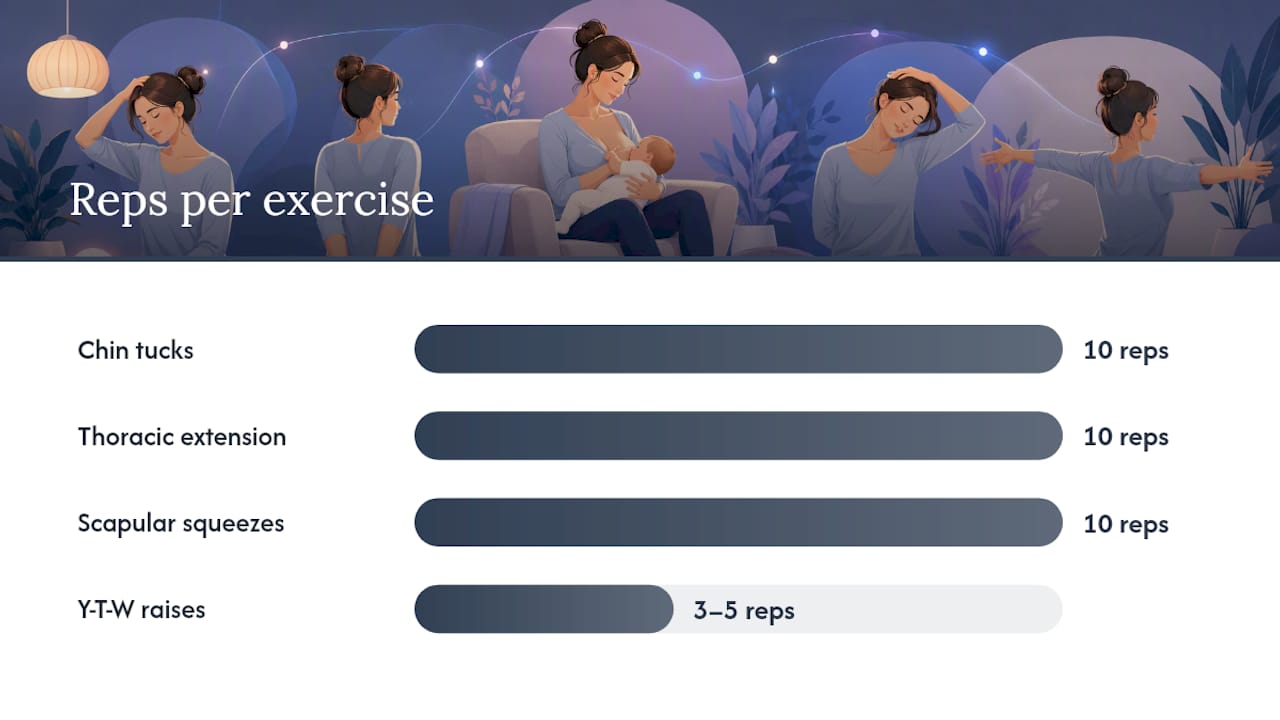
- Chin tucks (cervical retraction). Sit or stand tall, gently draw your chin straight back like you’re making a double chin, hold for 3 seconds, release. Repeat 10 times. This directly targets the deep neck flexors that forward head posture weakens.
- Thoracic extension. Sit in a chair, hands behind your head, and gently arch your upper back over the chair’s edge or a rolled towel. Ten slow reps opens up the rounded upper spine that feeding postures create.
- Scapular squeezes. Pull your shoulder blades down and together, as if pinching a pencil between them, hold for 5 seconds, repeat 10 times. This wakes up the mid-back muscles that stop your shoulders from rolling forward.
- Seated reverse fly or Y-T-W raises. Using light resistance (even just your arms’ own weight), lift your arms out to a “Y,” a “T,” then bend elbows into a “W,” holding each position for 2 to 3 seconds. Three to five reps per letter builds the scapular stability that a randomized controlled trial found meaningfully reduces neck pain and disability when added to standard postpartum posture programs.
Start with bodyweight or a light resistance band, and only add tension once the movements feel easy and pain-free. If you had a cesarean birth or significant pelvic floor trauma, check with your provider before adding resistance work, though gentle chin tucks and thoracic extension are almost always safe from the first postpartum week onward. Pair these sets with a slow exhale as you move, which naturally engages your deep core and takes some load off your spine.
Pro Tip: Keep a resistance band looped on your nursing chair’s armrest. When you finish a feed, it’s right there, and you’ll actually do the scapular squeezes instead of promising yourself you’ll get to it later.
Stop any movement that sharpens your pain rather than easing it, and don’t push through pinching or radiating sensations. Mild muscle fatigue after a set is normal; nerve-type pain is not.
Feeding and Holding Setup That Protects Your Neck
The exercises matter, but so does the position you’re in for the two to three hours a day you spend feeding. Small setup changes remove the problem at its source instead of just treating the aftermath.
Start with your chair. Pick one with real back support, not a soft couch that lets your spine collapse, and keep your feet flat on the floor or on a small stool so your hips aren’t tilting backward. Then bring your baby up to breast level using a nursing pillow, folded blanket, or the chair’s armrest, rather than hunching your neck and shoulders down to your baby. Clinical guidance from postpartum posture specialists consistently points to this single adjustment as the highest-leverage fix available.
Rotating your hold matters too. Cradle and cross-cradle holds work well early on but load the same muscles repeatedly if you always use the same arm. Try alternating with a football hold, which tucks your baby to your side rather than across your body, or a side-lying position for at least one feed a day if you’re comfortable with it. Observational research on feeding positions links prolonged, unvaried postures to higher rates of reported neck pain, which makes rotation a simple, free preventive step.
A few more habits worth building in:
- Switch which arm or hip carries your baby throughout the day, not just during feeds
- Keep your elbows bent and your baby held close to your body when lifting or carrying, rather than extended out in front of you
- Adjust carrier straps so your baby sits at chest height, not low near your hips, which pulls your shoulders forward
Small Habits That Fit a New Mom’s Day
You don’t need a dedicated workout window. You need cues attached to things you’re already doing dozens of times a day.
- After every feed, do a 10 second posture check. Roll your shoulders back, tuck your chin, and take one deep breath before you stand up.
- Set an hourly reminder for a “balloon on a string” reset. Imagine a string gently pulling the crown of your head toward the ceiling, which lengthens your neck and undoes the slump.
- Alternate sides during diaper changes and burping, the same way you rotate feeding arms, so no single side absorbs all the repetitive load.
- Ask your partner to do a quick posture check-in during evening routine, a second set of eyes catches slouching you’ve stopped noticing in yourself.
Pro Tip: Stick a small sticker or piece of tape on your phone case. Every time you see it, that’s your cue for one chin tuck. It takes four seconds and stacks up fast over a day.
When to See a Physical Therapist or Provider
Most postpartum neck pain responds to consistent home exercise and setup changes within a few weeks. Some signs mean it’s time to get evaluated rather than wait it out:
- Numbness, tingling, or weakness radiating into your arm or hand
- Pain that’s severe, constant, or waking you from sleep
- No improvement after several weeks of consistent chin tucks, thoracic extension, and setup changes
- Headaches at the base of your skull that are getting more frequent, not less
A physical therapist will typically measure your craniovertebral angle, score your symptoms using the Neck Disability Index, and build a scapular stabilization plan around your specific feeding routine. Bring a two or three day log of your typical holding and feeding positions, and be specific about which side you favor. Ask directly for a postpartum-specific rehab plan, since generic neck programs don’t usually account for breastfeeding mechanics.
The Research Behind These Recommendations
Postpartum neck pain isn’t a mystery ailment. It’s a predictable biomechanical response to repetitive forward postures, and the research on correcting it is unusually consistent for a musculoskeletal issue.
More than half of breastfeeding mothers report neck pain in studies examining postpartum neck mechanics and prevalence, a figure high enough that it should be treated as an expected part of early postpartum recovery, not a rare complication. The good news is that the research on what actually helps is equally clear.
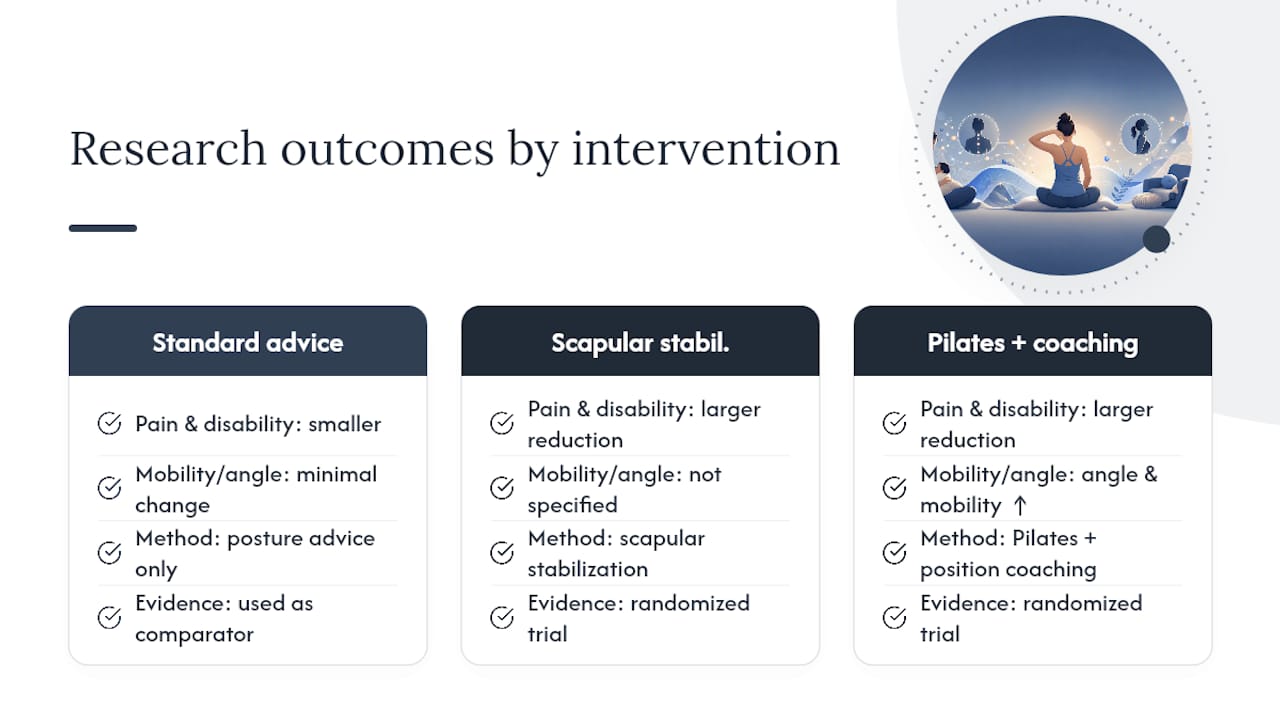
A randomized controlled trial testing scapular stabilization work found it produced larger reductions in neck pain and disability than standard posture advice alone. Separately, an RCT combining Pilates-based exercise with breastfeeding position coaching improved craniovertebral angle, cervical mobility, and patient-reported disability more than positioning advice by itself. The habit-change method promotes active strengthening paired with setup correction, not passive fixes alone. For a routine you can start today, the breastfeeding-specific micro-set guide walks through the same movements covered above with feeding-timed cues.
A Realistic Word for Exhausted New Mothers
You are recovering, not broken. Expect gradual change over weeks, not overnight relief, and judge progress by small wins: less morning stiffness, fewer tension headaches. Give a simple routine two to six weeks before deciding whether it’s working.
— Madhukar
Get a Structured Routine Instead of Guessing at Exercises
The approach is built around the common problem of figuring out which movements actually matter when running on broken sleep and having five free minutes between feeds. Exercises are organized into structured, habit-based sequences you can follow without re-learning your routine every day.

The breastfeeding posture guide walks through supported feeding setups and short micro-sets timed to your actual feeding rhythm, and the posture correction mechanics guide breaks down why these specific movements work rather than just listing them. If you’re also dealing with disrupted sleep on top of neck pain, the sleep position guide covers pillow height and alignment for side-sleeping with a healing body. Start with the breastfeeding posture guide today and build your first micro-set routine before your next feed.
Sources
- Mechanics and prevalence of postpartum neck pain (PMC article)
- Effect of scapular stabilization exercise on breastfeeding women with non-specific neck pain
- Effect of pilates exercises plus breastfeeding positioning adjustment on craniovertebral angle in breastfeeding women with forward head posture | Scientific Reports
- Impact of breastfeeding positions on neck pain in postpartum mothers | International Journal Of Community Medicine And Public Health
FAQ
What is the 3-3-3 rule for postpartum recovery?
There’s no single clinically defined “3-3-3 rule” for postpartum posture; the term shows up loosely in parenting circles to describe short recovery check-ins. For neck pain specifically, a more reliable structure is the micro-set approach covered above: 60-second exercise sets, three to four times daily, timed to feeds.
How do I fix nursing mother’s neck?
Bring your baby to breast level with a pillow or armrest instead of leaning down, then add chin tucks, thoracic extension, and scapular squeezes in short daily sets. Trials combining scapular stabilization with posture coaching show measurably better results than posture advice alone.
What is postpartum neck, exactly?
Postpartum neck, sometimes called “nursing neck,” refers to forward head posture and upper-back rounding that develops from repeated feeding and holding positions after childbirth. It’s a mechanical adaptation to posture, not a structural injury, and it responds well to targeted exercise.
How can I fix my postpartum posture overall?
Combine ergonomic feeding setup (supported back, baby at breast level, rotated holds) with daily scapular and neck-strengthening exercises, and build in hourly micro-movement checks. Most mothers notice reduced stiffness within a few weeks of consistent practice, and structured routines make consistency easier to maintain.