Kneeling chairs do what they claim in the short term: they tilt your pelvis forward, help preserve the spine’s natural lumbar curve, and cut down on lower-back muscle strain compared to sitting at 90 degrees. That’s the verdict backed by radiographic and EMG research. But they work best as a short-duration active-sitting tool for focused tasks, not an all-day swap for your office chair, and they only deliver those kneeling chair benefits when the angles are set right and you ease into using one.
TL;DR:
- Kneeling chairs improve lumbar curvature preservation when set at around 20 degrees, reducing lower-back muscle activity during focused tasks.
- They shift load to the shins and knees, which can cause discomfort or pain for people with knee issues or poor circulation, especially in the first weeks.
- Proper adjustment of seat and knee angles, gradual wearing-in, and matching desk height are crucial for comfort and effectiveness.
- Using kneeling chairs as a short-term tool combined with posture correction habits enhances long-term spine health.
- Not all models have adjustable angles, so prioritize quality padding, sturdy frames, and compatible ergonomic setup for best results.
Table of Contents
- What a kneeling chair is and how it changes sitting geometry
- Evidence-backed kneeling chair benefits: what the research shows
- Potential downsides and who should be cautious
- How to use a kneeling chair safely: adaptation schedule and setup checklist
- Practical buying and setup tips that actually matter
- Where kneeling chairs fit in a real posture correction plan
- Start a structured posture program instead of guessing chair by chair
- Sources
What a kneeling chair is and how it changes sitting geometry
A kneeling chair drops the traditional backrest and seat pan setup entirely. Instead, you sit on a forward-sloping seat pan, usually angled between 15 and 30 degrees, with padded rests supporting your shins and knees below. That geometry forces your hips open to roughly 120 to 135 degrees, compared to the closed 90-degree hip angle of a standard office chair.
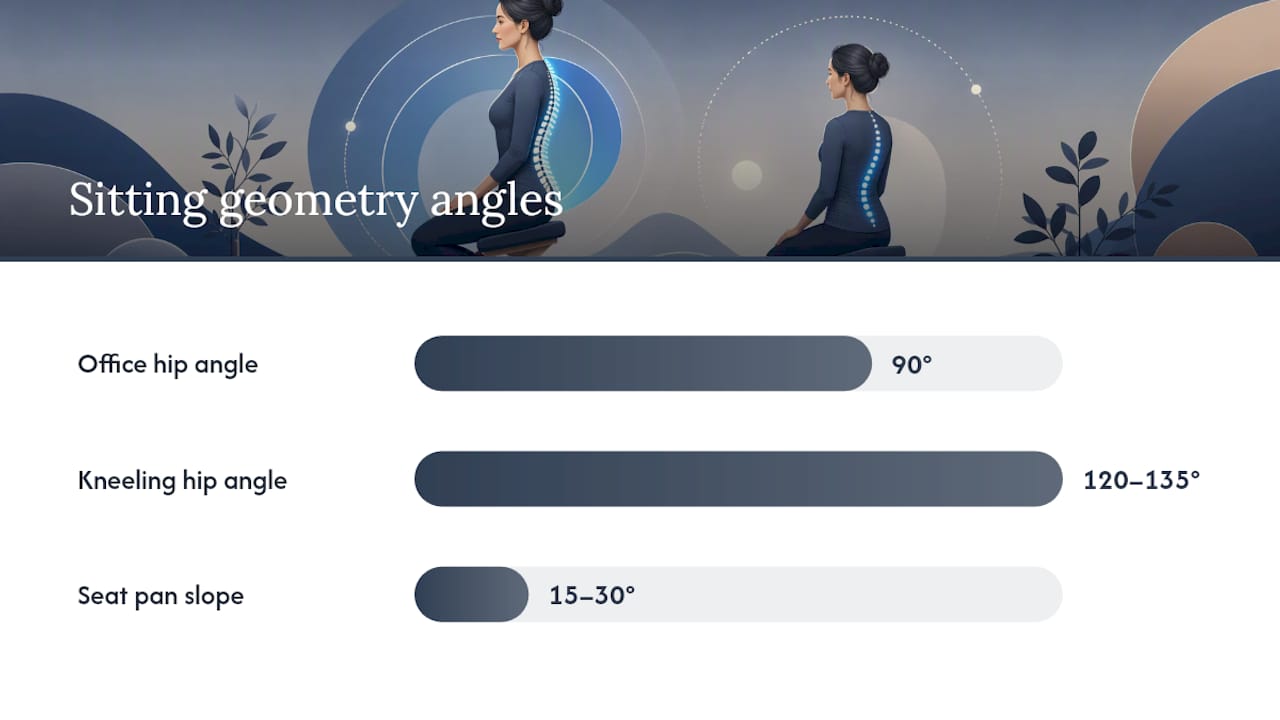
The mechanism matters more than the shape. When the seat tilts forward, your pelvis follows it into a slight anterior tilt. That preserves the spine’s natural lumbar curve, called lordosis, instead of letting it flatten the way it does in a conventional chair.
Picture the chain reaction: seat angle shifts your pelvis, pelvis tilt opens your hips, and open hips let your lower spine keep its natural inward curve instead of collapsing into a slouch.
- Forward-sloping seat pan (15 to 30 degrees) redistributes weight toward your shins and thighs.
- Open hip angle (120 to 135 degrees) reduces the tendency to round the lower back.
- Anterior pelvic tilt keeps lumbar lordosis intact instead of flattening it under load.
Evidence-backed kneeling chair benefits: what the research shows
The strongest case for kneeling chairs comes from measured spinal curvature, not marketing copy. A repeated-measures study comparing an ergonomically designed kneeling chair set at +20 degrees against a standard computer chair found a mean lumbar curvature difference of about 7.633 degrees favoring the kneeling chair for maintaining a standing-like lumbar shape. That’s a meaningful gap when you consider how much time office workers spend collapsed into a rounded lower back.
The number that matters: kneeling chairs preserved roughly 7.6 degrees more of the spine’s natural standing curve than a standard chair in controlled testing, a difference large enough to show up on radiographs, not just self-reported comfort scores.
A separate pilot study using radiographic imaging on both chronic low back pain patients and healthy controls reached a similar conclusion. Lumbar lordosis dropped less on a kneeling chair than on a usual chair, and the chair effect on sacral slope and lumbar curvature reached statistical significance. That consistency across two different research designs, one comparing chair angles and one comparing patient groups, is what gives the biomechanical claim real weight.
Muscle activity backs up the curvature data. EMG research measuring lumbar erector spinae activity, the muscles running along either side of your spine, found decreased activation in kneeling configurations compared to standard 90-degree sitting. A 2026 study went further and tested four different angle combinations of seat pan and knee rest, identifying SA20-KA20 as the most favorable pairing for both lower muscle activity and perceived comfort. That’s a seat pan angle around 20 degrees paired with a knee rest angle around 20 degrees.
Put together, the practical upside looks like this:
- Less compressive load on the lower back during seated work.
- More passive engagement of your core to stabilize the open hip position.
- Better posture retention during short, focused tasks like drafting, coding, or reading.
- Some users report easier breathing and circulation with the hips open, though this effect is harder to measure directly.
The catch is consistency. Subjective comfort and long-term muscle activation show mixed results depending on which angle combination researchers test and whether the design includes a backrest. One person’s ideal 20 degree setup can feel wrong for another body type, which is exactly why angle adjustment matters more than any single “best” chair.
Potential downsides and who should be cautious
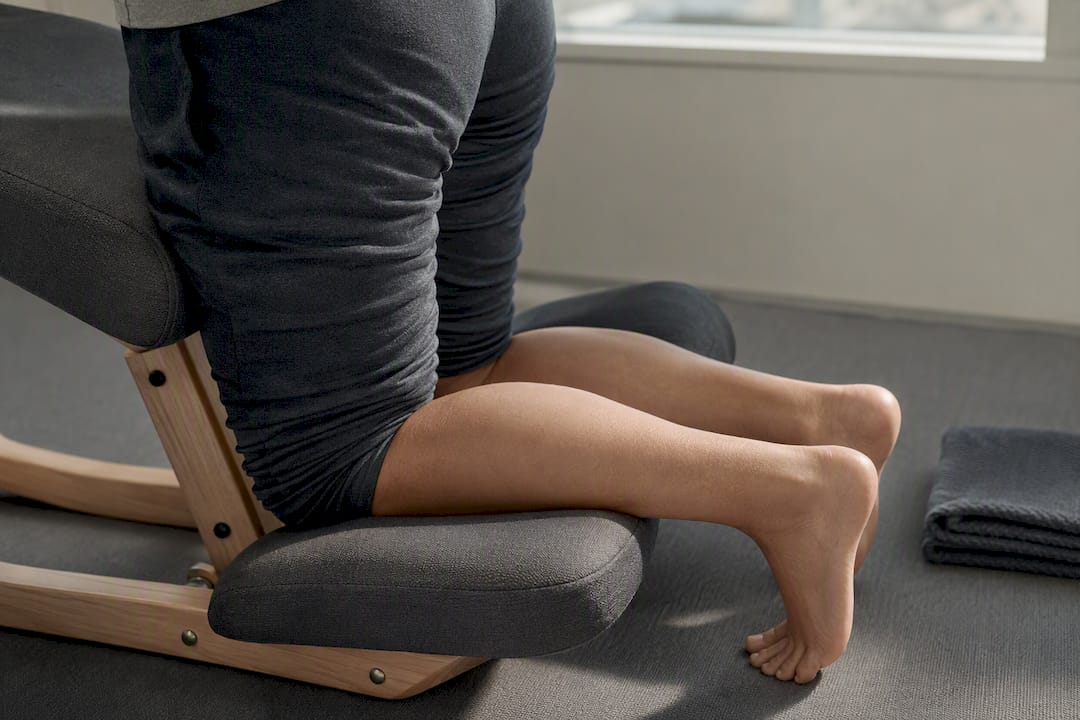
Every kneeling chair benefit comes with a tradeoff, and the biggest one is where your body weight actually lands. Because the design shifts load onto your shins and thighs instead of your seat and back, that pressure point becomes a problem for certain people fast.
Shin and knee discomfort is the most common complaint, especially in the first week or two. If you have knee osteoarthritis, recent knee surgery, or poor circulation in your lower legs, that pressure can turn into real pain rather than mild adjustment soreness.
The second risk hides upstream. Pelvic tilt and head posture are mechanically linked. If your monitor or desk height isn’t raised to match your new seated position, you’ll crane your neck forward to see the screen, undoing the lumbar benefit by trading it for upper back and neck strain.
Comfort outcomes are also inconsistent. Some people with certain disc conditions find the forward tilt aggravates symptoms rather than relieving them, which is a good reason to check with a clinician before committing to daily use, particularly if you already manage chronic low back pain.
- Watch for numbness or tingling in your shins after 20 to 30 minutes.
- Stop if you notice new neck or upper back tightness within the first few sessions.
- Reassess if lower back pain increases rather than decreases after a week of consistent use.
Pro Tip: Keep a simple daily log of when discomfort starts and where. A pattern that shows up at minute 15 every time usually means an angle problem, not a chair problem.
How to use a kneeling chair safely: adaptation schedule and setup checklist
Jumping into a kneeling chair for a full workday is the fastest way to end up sore and convinced it doesn’t work. Your body needs a transition period, and the research on angle combinations gives you a reasonable starting point rather than guesswork.
- Start small. Begin with 10 to 20 minute sessions, two to three times a day, during your first few days.
- Set your angles. Try a seat pan around 20 degrees and a knee pad around 20 degrees as your baseline, since the SA20-KA20 combination performed best for reducing muscle strain and discomfort in recent testing.
- Increase gradually. Add 15 to 20 minutes every two to three days, working toward one to two hour sessions by the end of your trial week.
- Match your desk height. Raise your monitor and keyboard so your neck stays neutral once your seated height changes; check ergonomic desk setup guidance if you’re unsure where to start.
- Track functional signs, not just posture. Note whether you can work at your screen without neck strain and whether typical tasks feel easier, rather than chasing a perfect-looking spine angle.
- Know when to stop. Quick relief within the session is a good sign; new or worsening pain after several sessions means reduce duration or pause entirely.
Practical buying and setup tips that actually matter
Not every kneeling chair on the market reflects the angle research above, so look past the aesthetic and check the mechanics. An adjustable seat pan angle matters more than any other spec, since the 20 degree range researchers tested isn’t a universal fit for every body.
Beyond angle adjustment, prioritize quality padding on both the seat and shin cushions, a sturdy frame with a clear weight rating, and an adjustable knee pad height so the pressure lands where you want it rather than where the manufacturer guessed. A rocker base that allows small forward and back movement helps some people avoid the static discomfort that builds up during longer sessions.
Budget models work fine for occasional use, a few sessions a week during focused tasks. If you’re planning daily use, spending more on adjustability and padding quality pays off faster than you’d expect, since that’s where cheaper chairs cut corners first.
Most people get the best results pairing a kneeling chair with a proper lumbar-support office chair for longer stretches of the day, then switching to the kneeling chair for shorter, focused blocks. Alternating chairs, rather than picking one to rule your whole day, is what the evidence actually supports.
Where kneeling chairs fit in a real posture correction plan
Kneeling chairs are a genuinely useful tool for active sitting, but they’re not a standalone fix for forward head posture or chronic slouching. A chair can open your hips and support your lumbar curve for an hour. It can’t rebuild the muscle patterns that let your head drift forward in the first place.
That’s where habit change, postural awareness training, and targeted muscle rebalancing come in. Combine a kneeling chair trial with consistent posture correction habits and you get a tool that reinforces the work you’re already doing, rather than one more gadget sitting unused after two weeks.
— Madhukar
Start a structured posture program instead of guessing chair by chair
Kneeling chairs help, but they answer one narrow question: how you sit for an hour. Bestforwardheadposturefix builds the answer to the bigger question, why your head drifts forward in the first place and what daily habits actually reverse it.

The site’s guides walk through posture exercise sequences, desk and chair setup checklists, and the habit-tracking steps that turn a good chair choice into lasting change instead of a short-lived experiment. None of it requires buying anything. If you’ve just spent a week testing seat angles and monitor heights, the next logical step is learning what’s actually driving the strain in your neck and shoulders, and fixing that directly. Start with the forward head posture correction guides to build a program around whatever chair setup you land on.
Sources
- Assessment of the effect of four kneeling chair angle combinations on muscle activity and perceived discomfort (Sensors, 2026)
- Effect of a kneeling chair on lumbar curvature in patients with low back pain and healthy controls: A pilot study
- Ergonomically designed kneeling chairs: comparison of sagittal lumbar curvature