The deep neck flexors, made up of the longus colli, longus capitis, and rectus capitis anterior and lateralis, function as the neck’s core, stabilizing each vertebral segment during everyday movement. Most weakness comes from forward head posture, screen habits, or old neck pain, and it rarely announces itself with soreness. Retraining these muscles requires low-load, motor-control work like tiny craniocervical nods rather than heavy strengthening, and consistent practice over several weeks, not brute effort, is what changes the pattern.
TL;DR:
- Weakness in deep neck flexors is primarily caused by forward head posture and sedentary habits, with minimal symptoms but significant impact on stability.
- Proper testing focuses on control rather than strength, with exercises emphasizing gentle, small nods performed lying down and progressing to sitting or standing.
- Consistency, not intensity, is key, with short daily sessions building control and preventing substitution by superficial muscles like the sternocleidomastoid.
- Advances in control typically appear within weeks, but symptom relief depends on pairing exercises with posture and habit improvements.
- Avoid overexertion, resistance, or pushing range during training, and seek professional guidance if experiencing recent trauma or neurological symptoms.
Table of Contents
- What Are the Deep Neck Flexors?
- What Causes Deep Neck Flexor Weakness?
- What Are the Signs of Deep Neck Flexor Dysfunction?
- How Do You Test Deep Neck Flexor Strength?
- How Do You Activate the Deep Neck Flexors?
- How Do You Progress Deep Neck Flexor Training?
- What Are Common Mistakes When Training the Deep Neck Flexors?
- What Does the Research Say About Deep Neck Flexor Training?
- Precautions and Contraindications for Deep Neck Flexor Exercises
- Why Do the Deep Neck Flexors Matter for Spinal Health?
- How Does Deep Neck Flexor Weakness Relate to Neck Pathologies?
- What Do the Deep Neck Flexors Look Like Anatomically?
- How Do You Add Deep Neck Flexor Work to a Daily Routine?
- Why Habit Change Matters More Than Quick Fixes
- Ready to Build a Structured Retraining Plan?
- Where to Go for Deeper Reading
- Sources
What Are the Deep Neck Flexors?
The deep neck flexors sit tucked against the front of the cervical spine, well behind the muscles you can see or grab in the mirror. The longus colli runs in three overlapping sections from the upper chest vertebrae up to the base of the skull, and the longus capitis lies just above it, both attaching directly to the front of the vertebral bodies rather than skipping across several segments like the superficial muscles do. The rectus capitis anterior and lateralis are shorter still, connecting the skull to the first vertebra and fine-tuning small nodding movements at the craniocervical junction.
This placement is why clinicians classify them as segmental stabilizers rather than movers. They’re built for endurance, not force. Think of them less like a bicep and more like the small muscles that keep your ankle steady when you stand on one leg. When they underperform, bigger, more superficial muscles, especially the sternocleidomastoid, step in to cover the stability job they weren’t designed for. That substitution is the root of most of the dysfunction this article covers.
What Causes Deep Neck Flexor Weakness?
Forward head posture from hours spent hunched over a laptop or phone is the most common driver. The deep flexors lengthen and go quiet while the head sits forward of the shoulders, and the muscles simply stop getting asked to do their job.
Old neck pain or trauma changes the picture differently. Pain inhibits these muscles directly, and the body compensates by leaning on the sternocleidomastoid and upper traps instead, a pattern that can outlast the original injury by months. Sustained slouched postures at a desk or in a car seat train the same avoidance. Add in shallow breathing patterns or a forward-set jaw, both common in sedentary lifestyles, and the deep flexors get even less opportunity to fire correctly through the day.
What Are the Signs of Deep Neck Flexor Dysfunction?
Forward head posture is the most visible clue, often paired with a nagging ache at the base of the skull or cervicogenic headaches that build through the afternoon. Neck fatigue that shows up early, during something as simple as reading in bed or looking down at a phone, is another marker.
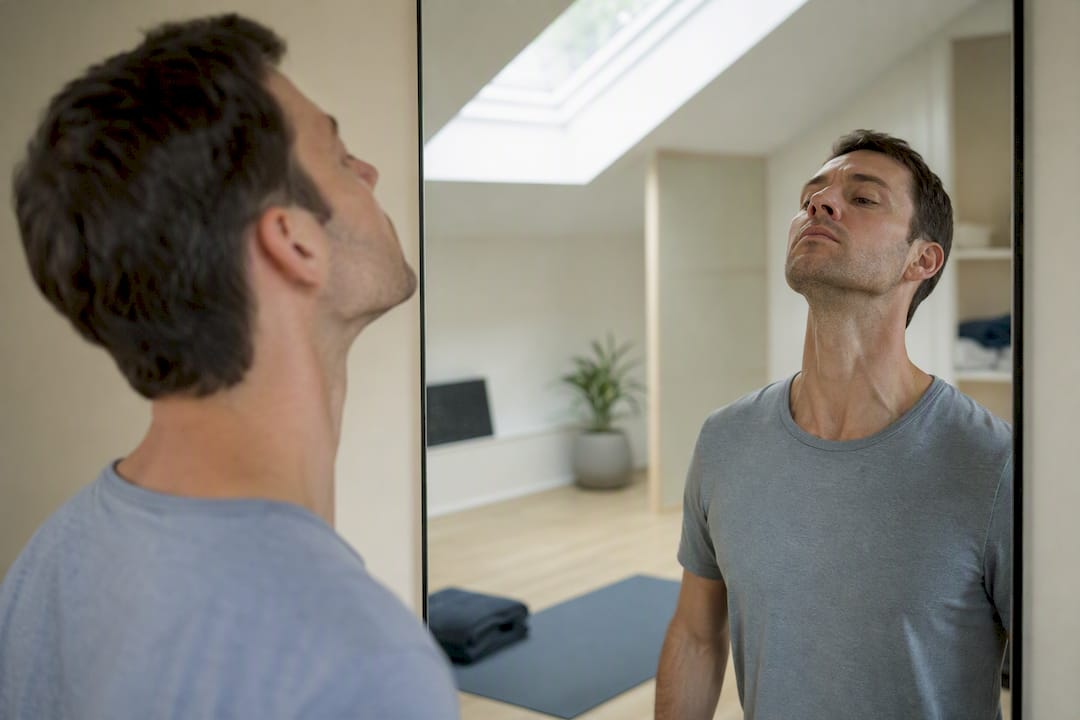
The clearest self-test sign: try a small nodding motion and watch for your sternocleidomastoid muscles bulging out at the sides of your throat. That bulge means the deep flexors got overruled before the movement even started, and most people can’t hold a slight chin nod steady for more than a few seconds without it.
How Do You Test Deep Neck Flexor Strength?
Clinicians use the craniocervical flexion test (CCFT), which measures control rather than raw strength. A pressure sensor placed under the neck registers small increases as you perform a tiny nodding motion, and the test progresses through incremental pressure stages rather than a single maximum effort. Passing a higher stage without the sternocleidomastoid kicking in shows genuine motor control, while failure typically means the superficial muscles took over.
You can approximate this at home without equipment:
- Lie on your back, chin gently tucked, and watch for neck bulging in a mirror or with a phone camera.
- Place two fingers lightly on your throat; if the muscles under your fingers tense hard, you’re substituting.
- Try holding a small, relaxed nod for about 10 seconds without your jaw clenching or breath catching.
See a clinician rather than self-treating if you have a recent trauma, numbness or tingling into the arms, dizziness with neck movement, or symptoms that keep progressing rather than plateauing.
How Do You Activate the Deep Neck Flexors?
Start supine, since gravity assists rather than fights you here.
- Lie on your back with your knees bent and a small towel roll under your neck for support.
- Rest your tongue on the roof of your mouth, just behind your front teeth. This one cue does more to quiet the sternocleidomastoid than almost anything else.
- Nod your chin slightly, as if gesturing a tiny “yes,” sliding the back of your head about 2 centimeters along the floor. This is not a full chin tuck, and it should feel almost too small to count.
- Hold for 10 seconds, breathing normally, then release slowly.
- Repeat for 10 reps, resting between each one.
Once supine holds feel steady and effortless, move to sitting. Use a fingertip lightly on your chin as a cue, guiding the small nodding motion rather than pushing against resistance, and check your form in a mirror to catch any early sternocleidomastoid bulging. Progressive templates from small supine nods to unsupported seated holds give you a natural staging system to follow as control improves.
Pro Tip: If you feel real effort or notice your neck muscles bulging, back off the range of motion. The exercise should feel almost too easy. That sensation is the entire point, not a sign you’re doing too little.
How Do You Progress Deep Neck Flexor Training?
Early on, favor frequency over intensity: several short sessions of a few minutes scattered through the day beat one long grinding set. Five nods held 10 seconds each, done four or five times daily, builds the habit faster than a single 20-minute workout ever will.
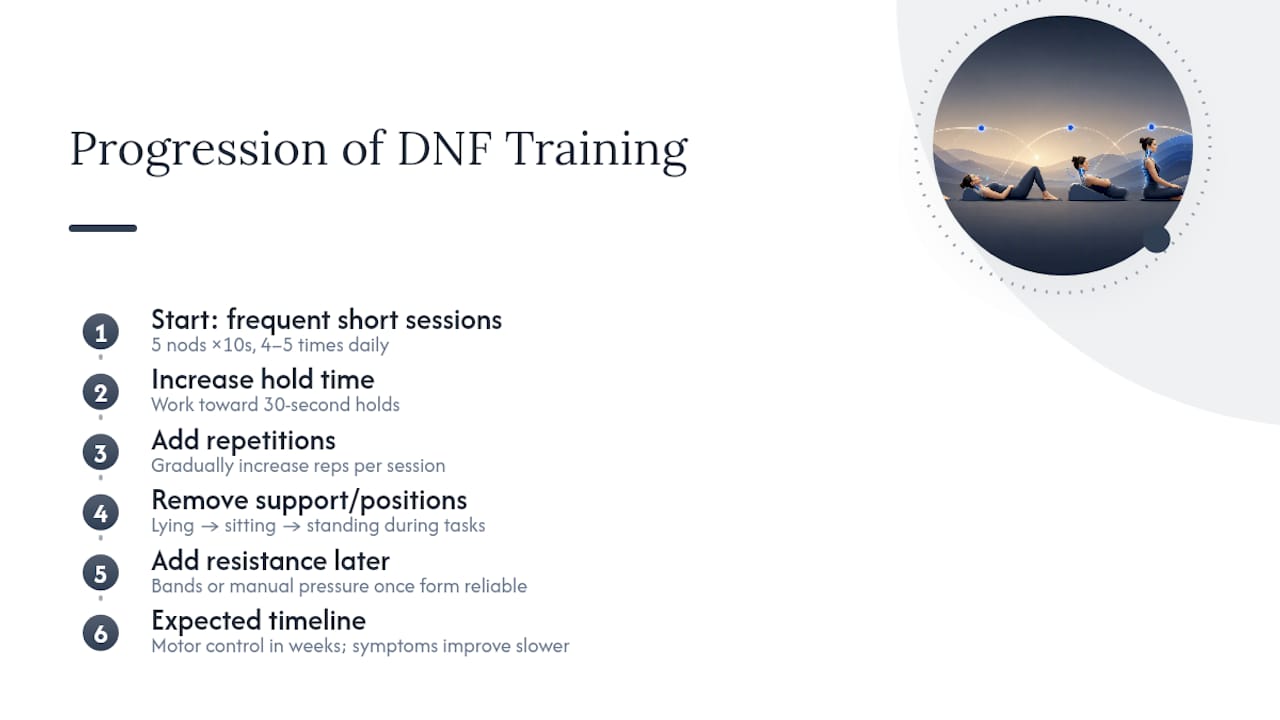
Progress by extending hold time toward 30 seconds, adding reps, and eventually removing the supported positions, moving from lying to sitting to standing while holding posture during simple tasks like typing or walking. Loading with resistance bands or manual pressure comes much later, and only once form is reliable without it.
Expect measurable improvements in motor control within a few weeks of consistent daily practice. Symptom relief, like fewer headaches or less neck fatigue, tends to follow on a slower and less predictable timeline, and usually depends on pairing these exercises with posture correction habits rather than treating them as a standalone fix.
What Are Common Mistakes When Training the Deep Neck Flexors?
The single biggest error is trying too hard. Increased effort recruits the sternocleidomastoid and upper traps almost immediately, which defeats the entire motor-control goal of the exercise even though it might feel like you’re working harder and doing better.
Watch for these specific red flags during practice:
- Visible bulging or hardening at the sides of the throat during a nod.
- Holding your breath or clenching your jaw through the hold.
- Pushing the chin down toward the chest instead of a small backward glide of the head.
- Adding weight, bands, or manual resistance before the small unloaded nod is fully controlled.
If these patterns persist despite reducing effort and range, a physical therapist can offer hands-on feedback that’s hard to replicate from a mirror alone.
What Does the Research Say About Deep Neck Flexor Training?
Clinical studies, including work associated with researchers like Jull, Falla, and O’Leary, consistently find reduced deep flexor endurance and altered activation patterns in people with chronic neck pain, and craniocervical flexion training measurably improves that motor control over the course of a program. The evidence leans toward low-load endurance retraining rather than heavy resistance work as the more effective lever for this specific deficit.
That said, most trials pair this exercise with other elements like manual therapy, posture education, or activity modification, so isolating exercise as the sole cause of improvement oversimplifies the picture. Study designs vary widely in duration and population, and outcomes differ depending on whether the underlying issue is postural strain, whiplash, or degenerative change. Treat craniocervical flexion training as a well-supported piece of a broader plan, not a guaranteed cure on its own.
Precautions and Contraindications for Deep Neck Flexor Exercises
These exercises are low-load by design, but that doesn’t make them risk-free for everyone. Anyone with a recent whiplash injury, cervical fracture, or unstable spinal condition should get medical clearance before starting, since even gentle nodding motions load the upper cervical joints.
Stop and seek evaluation if you notice dizziness, visual changes, ringing in the ears, or numbness and tingling radiating into the arms during or after practice. These can signal vertebral artery or nerve root involvement that a home exercise program shouldn’t push through.
People with inflammatory conditions affecting the cervical spine, such as rheumatoid arthritis with atlantoaxial instability, need a clinician’s guidance before attempting craniocervical flexion work, since the small joint most involved in this movement is exactly the one at risk. Pregnant individuals and older adults with significant osteoporosis should also check in with a provider first, less because of the exercise itself and more because positioning (particularly extended supine holds) may need adjustment.
If you have had recent neck surgery, active infection, or an undiagnosed lump or mass in the neck, hold off entirely until cleared. And if pain increases rather than decreases over a week or two of consistent practice, that’s a signal to stop and reassess rather than push through, since the entire premise of this training is that it should feel easy, not effortful or aggravating.
Why Do the Deep Neck Flexors Matter for Spinal Health?
The cervical spine relies on a balance between mobility and control, and the deep neck flexors are the primary muscles supplying that control at each individual vertebral level. Without them functioning properly, the neck loses its ability to fine-tune position moment to moment, and that job gets pushed onto joints, discs, and superficial muscles that weren’t built to handle it long term.
This matters more than most people assume, because the cervical spine carries the weight of the head, roughly 10 to 12 pounds, through a stack of small, mobile joints all day, every day. When the deep stabilizing muscles are weak, that load transfers unevenly across segments instead of being distributed and controlled the way a healthy system manages it.
Over years, this uneven loading contributes to the kind of wear-and-tear changes that show up on imaging in middle age and beyond. It’s not the only factor by any means, genetics and general activity level matter too, but posture-driven strain compounds daily and rarely announces itself until symptoms are well established.
Good deep neck flexor function also supports better shoulder and upper back mechanics, since the neck and shoulder girdle share fascia and movement patterns. A weak neck core often shows up as compensatory tension in the traps and levator scapulae, which is why so many people who train these deep muscles report loosening elsewhere in the upper body as an unexpected side effect. The neck doesn’t operate in isolation, and neither does the fix.
How Does Deep Neck Flexor Weakness Relate to Neck Pathologies?
Deep neck flexor weakness doesn’t cause cervical spondylosis or a herniated disc directly, but it changes the mechanical environment those conditions develop in. When the deep stabilizers aren’t doing their job, the cervical joints and discs absorb more shear and compressive stress than they’re designed for, particularly at the segments where forward head posture concentrates load, typically the lower cervical spine.
Cervical spondylosis, the degenerative wear of the vertebrae and discs that tends to appear with age, correlates with years of altered loading patterns. A neck that has spent decades compensating with superficial muscles instead of deep stabilizers is working with a different stress distribution than one where the deep flexors carried their share of the job.
Disc herniation follows a similar logic. Discs herniate under repeated or sustained mechanical stress, and poor segmental control from weak deep flexors means individual vertebral levels move less predictably under load. That’s not a guarantee of injury, plenty of people with weak deep flexors never herniate a disc, but it shifts the odds and often worsens recovery time when a herniation does occur, since the muscles that should stabilize the healing segment aren’t contributing.
This is part of why physical therapists routinely include craniocervical flexion work in rehabilitation for both conditions rather than treating it as unrelated to structural neck problems. Restoring segmental control doesn’t reverse existing degeneration, but it can reduce the ongoing mechanical strain that makes symptoms worse and recovery slower.
What Do the Deep Neck Flexors Look Like Anatomically?
Picture the cervical spine from the side, a gentle forward curve of seven vertebrae stacked from the base of the skull to the top of the shoulders. The deep neck flexors run along the front of that curve, hidden directly against bone, layered beneath the esophagus and major blood vessels rather than sitting near the surface like the sternocleidomastoid you can see and pinch between two fingers.
The longus colli spans nearly the full length of the cervical spine in three overlapping sections: a superior oblique portion angling up toward the first vertebra, an inferior oblique portion angling down toward the upper chest, and a vertical portion running straight up the middle connecting several vertebral bodies directly. This layered, overlapping design is part of why the muscle is so effective at controlling small movements across multiple segments simultaneously rather than just one joint.
The longus capitis sits just in front of and above the longus colli, connecting several cervical vertebrae up to the base of the skull, working almost like a strap that keeps the skull from tipping too far forward or extending too far back. The rectus capitis anterior and lateralis are much shorter, spanning only from the skull to the first cervical vertebra, functioning more like fine-tuning cables than primary movers.
If you’re trying to visualize location on your own body: place two fingers just behind your jawline, roughly where your throat meets the underside of your chin, and imagine a column of small muscle running straight back and down along the front of your spine from there. That’s roughly the territory these muscles occupy, working constantly and invisibly every time you hold your head upright.
How Do You Add Deep Neck Flexor Work to a Daily Routine?
The exercises themselves take almost no time, five reps of a 10 second hold takes under two minutes, which means the real challenge is remembering to do them, not finding time for them.
Anchor the practice to something you already do daily. A few nods while brushing your teeth, another set while waiting for coffee to brew, one more before bed while lying down: this kind of habit-stacking works better than scheduling a dedicated “neck workout” that competes with everything else on your calendar.
Pair the exercise with posture cues rather than treating it as separate from your workstation setup. A monitor raised to eye level, a chair that supports your lower back, and periodic reminders to stack your ears over your shoulders all reduce the forward head pull that caused the weakness in the first place. Scapular retraction work complements this well, since a stable shoulder blade gives the neck a more supportive base to work from.
If you’re rehabilitating after an injury or working with a physical therapist, deep neck flexor activation typically fits early in a broader program, often alongside cervical retraction exercises and gentle mobility work, before progressing to more demanding stability challenges. The sequencing matters: control comes before load, every time.
Why Habit Change Matters More Than Quick Fixes
Exercises alone rarely undo years of forward head posture. Lasting change means pairing craniocervical flexion training with ergonomic adjustments and breathing awareness, tracked consistently rather than attempted once and abandoned.
— Madhukar
Ready to Build a Structured Retraining Plan?
Bestforwardheadposturefix is the alternative to guessing your way through neck exercises you found in a random video. Where most sources give you one isolated stretch, Bestforwardheadposturefix gives you the full sequence: posture education, habit-change guidance, and stepwise programs that connect deep neck flexor activation to the ergonomic and breathing changes that make it stick.

The site’s guides walk through exactly how to assess your own neck alignment before you start, so you’re tracking real progress instead of guessing whether the small nods are working. If you’re ready to move past one-off exercises and build a plan that actually holds up under a busy schedule, visit the Bestforwardheadposturefix landing page and start with the assessment guide today.
Where to Go for Deeper Reading
For readers who want the clinical detail behind these exercises, a few sources stand out.
The NCBI anatomical reference covers muscle structure in detail. The Physiopedia protocol outlines staged progressions clinicians use directly.
This article is general information, not a substitute for advice from a qualified doctor. Consult a qualified healthcare professional about your own circumstances before acting on anything here.
Sources
- Prevertebral muscles and deep cervical fascia — NCBI (book chapter)
- PMC article on deep cervical flexor research
- Deep Neck Flexor Stabilisation Protocol — Physiopedia