Most morning neck stiffness comes down to something mechanical: how you slept, what you slept on, or how you sat the day before. It’s rarely a sign of something dangerous, and it usually eases within a day or two with basic self-care.
The first hour after waking matters most. Try these:
- Move gently before you rush into your day: slow chin tucks, side-to-side turns, ear-to-shoulder tilts.
- Apply ice if the area feels inflamed and swollen, or heat if it just feels tight and achy.
- Drink water. Overnight dehydration stiffens soft tissue, and a glass of water plus movement often loosens things up within minutes.
- Consider a short-term OTC option like acetaminophen or an NSAID such as ibuprofen, but don’t rely on them daily without talking to a doctor.
One exception overrides all of the above: if the stiffness comes with fever, confusion, light sensitivity, or a rash, stop reading and get emergency care. That combination can point to meningitis, not a bad pillow.
Key Takeaways
Morning neck stiffness is usually a mechanical problem caused by sleep position and daytime posture together, and it responds to targeted self-care and pillow adjustments rather than one-off fixes.
| Point | Details |
|---|---|
| Check red flags first | Fever, confusion, light sensitivity, or limb weakness mean emergency care, not home remedies. |
| Match pillow to position | Side sleepers need more loft, back sleepers moderate support, stomach sleepers minimal loft. |
| Move before you stretch hard | Gentle range-of-motion and hydration in the first hour loosen tissue faster than static stretching. |
| Fix daytime posture too | Forward head posture during the day undoes overnight sleep-setup improvements. |
| See a professional if recurring | Persistent stiffness beyond a week or worsening symptoms call for a doctor or physical therapist. |
Table of Contents
- What Causes Neck Stiffness in the Morning
- How to Relieve Neck Stiffness the Same Morning
- Setting Up Your Pillow and Sleep Routine to Stop It Recurring
- A Quick Morning Routine to Reset Your Neck and Posture
- When Morning Neck Stiffness Needs Medical Attention
- Does Dehydration Really Make Neck Stiffness Worse?
- Sources
What Causes Neck Stiffness in the Morning
Sleep position drives most cases. Sleeping with your neck rotated, over-flexed by too high a pillow, or over-extended by too flat one strains the small joints and muscles that hold your cervical spine steady. Stomach sleeping is the worst offender here, since it forces your head to turn sideways for hours at a stretch.
But sleep is only half the story. If you spend your days hunched over a laptop or looking down at a phone, forward head posture loads the muscles at the base of your skull and top of your shoulders all day long. Those muscles, the levator scapulae and upper trapezius, arrive at bedtime already fatigued, and overnight immobility lets that tension set in. That’s why waking with a stiff neck is so often a sleep-position problem layered on top of a daytime posture problem.
Less common but worth knowing about:
- Cervical arthritis or facet joint irritation. Stiffness that’s worse in the morning and slowly loosens as you move suggests joint wear rather than a strained muscle.
- Nerve compression (cervical radiculopathy). Numbness or tingling radiating into your arm or hand points to a pinched nerve, not a pillow problem.
- Fibromyalgia. Widespread morning stiffness paired with fatigue and tenderness at multiple points can signal this condition rather than a simple sleep issue.
And the rare but serious exception: meningitis can cause neck stiffness, but it almost always shows up with fever, headache, and sensitivity to light, not stiffness alone.
How to Relieve Neck Stiffness the Same Morning
Most non-serious stiffness eases within a few days using basic home care: gentle movement, temperature therapy, and short-term pain relief. Here’s the order that works best:
- Move first, before anything else. Slowly look up, then down. Turn your head left, then right. Tilt your ear toward each shoulder. Ten slow reps of each, stopping short of any sharp pain.
- Ice for the first 24 to 48 hours if there’s swelling or an acute pull, then switch to heat afterward to bring blood flow back into the area.
- Take a short walk. Full-body movement increases circulation to your neck muscles faster than stretching alone.
- Use OTC medication sparingly. Acetaminophen or an NSAID can knock down pain enough to move normally, but treat it as a bridge, not a daily habit.
- Breathe deliberately for a minute. Shallow, tense breathing keeps neck and shoulder muscles guarded; a few slow breaths signals your body to release that grip.
Pro Tip: Do your neck movements in the shower under warm water. The heat loosens tissue while you move it, which works faster than stretching cold muscle on a dry bathroom floor.
Setting Up Your Pillow and Sleep Routine to Stop It Recurring
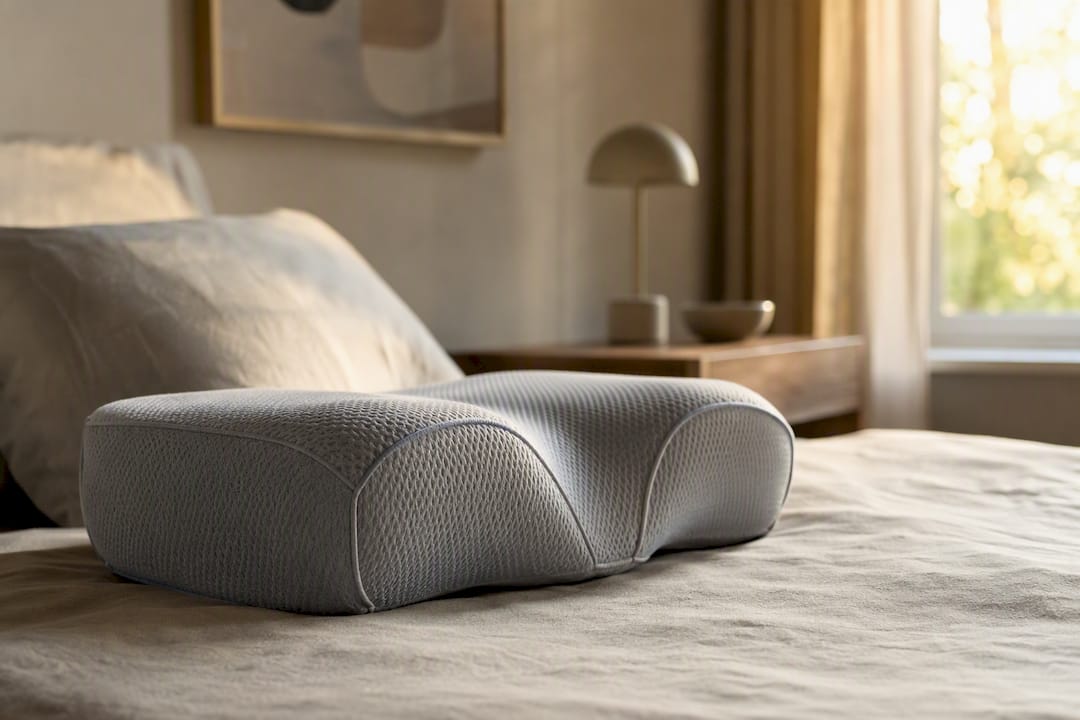
The single biggest fix most people skip is matching their pillow to their sleep position. Side sleepers generally need more loft to fill the gap between the ear and the mattress, since a flat pillow lets the head drop and rotate all night. Back sleepers do better with moderate loft that supports the neck’s natural curve without pushing the chin up. Stomach sleepers should use minimal loft, or none at all, and honestly, switching out of that position altogether solves more neck problems than any pillow swap.
The goal with any pillow choice is the same: keep your head balanced over your spine like a golf ball resting on a tee, not tilted forward, backward, or twisted to one side.
- If you’ve had the same pillow for over two years, it’s likely lost its shape and support.
- A simple test: lie in your usual position and have someone check if your nose lines up with the center of your chest. If not, adjust loft up or down.
- Consider whether your mattress sags in the middle. A sagging surface undoes even a perfect pillow.
- In the hour before bed, apply heat to a tight neck, put your phone down, and avoid reading in a slumped position.
| Sleep Position | Pillow Guidance |
|---|---|
| Side sleeper | Higher loft to fill the shoulder gap and keep the spine level |
| Back sleeper | Moderate loft with support under the neck’s curve |
| Stomach sleeper | Minimal loft, or none, to reduce rotation and extension |
A Quick Morning Routine to Reset Your Neck and Posture
A five-minute routine done consistently reduces neck pain more reliably than sporadic stretching after things already hurt. Here’s a sequence worth doing daily:
- Chin tucks: Pull your head straight back, like you’re making a double chin, and hold for five seconds. Repeat ten times.
- Neck rotations: Turn your head slowly left and right, ten reps each direction, stopping well before any pinch.
- Lateral flexion: Tilt your ear toward each shoulder, holding for three to five seconds per side.
- Scapular squeezes: Pull your shoulder blades back and down, hold for five seconds, ten reps, to counteract the rounded-forward posture that builds overnight tension.
- Seated chin-tuck hold: Hold the chin-tuck position for thirty seconds while sitting upright, training the posture you want to carry into your day.
Do this once every morning for the mobility drills, and build the chin-tuck hold into a few times a day if you sit at a desk. If stiffness doesn’t improve after a couple of weeks of consistent practice, that’s a sign to see a physical therapist rather than push through it alone. For a deeper breakdown of how these exercises tie into daytime posture correction, see our guide on ergonomic adjustments that improve neck posture.
Pro Tip: Pair your chin-tuck holds with a glance at your monitor height. If you’re tucking your chin correctly but still looking down at a screen all day, the exercise is fighting a losing battle.
When Morning Neck Stiffness Needs Medical Attention
Most stiffness is harmless, but certain signs mean it’s time to stop self-treating:
- Fever, confusion, or sensitivity to light alongside neck stiffness
- Numbness, tingling, or progressive weakness in an arm or hand
- Loss of bladder or bowel control
- Severe stiffness following a fall, car accident, or other trauma
Any of these warrant an emergency room visit, not a wait-and-see approach. For stiffness that lingers beyond a week without those red flags, start with your primary care provider or an urgent care clinic. If the problem keeps coming back month after month, a physical therapist can assess movement patterns and build a plan targeted to what’s actually driving your case.
Does Dehydration Really Make Neck Stiffness Worse?
Yes, more than most people realize. The discs between your cervical vertebrae are largely water, and they lose fluid overnight simply from lying still for hours without movement to pump fluid through the tissue. Waking up dehydrated compounds that effect, leaving muscles and connective tissue stiffer than they’d otherwise be.

Gentle movement paired with water intake speeds up recovery because rehydrating tissue and restoring blood flow after a night of immobility is what actually loosens the stiffness, not just the stretch itself. That’s part of why a stretch alone sometimes feels ineffective if you’re still running low on fluids from the night before.

Nutrition plays a smaller but real role too. Magnesium deficiency is linked to increased muscle cramping and tension in some people, and diets low in anti-inflammatory foods (fatty fish, leafy greens, nuts) may leave muscles more prone to lingering soreness. Caffeine and alcohol both have mild dehydrating effects, so a heavy night of either can leave your neck tighter than usual come morning.
None of this replaces posture or pillow fixes. But if you’re already doing the mobility work and still waking up stiff, check whether you’re drinking enough water during the day, not just gulping coffee, and whether your evening habits are quietly working against you.
Why a Posture-First Plan Beats One-Off Fixes
A new pillow can help within days, but it rarely holds if your daytime posture keeps loading the same muscles. Forward head posture is a habit built over years of screen time, and it needs its own correction work, not just a better night’s sleep. Sleep setup and daytime posture training work together. Bestforwardheadposturefix builds structured, sustainable habit change around exactly that gap, with deeper guides on monitor height and neck alignment for anyone ready to go further than symptom relief.
— Madhukar
Sources
- Stiff Neck: Possible Causes, Relief & Remedies — Cleveland Clinic
- Sleeping with Neck Pain: Advice from a Pain Specialist — HSS
This article is general information, not a substitute for advice from a qualified doctor. Consult a qualified healthcare professional about your own circumstances before acting on anything here.