To stretch your left sternocleidomastoid: stabilize your right collarbone with your fingertips, rotate your head to the right, tilt your chin up and slightly back, and hold for a clinically recommended duration. This single move targets the muscle running from your collarbone to the base of your skull, called the sternocleidomastoid (SCM), which tightens from hours of looking down at screens and pulls your head forward out of alignment.
Here’s the full sequence:
- Set up: Sit or stand tall, press your right fingertips flat against your right collarbone, and relax your shoulders away from your ears.
- Move: Rotate your head to the right, then gently tilt your chin upward and slightly backward until you feel a stretch along the left side of your neck.
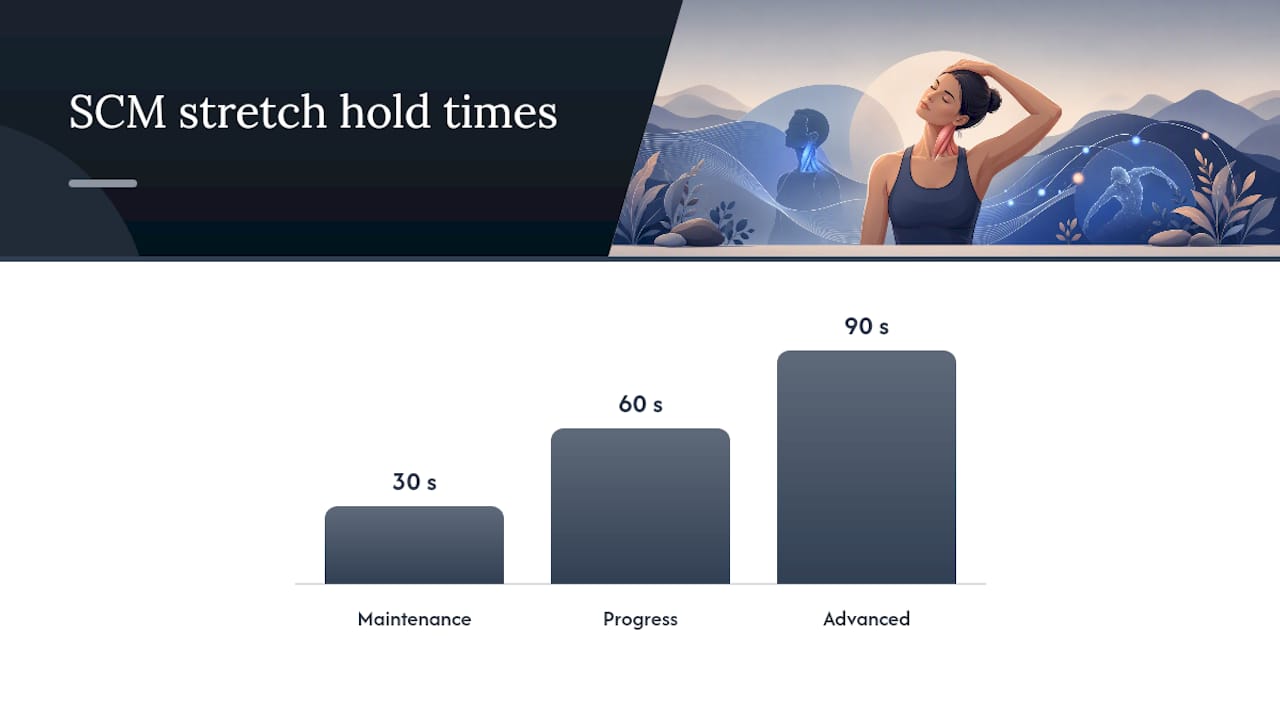
- Hold: Stay there for 30 seconds, breathing normally, then release slowly and switch sides.
Stop immediately if you feel dizziness, sharp shooting pain, or numbness anywhere in your arm or hand. Those are your body’s signals that this isn’t a normal muscle stretch and needs a closer look before you continue.
Key Takeaways
The most effective SCM stretch combines head rotation away from the tight side with contralateral tilt and slight extension, held a recommended range of hold durations, number of repetitions, and daily frequency.
| Point | Details |
|---|---|
| Use the right movement combo | Rotate away from the tight side, tilt back into extension, and hold 30 to 90 seconds. |
| Release before you stretch | Spend 1 to 2 minutes on pinch-and-glide massage from clavicle to mastoid first. |
| Progress over weeks, not days | Follow a 4 to 6 week plan moving from 30-second holds to 90 seconds plus strengthening. |
| Know your stop signs | Dizziness, radiating pain, or numbness mean stop and check with a clinician. |
| Pair stretching with posture habits | Combine SCM work with scalene stretches and posture correction for lasting relief. |
Table of Contents
- How to Do an SCM Stretch With Proper Form
- How Do You Release the SCM Before Stretching It?
- What Are the Best SCM Stretch Variations?
- How Often Should You Do the SCM Stretch?
- When Should You Stop Stretching the SCM?
- Why the SCM Matters More Than People Realize for Posture
- What the Research Actually Supports About SCM Stretching
- Frequently Asked Questions About the SCM Stretch
- Sources
How to Do an SCM Stretch With Proper Form
Getting the SCM stretch right is less about flexibility and more about sequencing. Most people rush the head extension before they’ve rotated far enough, which stretches the wrong fibers and wastes the rep. The muscle runs diagonally, so the stretch has to follow that same diagonal path to actually lengthen it.
Start with posture, not the neck. Sit or stand with your spine tall and your shoulders pulled down and back, away from your ears. If your shoulders round forward, the SCM stretch shortens the range you can safely access and the whole thing feels tighter than it should. Anchor one hand flat against the collarbone on the same side you’re about to stretch. This stabilizes the muscle’s lower attachment point so the movement isolates the neck instead of just shrugging the shoulder up.
Here’s the step-by-step breakdown:
- Stabilize: Place your fingertips or palm flat against the collarbone and upper chest on the side you want to stretch (if stretching the left SCM, anchor the left collarbone).
- Rotate: Turn your head away from that side, toward the right if stretching the left SCM, until your chin lines up roughly over your shoulder.
- Tilt: From that rotated position, tip your head backward into slight extension while lifting your chin, rather than just tilting sideways.
- Hold and breathe: Keep breathing slowly through your nose. Hold the position for a duration typically recommended in clinical practice, depending on your comfort and how tight the muscle feels.
- Release and repeat: Come back to neutral slowly, then repeat two to three times before switching to the opposite side.
The directional combination matters more than most guides explain. Effective SCM stretching requires extension at the joints of the neck combined with slight head flexion specifically at the top joint where your skull meets your spine, called the atlanto-occipital joint, paired with tilting away from the stretch side and rotating toward it. Skip any one of those three directions and you’ll feel a generic neck stretch instead of one that actually isolates the SCM.
On hold time, 30 to 90 seconds per repetition, two to three times per side, is the range clinical handouts consistently recommend. Thirty seconds is enough for a daily maintenance routine. Push toward 60 or 90 seconds only once the shorter hold feels easy and pain-free.
Pro Tip: Exhale slowly as you deepen the tilt into extension. A tense inhale tends to make people brace their shoulders back up toward their ears, which cancels out the stabilizing hand you just placed on the collarbone.
Watch for a few common mistakes. The biggest one is skipping rotation entirely and just tilting the head sideways, which stretches the upper trapezius instead of the SCM. Another is cranking the neck into extension too fast, which can trigger dizziness in people with any inner-ear or vascular sensitivity. And a lot of people forget the stabilizing hand altogether, letting the shoulder hike up and stealing range that should come from the neck itself. Symmetry matters too. If one side feels dramatically tighter or more painful than the other, that asymmetry is worth noting rather than pushing through.
How Do You Release the SCM Before Stretching It?
A tight muscle stretches better after it’s been softened first, and the SCM responds well to a few minutes of gentle self-massage before you move into the full stretch.
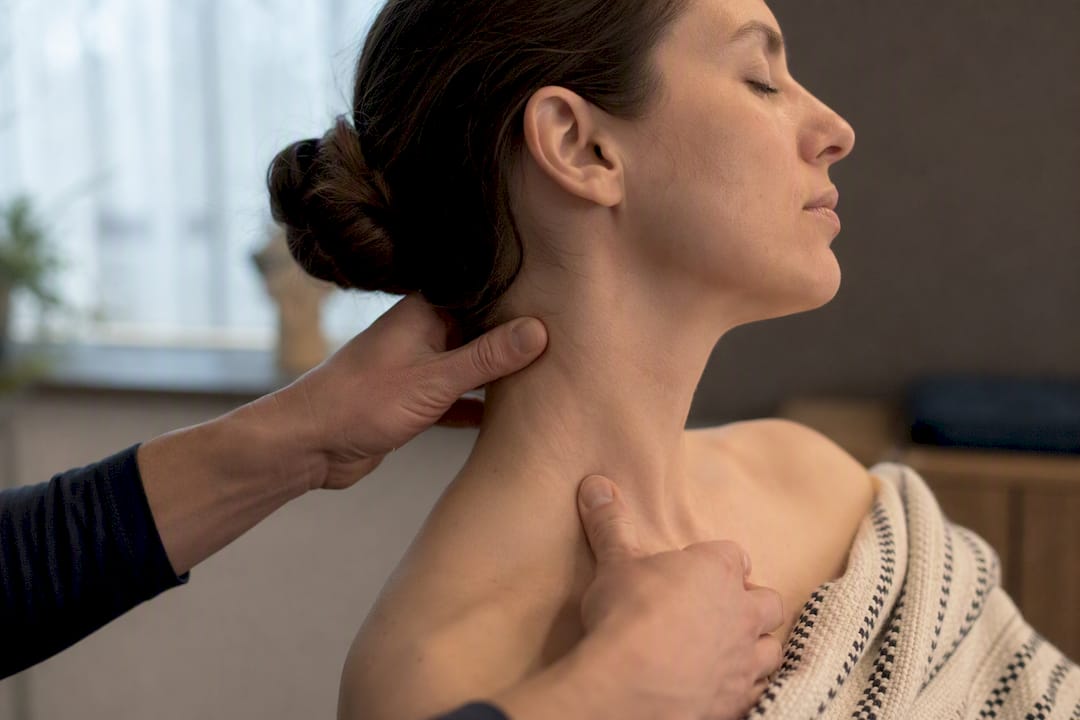
Locating the muscle is straightforward once you know what to feel for. Turn your head slightly to one side and you’ll see and feel a rope-like band running diagonally from just above your collarbone up to the bony bump behind your ear (the mastoid process). That band is the SCM, and it’s the same one you just spent the last section stretching.
Self-release before stretching:
- Pinch-and-glide: Gently pinch the muscle between your thumb and index finger near the collarbone, then slide upward toward the ear in slow, light passes.
- Full-length glides: Run flat fingertips from clavicle to mastoid, applying just enough pressure to feel the tissue, not to cause pain.
- Duration: Spend one to two minutes per side, working slowly rather than rushing through repetitions.
- Position: Lying down with your head supported often lets the muscle relax more fully than sitting upright, especially if you’re new to self-massage.
Self-massage using pinch or glide techniques, combined with contract-relax stretching, is a standard approach clinics use to reduce SCM tightness before deeper stretching work.
Pro Tip: Do the release work right before bed or first thing in the morning, when the muscle tends to be least guarded. A cold, tense muscle first thing after waking resists deep work far more than one that’s had a few hours to warm up.
Keep the pressure light. This area holds your carotid artery and jugular vein close to the surface, so avoid deep, sustained pressure and never press hard near the front of the neck. Stop immediately if you feel numbness, tingling, or lightheadedness during the massage, not just during the stretch itself.
What Are the Best SCM Stretch Variations?
Not everyone can jump straight into the full rotation-and-extension version, and that’s fine. The stretch scales.
- For dizziness or acute pain: Do the stretch lying down with your head supported on a pillow, moving through a much smaller range and skipping the extension component entirely until symptoms settle.
- For limited neck mobility: Perform the rotation and tilt seated with your back against a chair, keeping movements small and stopping well before any pulling sensation turns sharp.
- For a deeper stretch: Add overpressure by using your free hand to gently press your head slightly further into rotation and extension once you’re already comfortable with the basic hold.
- Clavicle stabilization variation: Instead of a flat hand, hook your fingers just under the collarbone bone itself for a firmer anchor point, which lets more of the stretch reach the muscle’s lower fibers.
- Pairing with other muscles: Forward head posture rarely involves the SCM alone. Combining SCM work with scalene and pec minor stretches addresses the fuller pattern of tightness that pulls the head forward in the first place.
How Often Should You Do the SCM Stretch?
Consistency beats intensity here. Daily stretching, once or twice a day, tends to produce steadier improvement than occasional long sessions.
- Weeks 1 to 2: Hold each rep for a recommended moderate duration, with multiple repetitions per side, once daily. Focus purely on getting the rotation and extension sequence correct.
- Weeks 3 to 4: Extend holds to 45 to 60 seconds, still two to three reps per side, and add a second daily session if your schedule allows.
- Weeks 5 to 6: Push holds toward 60 to 90 seconds where comfortable, and start layering in light isometric neck strengthening alongside the stretching, since flexibility work alone tends to produce less durable results than stretching paired with strengthening and posture habits.
Track progress with something simple: a short daily note logging your pain level on a 1 to 10 scale and how far you can comfortably rotate your head. Most people notice a measurable difference in range of motion within two to three weeks of consistent daily practice.
When Should You Stop Stretching the SCM?
Certain signals mean you should back off and get the situation checked rather than push through.
- Stop immediately if you experience dizziness, visual changes, ringing in the ears, or pain that radiates down the arm.
- Stop immediately if you notice numbness or tingling in your face, arm, or hand during or after the stretch.
- Seek medical clearance first if you’ve had a recent whiplash injury, any diagnosed vascular condition, or an unstable cervical spine.
- Seek medical clearance first if neck pain came on suddenly with no clear cause, or if it’s accompanied by fever or unexplained weight loss.
Clinical rehabilitation literature consistently points to supervised techniques, including physical therapist-guided manual therapy and contract-relax stretching, as the safer path forward for people with marked stiffness, recent trauma, or symptoms that don’t respond to home stretching within a few weeks.
If any red flag applies to you, a physical therapist can assess whether forward head posture, a structural issue, or something else entirely is driving your symptoms, and can supervise techniques like PNF stretching that carry more risk when done without guidance. When describing symptoms to a clinician, be specific: which side, what movement triggers it, whether it radiates, and how long it’s been going on. For general neck pain management strategies while you sort out next steps, these clinician-backed relief tips cover complementary approaches worth knowing.
Why the SCM Matters More Than People Realize for Posture
A tight SCM doesn’t just limit how far you can turn your head. It’s mechanically tied to forward head posture and the tension headaches that often come with it, since a shortened SCM helps pull the skull forward and down relative to the shoulders.
Bestforwardheadposturefix built its approach around this exact mechanism. A few things worth knowing:
- The site’s core guides on forward head posture correction treat stretching as one piece of a larger habit-and-strengthening framework, not a standalone fix.
- SCM-specific symptom guides break down how tightness in this muscle connects to headaches, jaw tension, and reduced neck rotation.
- Every pound your head sits forward of your shoulders multiplies the load your neck muscles, including the SCM, have to carry, which is why realigning posture tends to speed up symptom relief compared to stretching in isolation.
Stretching loosens the muscle. Fixing the posture that keeps re-tightening it is the part most people skip.
What the Research Actually Supports About SCM Stretching
The instinct to chase a deeper stretch or a fancier variation is understandable, but it’s usually the wrong move. What the evidence actually supports is unglamorous: rotate correctly, tilt into extension, hold for a real 30 seconds, and do it daily. Most people fail at the first part, not the hold time.
Conventional advice oversells the stretch itself and undersells the setup. A hand stabilizing the collarbone and two minutes of pinch-and-glide beforehand matter as much as the hold. Skip those and you’re stretching a guarded, half-cooperative muscle.
If you take one thing from this: prioritize form and consistency over intensity. A correct 30-second stretch done daily for six weeks will outperform an aggressive 90-second stretch done sporadically, every time.
Frequently Asked Questions About the SCM Stretch
How long should you hold an SCM stretch?
Most protocols recommend 30 to 90 seconds per repetition, two to three reps per side, once or twice daily.
Can SCM tightness cause headaches?
Yes. SCM tightness is linked to tension-type headaches and reduced neck rotation, largely through its role in pulling the head into a forward posture.
Is it safe to stretch both sides of the SCM every day?
For most people without red-flag symptoms, daily stretching on both sides is safe and often recommended as part of a posture-correction routine.
What’s the difference between an SCM stretch and a general neck stretch?
An SCM stretch specifically combines rotation, contralateral tilt, and slight extension to target the diagonal muscle fibers, while a general neck stretch often only involves a simple sideways tilt.
When should you see a clinician instead of stretching at home?
See a clinician if you experience dizziness, radiating arm pain, numbness, recent neck trauma, or symptoms that haven’t improved after several weeks of consistent home stretching.
This article is general information, not a substitute for advice from a qualified doctor. Consult a qualified healthcare professional about your own circumstances before acting on anything here.
Sources
- All About the Sternocleidomastoid Muscle: Anatomy and Treatment
- Sternocleidomastoid (SCM) – Stretching – Learn Muscles