The most reliable immediate approach to a tight pectoralis minor is low-load self-release followed by a targeted unilateral self-stretch, held for a moderate duration and repeated multiple times.
That combination consistently produces the largest measurable change in muscle length, and you can do it without any equipment.
Start here, right now:
- Roll a lacrosse ball slowly along the upper chest just below your collarbone for 60–90 seconds to reduce muscle guarding.
- Move into a unilateral self-stretch: step one arm into a doorway at roughly 90 degrees, rotate your body away, and hold 20–30 seconds.
- Reset your posture: pull your shoulder blades gently down and back, lift your sternum, and breathe.
Hold each stretch for a moderate duration, perform several repetitions per side, and stop immediately if you feel sharp pain, numbness, or tingling down the arm.
Table of Contents
- What does the pec minor do, and why does tightness wreck your posture?
- How can you tell if your pec minor is tight?
- How to prepare the pec minor with self-release before stretching
- The most effective pec minor stretches, with cues and a dosage guide
- How to build a routine around pec minor work
- When should you stop stretching and see a clinician?
- What does the research actually show about pec minor stretching?
- Key Takeaways
- Why stretches alone will not fix your posture
- A structured posture program that goes beyond stretching
- Further reading and primary sources
What does the pec minor do, and why does tightness wreck your posture?
The pectoralis minor is a small, triangular muscle that runs from ribs 3–5 up to the coracoid process, a bony hook on the front of your shoulder blade. Because it attaches directly to the scapula, its length controls how your shoulder blade sits and moves.
When the pec minor shortens, it pulls the coracoid forward and down. That tips the scapula into anterior tilt and internal rotation, which is the mechanical root of rounded shoulders.
This postural change reduces the posterior tilt needed for clean overhead motion, narrows the subacromial space (compressing the rotator cuff tendons), and causes the upper trapezius to compensate by hiking the shoulder.
The result is a posture common in people who spend substantial time at a desk: chest caved, shoulders rolled forward, and head drifting ahead of the spine.
Study callout: A 2006 peer-reviewed comparison of three pec minor stretching techniques found measurable differences in muscle length change across methods, with the unilateral self-stretch producing the largest gain at 2.24 cm. That gap matters when you are choosing which technique to prioritize.
Tight pec minor fibers also contribute to restricted overhead reach, anterior shoulder pain with pressing movements, and, because the scapula’s position affects the cervical spine’s load distribution, neck stiffness and headaches.
Stretching this muscle is not just a shoulder fix. For people working on forward head posture correction, releasing the pec minor is often one of the first structural pieces to address.
How can you tell if your pec minor is tight?
You do not need a clinic visit to get a reasonable answer. These three checks take under five minutes.
- Wall posture check. Stand with your heels, glutes, and upper back against a wall. Can the back of your head touch without forcing your chin up? Can both arms hang with the backs of your hands near the wall? If your shoulders pull forward and your head floats away from the wall, anterior chest tightness is likely involved.
- Doorway reach comparison. Stand in a doorway and raise one arm to 90 degrees, elbow bent, palm on the frame. Rotate your torso away. Note how far you rotate before you feel resistance. Compare sides. A meaningful difference of more than 10–15 degrees suggests unilateral tightness.
- Supine arm-fall test. Lie on your back with arms at your sides. Relax completely. If one or both shoulders sit noticeably higher off the floor than the other, or if you feel a pull across the upper chest when you try to let the arm rest flat, the pec minor is likely shortened on that side.
Signs that point toward pec minor involvement:
- Tightness or pressure below the collarbone, toward the front of the shoulder
- Anterior shoulder pinch when reaching overhead or behind your back
- Rounded shoulder posture that returns within minutes of consciously correcting it
- Restricted rotation in the doorway test compared to the other side
Signs that suggest seeing a clinician instead:
- Sharp pain at the front of the shoulder during any of these tests
- Numbness or tingling into the arm or hand (possible thoracic outlet involvement)
- Significant weakness in the arm or hand
- Symptoms that appeared after a fall, collision, or acute injury
If the self-tests are ambiguous or symptoms are bilateral and severe, a physiotherapy assessment will give you a clearer picture than any home test can.
How to prepare the pec minor with self-release before stretching?
Stretching a muscle that is actively guarding rarely produces lasting length change. A brief soft-tissue release beforehand reduces that guarding and makes the stretch more effective.
Lacrosse ball release
Place a lacrosse ball just below your collarbone, slightly inward from the front of the shoulder. You are targeting the pec minor’s belly, not the coracoid tip itself.
Lean into a wall to control pressure, find a tender spot, and hold gentle sustained pressure for 30–60 seconds before moving to the next area.
Spend no more than 1–2 minutes per side. Avoid pressing directly onto the bony coracoid process, and stop immediately if you feel tingling or a sharp, shooting sensation.

Thoracic foam roll opener
Lie over a foam roller placed horizontally across your mid-back, arms crossed over your chest. Extend gently over the roller for 30–60 seconds, then shift it one segment up or down the thoracic spine.
This opens the thoracic extension that the pec minor’s tightness tends to suppress, and it prepares the chest for a deeper stretch without loading the anterior shoulder.
Pro Tip: When using the lacrosse ball near the coracoid region, try “pinning” the tissue by holding the ball still while slowly raising and lowering your arm. This technique, used by manual therapists, moves the muscle under a fixed point of pressure rather than rolling across it, which tends to produce more specific release with less anterior shoulder irritation.
Clinicians who work with overhead athletes often prefer low-load, long-duration supine methods over aggressive rolling precisely because the anterior shoulder capsule is easy to stress with too much pressure. Keep the load light, especially if you have any history of shoulder instability.
The most effective pec minor stretches, with cues and a dosage guide
1. Unilateral self-stretch (highest evidence)
- Stand in a doorway, arm at 90 degrees, elbow bent, forearm resting on the frame.
- Step the same-side foot forward and rotate your torso away from the arm until you feel a stretch across the upper chest, not a pinch at the front of the shoulder.
- Pull your shoulder blade gently down and back before rotating. That scapular retraction is the cue that separates a pec minor stretch from an anterior capsule stress.
- Hold 20–30 seconds. Repeat 2–4 times per side.
Common mistake: Letting the shoulder roll forward as you rotate. If the front of the shoulder hurts, reduce the arm height slightly and re-cue the shoulder blade back.
2. Doorway/corner stretch variants
The doorway chest stretch can be modified by changing arm height to target different fiber orientations. A high-arm position (above 90 degrees) emphasizes the lower pec fibers; a 90-degree position hits the mid-chest; a lower arm angle reaches the upper fibers closer to the pec minor. For each variant, the same rule applies: feel the stretch in the chest, not a pinch at the shoulder joint. Coaching the scapular position before rotating is what keeps the load on the muscle rather than the capsule.
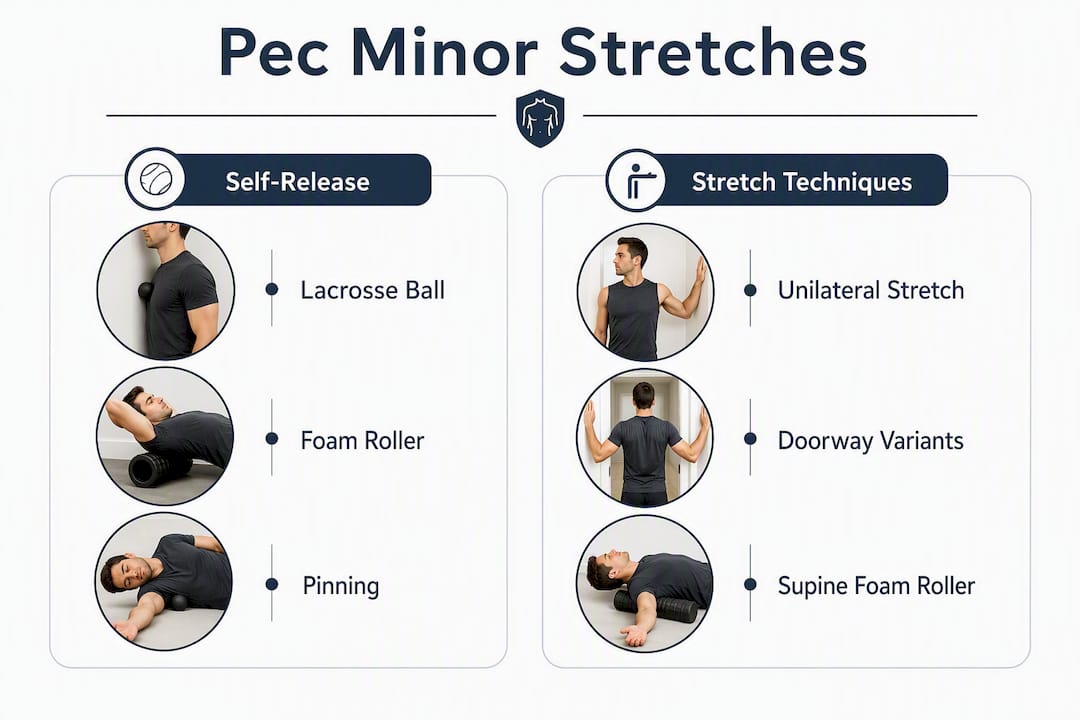
3. Supine low-load stretch on a half foam roller
Lie lengthwise on a half foam roller (flat side down) so your spine is supported from tailbone to head. Let both arms fall out to the sides at roughly 90 degrees, palms up. Gravity does the work.
This is a low-load, long-duration method that lengthens the pec minor without any anterior shoulder torque, making it the preferred option for people with shoulder instability or post-surgical restrictions.

4. Floor T-stretch (active alternative)
Lie face down, one arm extended to the side at 90 degrees. Gently press the palm into the floor and roll your body weight onto that shoulder until you feel a stretch across the chest. The Superman/T-position variation keeps spinal load low and avoids the anterior shoulder pinching that doorway stretches can produce when form breaks down.
Dosage table
| Variable | Recommendation | Notes |
|---|---|---|
| Hold time | 20–30 seconds | Longer holds (up to 60 s) for low-load supine methods |
| Repetitions | 2–4 per side | Start at 2; progress to 4 as tolerance improves |
| Frequency | Daily or alternate days | Daily for acute tightness; alternate days for maintenance |
| Progression | Increase hold duration first | Add gentle active range of motion after 2–3 weeks |
| Regression | Reduce arm height or use supine method | Use foam roller version for pain or instability |
Progression and regression notes:
- If any stretch produces anterior shoulder pain, drop to the supine foam roller method and reduce hold time.
- For hypermobile joints, avoid end-range loading; stay in a comfortable mid-range and focus on scapular control instead.
- Progress by adding 10 seconds to hold time every 1–2 weeks before increasing repetitions.
How to build a routine around pec minor work?
A pec minor stretch in isolation will not hold. The muscle re-shortens quickly if the scapular stabilizers are not strong enough to maintain the corrected position.
Quick 5-minute daily sequence:
Lacrosse ball release (90 seconds per side) → unilateral self-stretch (2 reps, 30 seconds each) → 10 scapular retractions (squeeze shoulder blades together, hold 3 seconds) → 10 prone Y-raises for lower trapezius activation. That sequence takes under five minutes and addresses both the tight anterior tissue and the weak posterior stabilizers simultaneously.
15-minute post-workout routine:
Add thoracic foam roll extension (2 minutes) and upper back stretches before the pec minor work, then finish with a combined SMR, stretch, and thoracic mobility sequence that addresses the full anterior chain. Pair with band pull-aparts or face pulls to reinforce scapular retraction under light load.
Pairing pec minor stretches with lower trapezius and serratus anterior work is not optional if you want lasting posture change. The pec minor will keep shortening if the muscles that hold the scapula in posterior tilt are underactive.
Daily habit cues:
Set a reminder every 45–60 minutes at your desk. Stand, clasp your hands behind your back, press your shoulder blades together, and hold for 10–20 seconds. That micro-break, described by MedlinePlus as a basic chest stretch, is simple enough to do anywhere and keeps the anterior chain from locking up between dedicated sessions.
When should you stop stretching and see a clinician?
Self-care is appropriate for most cases of postural pec minor tightness. There are clear situations where it is not.
Stop stretching and seek professional evaluation if you notice:
- Sharp or stabbing pain at the front of the shoulder during or after stretching
- Numbness, tingling, or weakness in the arm or hand (possible thoracic outlet or nerve involvement)
- Symptoms that appeared after a traumatic event (fall, collision, direct impact to the chest)
- No improvement after 3–4 weeks of consistent daily practice
- Significant asymmetry in arm strength between sides
For people with a history of shoulder dislocation or diagnosed instability, the supine low-load method is safer than doorway or unilateral self-stretches, and a clinician should guide the program.
Adhesive capsulitis (frozen shoulder) is a contraindication to aggressive stretching; graded, clinician-supervised mobilization is the appropriate path. If you have had shoulder surgery within the past year, get clearance before starting any of these techniques.
For neck pain that accompanies the shoulder tightness, assessing neck alignment alongside the shoulder work helps clarify whether the cervical spine needs separate attention.
A clinician assessment typically includes manual palpation, range-of-motion testing, and a graded loading plan that progresses from mobility to strength over weeks, not days.
Minor muscle strains follow a different protocol from simple tightness. Clinical guidance on pectoralis strains distinguishes between minor tears managed with rest and graded return, and major tears that may require surgical evaluation.
If you felt a pop or sudden sharp pain during a pressing exercise, that is a strain scenario, not a posture scenario.
What does the research actually show about pec minor stretching?
The clearest evidence comes from a 2006 comparative study by Borstad that measured pectoralis minor length changes across three stretching techniques in the same subjects.
Those numbers are worth sitting with. The sitting manual stretch, which is one of the most commonly taught clinic techniques, produced less than a third of the length change of the unilateral self-stretch. The practical implication: technique selection and coaching cues matter far more than simply “doing a chest stretch.”
The study’s limitations are worth noting. Muscle length change in a single session does not automatically translate to permanent structural change; consistent repetition over weeks is what drives lasting adaptation. The study also measured immediate post-stretch length, not long-term retention.
What it does confirm is that load placement and scapular positioning during the stretch determine how much of the force reaches the pec minor versus the anterior shoulder capsule.
Clinicians who follow Mike Reinold’s clinical notes on pec minor stretching often favor low-load, long-duration supine methods for patients with anterior shoulder sensitivity, precisely because the Borstad data shows that technique matters, not just effort.
For further reading:
- Borstad 2006 — PubMed: the primary comparative study on pec minor stretch techniques
- Mike Reinold — clinical perspective on pec minor stretching: practitioner guidance on stretch selection and scapular positioning
- ACE Fitness — chest stretch variations: accessible overview of chest stretch programming
Key Takeaways
The unilateral self-stretch produces the largest measurable pec minor length change at 2.24 cm, making it the highest-priority technique when combined with self-release and scapular retraction cues.
| Point | Details |
|---|---|
| Prioritize the unilateral self-stretch | Research shows a 2.24 cm mean length change, nearly three times the sitting manual method. |
| Self-release first | Spend 60–90 seconds with a lacrosse ball before stretching to reduce guarding and improve results. |
| Follow the dosage | Hold 20–30 seconds, repeat 2–4 times per side, daily for tightness or alternate days for maintenance. |
| Pair with scapular strengthening | Scapular retractions and lower trapezius activation prevent the pec minor from re-shortening. |
| Bestforwardheadposturefix approach | The site’s structured posture program pairs pec minor work with habit change and muscle rebalancing for lasting correction. |
Why stretches alone will not fix your posture?
Most people who start stretching their pec minor notice real improvement within a week or two.
Then they plateau, or the tightness returns after a few days off. That pattern is not a failure of the stretch. It is a signal that the stretch was never the whole solution.
The pec minor shortens because something is pulling it there: hours of forward-leaning posture, weak scapular stabilizers, a thoracic spine that has lost its extension. Stretching addresses the symptom.
The cause is a pattern, and patterns require habit change, not just a daily hold.
What actually produces durable posture change is a combination of things: consistent mobility work, progressive scapular and thoracic strengthening, and the kind of daily awareness that catches the rounded-shoulder drift before it becomes the default position again.
The stretches in this article are a necessary starting point. They are not the destination.
The conventional advice to “just stretch more” also misses the load-placement problem the Borstad study quietly highlights.
Two people can do the same doorway stretch and get completely different results depending on whether the scapula is posteriorly tilted or not. Technique precision, not volume, is what separates progress from spinning wheels.
A structured posture program that goes beyond stretching
Pec minor work is one piece of a larger posture correction picture, and knowing the stretches is different from having a plan that holds together week after week.

Bestforwardheadposturefix offers structured educational content that connects pec minor release to the full posture correction sequence: thoracic mobility, scapular strengthening, ergonomic habit changes, and the awareness-building that makes gains stick.
The program is built around the same science-backed principles covered in this article, organized into a progression you can follow without guessing what comes next.
The program includes:
- Step-by-step mobility and strengthening progressions
- Posture habit tools and desk ergonomics guidance
- Targeted routines that pair chest release with scapular activation
- Educational content on posture mechanics and symptom management
If you are ready to move from individual stretches to a complete posture correction plan, start with the Bestforwardheadposturefix posture program and follow the structured sequence from mobility through strength.
Further reading and primary sources
- Borstad JD (2006) — Resting position variables at the shoulder: evidence to support a posture-impairment association: the primary peer-reviewed study comparing three pec minor stretch techniques with measured length changes.
- Mike Reinold — What is the best stretch for the pectoralis minor?: practitioner-level discussion of stretch selection, scapular positioning, and clinical reasoning for low-load methods.
- Mike Reinold — New stretch for pec minor (clinical notes): detailed clinical perspective on the pinning technique and supine low-load approaches.
- ACE Fitness — 5 chest stretch variations: accessible programming overview from the American Council on Exercise covering pec major and minor stretch variants.
- MedlinePlus — Chest stretch: a straightforward reference from the U.S. National Library of Medicine on basic chest stretch technique and hold guidance.