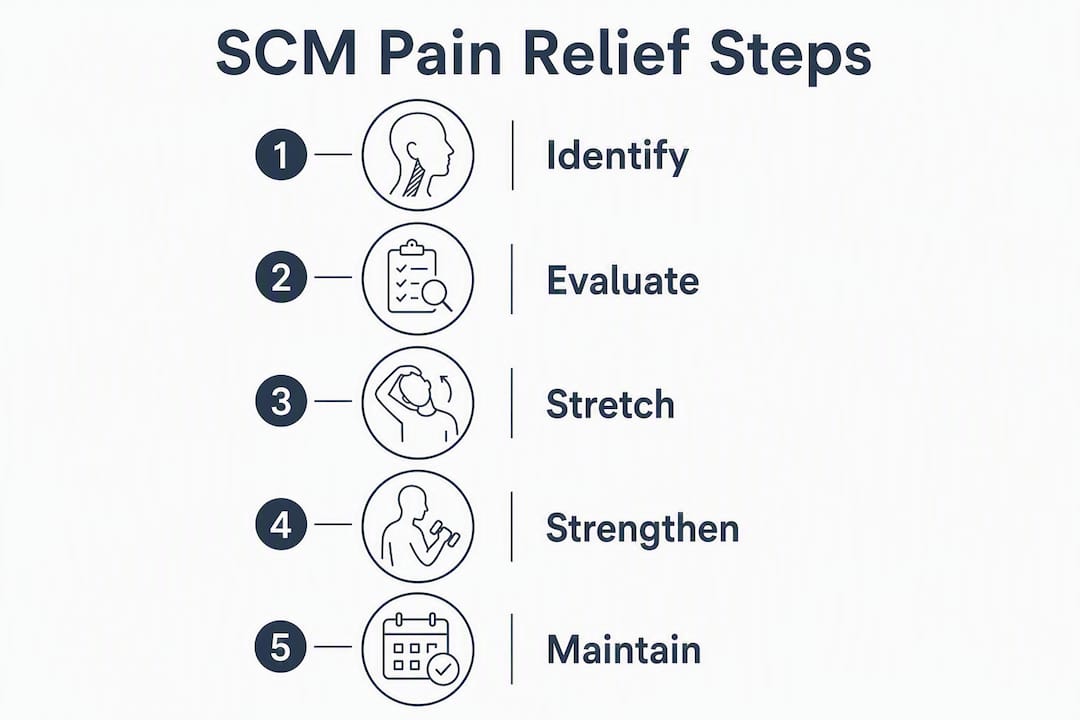
- Sternocleidomastoid pain can be managed with rest, heat, gentle massage, and posture adjustments, usually resolving in a few days. Persistent symptoms or neurological signs require medical evaluation, with treatment including physical therapy and ergonomic corrections. Long-term relief depends on addressing underlying posture issues, strengthening deep neck flexors, and maintaining good workspace habits.
Sternocleidomastoid pain is aching, stiffness, or trigger-point tenderness along the large paired muscle running from behind your ear down to your collarbone — and the first things to do are rest the neck, apply a warm compress for 15–20 minutes, gently massage the muscle’s surface, and check whether your head is jutting forward at your screen.
Most acute flares respond to those steps within a few days. If symptoms persist beyond one week, or if you notice arm numbness, sudden severe pain after a trauma, or high fever, stop self-treating and see a clinician.
Immediate steps you can take right now:
- Rest the neck from aggravating positions (no prolonged phone-looking or chin-tucking).
- Apply a warm compress or heating pad for 15–20 minutes to reduce muscle tension.
- Gently massage the surface of the muscle with two fingers — never press deeply into the front of the neck.
- Take an OTC analgesic such as ibuprofen or acetaminophen per package directions if pain is moderate.
- Do a quick posture check: ears should sit over shoulders, not in front of them.
Red flags — seek urgent care if you have any of these:
- Progressive weakness, numbness, or tingling in your arms or hands
- Sudden severe neck pain following a fall, collision, or trauma
- High fever alongside neck stiffness (possible meningitis)
- Difficulty swallowing or breathing
Clinical guidance is clear: symptoms that do not resolve within about one week of self-care warrant professional evaluation, not continued home management.
Table of Contents
- What the sternocleidomastoid muscle is and why it causes so much trouble
- Symptoms you should expect from SCM pain — including the ones that surprise people
- What actually causes SCM pain and who is most at risk
- How clinicians evaluate SCM pain and when you need urgent care
- Practical self-care you can start today to reduce SCM pain
- Targeted stretches and exercises for SCM pain relief
- When self-care isn’t enough: professional treatment options
- Ergonomics and daily habits that prevent SCM pain from coming back
- A 3-phase posture-correction program to reduce SCM load long-term
- How long does SCM pain take to heal?
- Key Takeaways
- The part most people skip — and why it matters most
- What Bestforwardheadposturefix offers for long-term SCM relief
- Useful sources and further reading
What the sternocleidomastoid muscle is and why it causes so much trouble?
The sternocleidomastoid (SCM) is a thick, rope-like muscle you can feel on either side of your neck the moment you turn your head. It originates from two points — the sternum (breastbone) and the clavicle (collarbone) — and inserts behind the ear at the mastoid process of the skull. That diagonal path gives it a lot of mechanical leverage, which is exactly why it does so much work.
Key anatomy at a glance:
- Origin: Manubrium of the sternum and medial third of the clavicle
- Insertion: Mastoid process and superior nuchal line of the occiput
- Primary actions: Rotates the head to the opposite side, flexes the neck forward, and tilts the head laterally toward the same side
- Landmark role: The SCM marks the anterior border of the posterior cervical triangle and sits directly over the carotid sheath, making it a critical surgical and clinical landmark
Because the SCM is superficial and spans a long distance, it is exposed to strain from almost any head movement or sustained posture. When you hold your head forward of your shoulders — a position most people spend hours in daily — the SCM works harder than it should as a secondary stabilizer. Over time, that chronic overload creates the tight bands and tender spots known as trigger points.
“Dysfunction or injury of the SCM can contribute to postural abnormalities, torticollis, impaired cervical mobility, and altered temporomandibular function.” — StatPearls / NCBI Bookshelf
Pro Tip: If you want to locate your own SCM, turn your head to the right while looking in a mirror. The left SCM will pop up as a visible cord running from your left collarbone to behind your left ear. That’s the muscle you’re dealing with.
Symptoms you should expect from SCM pain — including the ones that surprise people
SCM pain rarely stays where the muscle is. That’s what makes it so confusing and so frequently misdiagnosed.
Local symptoms are straightforward:
- Aching or sharp pain along the side of the neck
- Stiffness and reduced range of motion when turning the head
- Tenderness when pressing along the muscle belly
- A sensation of tightness or “pulling” from the collarbone up toward the ear
The referred pain patterns are where things get interesting. According to StatPearls / NCBI, SCM trigger points can send pain to the face, forehead, eyes, cheeks, sinuses, and ears — locations that have nothing to do with the neck anatomically. That’s why people with active SCM trigger points often end up at an ENT or an allergist before anyone checks their neck.
Common referral sites:
- Forehead and top of the skull (often mistaken for tension headache)
- Around and behind the eye (can mimic sinus pressure)
- Cheek and jaw area (sometimes confused with TMJ disorder)
- Ear and behind the ear (frequently misread as ear infection)
- Throat and front of the neck
- Shoulder and upper chest
Associated symptoms can include dizziness, nausea, and even a sense of imbalance or vertigo — because the SCM contains proprioceptive fibers that feed into the vestibular system. Visual disturbances and tearing of the eye have also been reported in clinical case studies of SCM myofascial syndrome.
A one-sentence differential: if your “ear infection” has no fever, no fluid, and no response to antibiotics, or your “sinus pain” persists despite decongestants, ask your provider to palpate the SCM before ordering more imaging.

Pro Tip: Gentle surface palpation along the SCM belly can reproduce your referral pattern and help confirm the muscle is the source. Press lightly with two fingers — never dig into the front of the neck near the carotid pulse.
What actually causes SCM pain and who is most at risk?
The most common driver is forward head posture combined with prolonged static positions. When your head drifts forward of your shoulders — even by an inch or two — the SCM shifts from a dynamic mover to a chronic postural stabilizer. That sustained low-level contraction is exactly the environment where trigger points develop.
Common causes and risk factors:
- Forward head posture from desk work, phone use, or reading
- Prolonged computer or smartphone use without ergonomic adjustment
- Awkward sleeping positions (stomach sleeping, unsupportive pillow)
- Carrying asymmetric loads such as a heavy bag on one shoulder
- Repetitive cervical motions in sports or manual work
- Emotional stress and anxiety, which drive chronic muscle guarding
- Whiplash or direct trauma to the neck
- Arthritis or degenerative cervical disc disease as secondary contributors
Research published in IISE Transactions on Occupational Ergonomics and Human Factors found positive correlations between head tilt angle and SCM muscle oscillation frequency and stiffness, and that sitting for more than six hours per day raises the risk of chronic neck pain.
Telework settings — where monitors are often too low and chairs are not adjusted — have made this worse by normalizing non-ergonomic head positions for hours at a stretch.
“Muscle strain from poor posture and repetitive motion are among the most common causes of neck pain, and posture and workspace adjustments are front-line recommendations.” — Mayo Clinic
Stress deserves its own mention. The link between workplace stress and neck muscle tension is well-documented: psychological load increases baseline muscle tone, which keeps the SCM in a semi-contracted state even when you’re sitting still. That’s a recipe for trigger-point formation over weeks and months.
How clinicians evaluate SCM pain and when you need urgent care?
A clinical assessment for suspected SCM involvement typically follows a structured sequence. Knowing what to expect makes the appointment more productive.
What a clinician will assess:
- Posture and alignment: Head position relative to shoulders, thoracic kyphosis, shoulder height asymmetry
- Active range of motion: Rotation, flexion, extension, and lateral flexion — noting which movements reproduce pain
- SCM palpation: Systematic pressure along the muscle belly to locate trigger points and reproduce referral patterns
- Trigger-point provocation: Sustained pressure to confirm reproducible referred pain consistent with SCM involvement
- Neurological screen: Grip strength, sensation in the arms and hands, deep tendon reflexes — to rule out cervical radiculopathy
MedlinePlus / NIH lists specific warning signs that require prompt evaluation rather than watchful waiting.
Red flags that mean you should seek care now, not next week:
- Progressive numbness, tingling, or weakness in an arm or hand
- Sudden severe neck pain following any trauma (fall, car accident, sports injury)
- High fever with neck stiffness
- Signs of infection: warmth, redness, swelling over the neck
- Unexplained weight loss alongside neck pain
- Pain that is rapidly worsening despite rest
When imaging is appropriate: persistent symptoms beyond 4–6 weeks, suspected structural injury, or atypical neurological signs all warrant X-ray or MRI to rule out disc herniation, fracture, or other structural pathology. Your clinician may also refer you to a physical therapist, neurologist, or orthopedic specialist depending on findings.
Practical self-care you can start today to reduce SCM pain
Most acute SCM flares respond well to conservative home management. The key is being deliberate about what you do and, just as importantly, what you avoid.
Step-by-step immediate actions:
- Position yourself well. Sit or lie with your head supported in a neutral position. Avoid lying on your stomach or craning your neck forward.
- Apply heat first. A warm compress or heating pad on the neck for 15–20 minutes relaxes the muscle and increases blood flow. Use heat in the first 48–72 hours for chronic or subacute pain.
- Switch to ice if acutely inflamed. For a fresh strain (first 24–48 hours), ice for 10–15 minutes reduces inflammation. Wrap ice in a cloth — never apply directly to skin.
- Gentle surface massage. Using two fingers, apply light circular pressure along the SCM from the collarbone up toward the ear. Spend 30–60 seconds on any tender spot, then move on.
- Short mobility walks. A 5–10 minute walk every hour keeps the neck from stiffening further and promotes circulation without loading the muscle.
- OTC analgesics. Ibuprofen (Advil, Motrin) addresses both pain and inflammation; acetaminophen (Tylenol) manages pain without anti-inflammatory effect. Follow package directions and consult a pharmacist if you have contraindications.
Safety: what NOT to do
The SCM lies directly over the carotid sheath, which contains the carotid artery, internal jugular vein, and vagus nerve.
Anatomical caution from NCBI is explicit: aggressive anterior neck pressure risks compressing major vessels or nerves. Keep all self-massage superficial and on the muscle belly itself, not in the groove between the SCM and the trachea.
Do’s and don’ts:
- ✓ Do take regular posture breaks every 30–45 minutes
- ✓ Do support your head with a rolled towel or cervical pillow at night
- ✓ Do keep movements gentle and within a pain-free range
- ✗ Don’t press deeply into the front of the neck near your pulse
- ✗ Don’t apply heat over an acutely swollen or inflamed area
- ✗ Don’t continue self-treating if neurological symptoms appear
Pro Tip: Set a phone timer for every 45 minutes during work. When it goes off, stand up, roll your shoulders back three times, and gently tilt your ear toward your shoulder on each side. That 60-second reset prevents the sustained SCM contraction that builds into a trigger point by end of day.
Targeted stretches and exercises for SCM pain relief
A progressive exercise approach works better than jumping straight to aggressive stretching. Start gentle, build gradually, and stop if any exercise produces arm numbness or tingling.
Exercise progression:
Active cervical rotation (warm-up). Sitting tall, slowly turn your head to the right as far as comfortable, hold 2 seconds, return to center, then left. 10 repetitions each side, twice daily.
SCM lateral stretch. Sit or stand with your right hand tucked under your right thigh (to anchor the shoulder). Tilt your left ear toward your left shoulder, then rotate your chin slightly upward to feel the stretch along the right SCM. Hold 20–30 seconds. 3 repetitions each side, twice daily.
Chin tuck (deep neck flexor activation). Sitting upright, gently draw your chin straight back — not down — creating a “double chin.” Hold 5 seconds, release. This activates the deep neck flexors that take load off the SCM. 10–15 repetitions, twice daily.
Cervical flexion stretch. Sitting tall, slowly lower your chin toward your chest until you feel a gentle stretch at the back of the neck. Hold 20 seconds. 3 repetitions, once or twice daily.
Scapular retraction. Sitting or standing, squeeze your shoulder blades together and slightly downward. Hold 5 seconds, release. This corrects the rounded-shoulder posture that overloads the SCM. 15 repetitions, twice daily.
Isometric cervical resistance. Place your right hand against your right temple. Gently push your head into your hand without allowing movement. Hold 5 seconds. Repeat on left side, then front and back. 5 repetitions each direction, once daily.
Thoracic extension over a foam roller. Place a foam roller horizontally across your mid-back. Support your head with your hands and gently extend over the roller for 30–60 seconds. This opens the thoracic spine and reduces the compensatory load the SCM carries when the upper back is stiff.
| Exercise | Sets | Reps / Hold | Frequency | Progression cue |
|---|---|---|---|---|
| Active cervical rotation | 1–2 | 10 each side | Twice daily | Increase range as pain allows |
| SCM lateral stretch | 3 | 20–30 sec hold | Twice daily | Add slight chin-up rotation |
| Chin tuck | 2–3 | 10–15 reps, 5 sec hold | Twice daily | Add resistance band at week 3 |
| Scapular retraction | 2–3 | 15 reps, 5 sec hold | Twice daily | Add light resistance at week 2 |
| Isometric cervical resistance | 1 | 5 reps, 5 sec hold | Once daily | Increase hold to 10 sec |
| Thoracic foam roller | 1 | 30–60 sec | Once daily | Move roller position up/down |
Electrophysiological evidence confirms that combined stretching and manual therapy improves outcomes in chronic neck pain by reducing abnormal SCM activity. Exercises alone are more effective when paired with posture correction.

Pro Tip: The chin tuck is the single most underused exercise for SCM pain. Most people stretch the SCM without ever strengthening the deep neck flexors that are supposed to share the load. Doing 10 chin tucks before you sit down at your desk takes 30 seconds and directly reduces the demand on the SCM throughout the workday.
When self-care isn’t enough: professional treatment options
If symptoms persist beyond two to four weeks of consistent home management, or if the pain is severe enough to limit daily function, professional treatment significantly improves outcomes.
Treatment options clinicians commonly use:
Physical therapy: A structured PT program addresses SCM pain through manual therapy, therapeutic exercise, postural retraining, and modalities like ultrasound or electrical stimulation. This is the most evidence-supported first-line professional option for cervical myofascial pain.
Manual and osteopathic manipulation: Hands-on joint mobilization and soft-tissue techniques target restricted cervical segments and hypertonic muscles. Useful when range of motion is significantly limited.
Dry needling and trigger-point injections: A fine needle inserted directly into an active SCM trigger point can produce an immediate twitch response and lasting pain relief. A clinical trial published on PubMed investigated dry needling of SCM trigger points in patients with cervicogenic headache and found measurable improvements in pain and function after a single session. Trigger-point injections using local anesthetic follow the same principle with added pharmacological effect.
Medication management: Muscle relaxants, short-course NSAIDs, or topical analgesics (like diclofenac gel) may be prescribed for acute flares. These manage symptoms but do not address the underlying postural cause.
Rare surgical indications: Surgery for SCM-related pain is uncommon and reserved for structural problems such as severe cervical disc herniation with neurological compromise, or congenital muscular torticollis unresponsive to conservative care. Cleveland Clinic guidance confirms that conservative care should be exhausted before any surgical discussion.
“Conservative care — including stretching, massage, physical therapy, and osteopathic manipulation — is the standard first-line approach; surgery is reserved for cases where structural damage exists or conservative care has clearly failed.” — Cleveland Clinic
The evidence base for dry needling and manual therapy in cervicogenic conditions is growing, but physical therapy with a posture-correction component remains the most consistently supported approach for long-term relief.
Ergonomics and daily habits that prevent SCM pain from coming back
Treating the SCM without fixing the environment that strained it is like patching a tire without removing the nail. Prevention requires real changes to how you set up your workspace and how you move through the day.
Ergonomic checklist:
- Monitor top edge at or just below eye level, screen 20–28 inches from your face
- Keyboard and mouse positioned so elbows stay at roughly 90 degrees, shoulders relaxed
- Chair height adjusted so feet rest flat on the floor and hips are at 90–100 degrees
- Phone held at eye level or used with a stand — not cradled between ear and shoulder
- Pillow that keeps the cervical spine neutral during sleep (neither too flat nor too high)
- Laptop users: use an external keyboard and raise the screen with a stand
Setting up an ergonomic desk properly is one of the highest-leverage changes you can make, because it removes the postural stressor for the 6–8 hours per day most people spend at a computer.
Daily habit plan:
- Morning: 5-minute gentle neck mobility routine before sitting down (rotations, lateral tilts, chin tucks).
- Every 45 minutes at work: stand, roll shoulders back, do 5 chin tucks.
- Midday: 10-minute walk with head in neutral position, shoulders back.
- Phone use: hold the device at eye level; set a reminder to check head position every 30 minutes.
- Evening: 10 minutes of foam rolling and thoracic extension before bed.
Pro Tip: Ergonomics research suggests that slight forward flexion angles — not a rigidly upright head — actually minimize SCM tension. Forcing a perfectly vertical head position can create its own muscle fatigue. Aim for a relaxed, supported neutral, not a military brace.
A 3-phase posture-correction program to reduce SCM load long-term
SCM dysfunction rarely exists in isolation.
StatPearls research confirms it usually reflects broader cervical and thoracic posture problems, and correcting only the local muscle rarely produces lasting relief. A structured program that rebalances the whole system is what actually sticks.
The Bestforwardheadposturefix approach uses three phases:
Phase 1: Pain control and mobility (weeks 1–2)
- Reduce acute pain with heat, gentle massage, and OTC analgesics as needed.
- Begin gentle active range-of-motion exercises twice daily (rotations, lateral tilts).
- Introduce chin tucks to start activating deep neck flexors.
- Audit and correct your workstation setup.
- Track pain level (0–10 scale) and range of motion daily.
Phase 2: Stability and strength (weeks 2–6)
- Progress chin tucks to resisted versions with a resistance band or light manual resistance.
- Add scapular retraction and thoracic extension exercises.
- Begin isometric cervical resistance in all four directions.
- Introduce mid-back strengthening (rows, band pull-aparts) to address thoracic posture.
- Log exercise adherence and note any symptom changes weekly.
Phase 3: Habit integration and ergonomics (week 6 onward)
- Consolidate the exercise routine to a sustainable 10–15 minutes daily.
- Implement all ergonomic adjustments as permanent fixtures, not temporary fixes.
- Build posture cues into existing habits (check head position every time you stand to get water).
- Schedule a monthly self-assessment: range of motion, trigger-point tenderness, posture photo.
- If symptoms recur, return to Phase 1 for one week before escalating to professional care.
Weekly tracking checklist:
- Pain level morning and evening (0–10)
- Exercise sessions completed (yes/no per day)
- Posture breaks taken (number per workday)
- Any new or worsening symptoms (note and date)
- Range of motion: can you rotate fully to both sides without pain?
Pro Tip: Pair posture cues with something you already do automatically. Every time you stand up to get water, take a drink, or walk to another room, do a quick shoulder roll and chin tuck. Within two weeks, the movement becomes reflexive — no willpower required.
How long does SCM pain take to heal?
Recovery time depends heavily on how long the problem has been building and how consistently you address the underlying causes.
Typical timeline:
- Acute flare (days to 2 weeks): A fresh strain from an awkward sleeping position or sudden movement usually resolves with rest, heat, and gentle stretching within 7–14 days.
- Subacute (2–6 weeks): Trigger points that have been active for weeks respond to consistent stretching, massage, and posture correction but take longer to fully deactivate.
- Chronic (months): Long-standing SCM tension tied to years of poor posture may take 8–12 weeks of structured rehabilitation before significant, lasting improvement is felt.
Factors that predict faster recovery:
- Early posture correction and ergonomic adjustment
- Consistent daily exercise adherence
- Addressing sleep position and pillow support
- Reducing psychological stress load
- Starting professional treatment before the problem becomes chronic
Factors that slow recovery:
- Longstanding forward head posture without correction
- Continuing the aggravating activity (e.g., unmodified desk setup)
- Comorbidities such as fibromyalgia, arthritis, or anxiety disorders
- Delayed treatment or inconsistent exercise
Harvard Health data puts the recurrence picture in perspective: between 50% and 85% of people who experience neck pain will have it again within five years.
That statistic makes the case for long-term maintenance over short-term symptom chasing. The goal is not just to get rid of the current flare but to change the conditions that created it.
Key Takeaways
SCM pain resolves faster and stays resolved longer when you combine immediate self-care with posture correction and targeted exercise rather than treating the muscle in isolation.
| Point | Details |
|---|---|
| Start self-care immediately | Rest, heat, gentle surface massage, and OTC analgesics address most acute SCM flares within 1–2 weeks. |
| Referred pain is common | SCM trigger points can send pain to the face, eyes, ears, and sinuses — often misdiagnosed as ENT conditions. |
| See a clinician at one week | Symptoms that don’t improve within about one week, or any neurological signs, require professional evaluation. |
| Exercise targets the root cause | Chin tucks, scapular retraction, and thoracic extension address the deep neck flexor weakness that overloads the SCM. |
| Bestforwardheadposturefix 3-phase program | The structured 6–8 week program at Bestforwardheadposturefix rebalances SCM load through posture correction, habit change, and progressive exercise. |
The part most people skip — and why it matters most
There’s a pattern worth naming directly: most people who deal with SCM pain treat it like a local problem. They stretch the neck, maybe get a massage, feel better for a week, and then the pain comes back.
That cycle repeats for months or years because the actual driver — how the whole cervical and thoracic system is loaded — never gets addressed.
The research on this is consistent. SCM dysfunction almost always reflects something upstream: weak deep neck flexors, a stiff thoracic spine, rounded shoulders, or a workstation that pulls the head forward for eight hours a day.
The SCM is doing someone else’s job. Treating only the SCM without fixing those upstream problems is like repeatedly replacing a fuse without finding the short circuit.
What actually works is less dramatic than most people expect. It is not a special massage technique or an expensive device.
It is chin tucks done consistently. It is a monitor raised three inches. It’s a 45-minute movement alarm that you actually follow. The boring, repeatable stuff compounds over weeks in a way that a single treatment session never can.
The other thing worth saying: the referred pain patterns from SCM trigger points are genuinely strange, and the medical system is not always good at recognizing them.
If you’ve been told your ear pain, sinus pressure, or chronic headache has no clear cause, the SCM is worth investigating before you accept “idiopathic” as a final answer.
A skilled physical therapist or manual therapist who understands myofascial referral patterns can often reproduce and then resolve symptoms that have stumped other providers.
Realistic expectations matter here too. Chronic SCM tension built over years of poor posture does not resolve in a week. But it does resolve — consistently, predictably — when the right combination of exercise, ergonomics, and habit change is applied with enough patience to let the neuromuscular system recalibrate.
What Bestforwardheadposturefix offers for long-term SCM relief?
Stretches and self-care get you through the acute phase. What keeps the pain from coming back is a structured approach to posture correction that addresses the whole cervical system, not just the symptomatic muscle.

Bestforwardheadposturefix is built specifically for that second part.
The site provides science-backed guides, step-by-step ergonomic setup instructions, and the 3-phase posture-correction program outlined in this article — all structured around the evidence that SCM dysfunction is a postural problem, not just a muscle problem.
You get detailed habit-change frameworks, muscle-rebalancing protocols, and practical ergonomics advice you can apply to your actual workspace today.
The difference from a generic “neck stretches” article is depth and structure. Each guide explains the biomechanical reason behind the recommendation, so you understand what you’re doing and why it works.
That understanding is what makes the habit stick.
Start with the posture correction program at Bestforwardheadposturefix and work through Phase 1 this week.
The resources are free to read, and the program is designed to fit into a normal workday without requiring equipment or clinic visits.
Useful sources and further reading
The clinical claims and exercise recommendations in this article draw from the following sources, selected for their authority and direct relevance to SCM anatomy, myofascial pain, and cervical rehabilitation.
Anatomy, Head and Neck: Sternocleidomastoid Muscle — StatPearls / NCBI Bookshelf: The primary anatomy and clinical reference for SCM structure, function, and dysfunction. Used for anatomy, trigger-point referral patterns, and the rationale for posture-based treatment.
Sternocleidomastoid Syndrome: A Case Study — PMC / NIH: Clinical case documentation of SCM myofascial syndrome with reproducible trigger-point referral patterns. Used to support the referral-pattern and diagnosis sections.
Dry Needling of SCM Trigger Points in Cervicogenic Headache — PubMed: Before-and-after clinical trial examining one-session dry needling of SCM trigger points. Used in the professional treatments section.
What Is the Sternocleidomastoid (SCM Muscle)? — Cleveland Clinic: Patient-facing clinical summary of SCM anatomy, causes of pain, and treatment options. Used for first-line treatment guidance and surgical indications.
Neck Pain — MedlinePlus / NIH: Government health encyclopedia entry covering neck pain causes, red flags, and when to seek care. Used for the red-flag and clinical evaluation sections.
Head Position and SCM Tension — IISE Transactions on Occupational Ergonomics and Human Factors: Biomechanical study correlating head tilt angle with SCM stiffness and oscillation frequency. Used for ergonomic recommendations and the causes section.
Sources were selected based on clinical authority (peer-reviewed research, government health databases, and major academic medical centers), direct relevance to SCM anatomy and myofascial pain, and applicability to the self-care and exercise recommendations in this article.
This article is general educational information, not medical advice. Confirm any treatment decisions with a qualified healthcare provider, and seek emergency care immediately if you experience neurological symptoms, sudden severe pain after trauma, or fever with neck stiffness.