The fastest evidence-backed route to cervicogenic headache relief is a structured physical-therapy-first program combining targeted manual techniques with progressive posture exercises.
A six-week PT program produced substantial headache frequency reduction in 72% of participants at 12-month follow-up.
If you have forward head posture and recurring neck-origin headaches, book an evaluation with a licensed physical therapist experienced in cervical manual techniques. That single step changes more than any supplement or self-help gadget will.
Table of Contents
- What causes cervicogenic headaches when your head sits too far forward
- Why accurate diagnosis changes everything about your treatment
- Evidence-backed first-line treatments: what the 2025 research actually shows
- What you can do today for immediate symptom relief
- Your 6-week home program for posture correction and headache reduction
- When conservative care isn’t enough: interventional options in the U.S.
- How to choose a qualified clinician for cervicogenic headache care
- What a realistic 6-week rehabilitation timeline looks like
- Potential side effects and risks of treatments
- Does diagnostic imaging actually change how cervicogenic headaches are managed?
- Complementary therapies with real evidence: acupuncture and biofeedback
- Key Takeaways
- Why posture correction belongs at the center of this conversation
- Bestforwardheadposturefix: structured resources for your recovery
- Annotated sources and further reading
What causes Cervicogenic Headaches when Your Head sits too Far Forward?
Cervicogenic headache (CGH) is head pain referred from the cervical spine: its joints, muscles, discs, and nerves, not from the brain itself.
The upper three cervical segments (C1–C3) share nerve pathways with the trigeminal system, which is why dysfunction there produces pain felt in the head.
Forward head posture is one of the most common mechanical drivers. For every inch the head shifts forward, the effective load on the cervical spine increases substantially, compressing upper cervical joints and overloading the suboccipital muscles.
That chronic stress triggers the referred pain patterns that define CGH.
Common Symptoms pointing to a Neck-Origin Headache:
- Pain starting at the base of the skull or upper neck, radiating toward the forehead or eye
- Headache triggered or worsened by specific neck movements or sustained postures
- Reduced cervical range of motion on the painful side
- Ipsilateral shoulder or arm discomfort accompanying the head pain
- Pain that eases when pressure is applied to specific upper cervical joints
Pro Tip:
If tilting your head back or rotating it to one side reliably reproduces your headache, that’s a strong mechanical clue pointing toward a cervical source rather than a primary migraine.
Why Accurate Diagnosis changes Everything about your Treatment?
Getting the diagnosis right matters because neck-based interventions work when the neck is the actual pain source. Apply those same treatments to a primary migraine and you’ll waste months.
Cervicogenic headaches are frequently misidentified as migraines or tension-type headaches. Harvard Medical School and the American Migraine Foundation both emphasize that correct diagnosis is the prerequisite for effective treatment, and they recommend specialist evaluation when the picture is unclear.
A physical therapist is a reasonable first stop when posture is a likely contributor. If the diagnosis remains uncertain, a physiatrist, neurologist, or pain specialist can clarify it, including through a diagnostic anesthetic nerve block. If numbing the relevant cervical structures abolishes the headache, that confirms the cervical source and opens the door to targeted interventions.
Red flags requiring Urgent Medical Attention:
sudden severe “thunderclap” headache, fever with neck stiffness, new neurologic deficits (vision changes, arm weakness, slurred speech), or headache following head or neck trauma. These need emergency evaluation, not a PT appointment.
Pro Tip:
Bring a headache diary to your first appointment: note when pain starts, what neck position preceded it, and which side it favors. That pattern data cuts diagnostic time significantly.
Evidence-Backed First-Line Treatments: what the 2025 Research Actually Shows
Physical therapy combining manual therapy and therapeutic exercise is the recommended first-line, non-surgical approach for CGH. The evidence behind it has gotten sharper.
A 2025 network meta-analysis in Frontiers in Neurology compared cervical spine manipulation (CSM), mobilization, SNAGs, exercise, and massage. CSM ranked highest for short-term pain relief with a SUCRA score of 98.9%.
SNAG mobilization produced significant long-term improvements in both pain (VAS) and neck disability (NDI), making it a particularly attractive option for ongoing posture-based programs.
| Intervention | Primary Outcome | Timeframe |
|---|---|---|
| Cervical spine manipulation (CSM) | Highest short-term pain relief (SUCRA 98.9%) | — |
| SNAG mobilization | Significant VAS and NDI improvement | Long-term |
| PT 6-week program | 72% with substantial headache frequency reduction | 12 months |
| Exercise therapy alone | Reduced neck disability; headache impact less certain | 1–12 months |
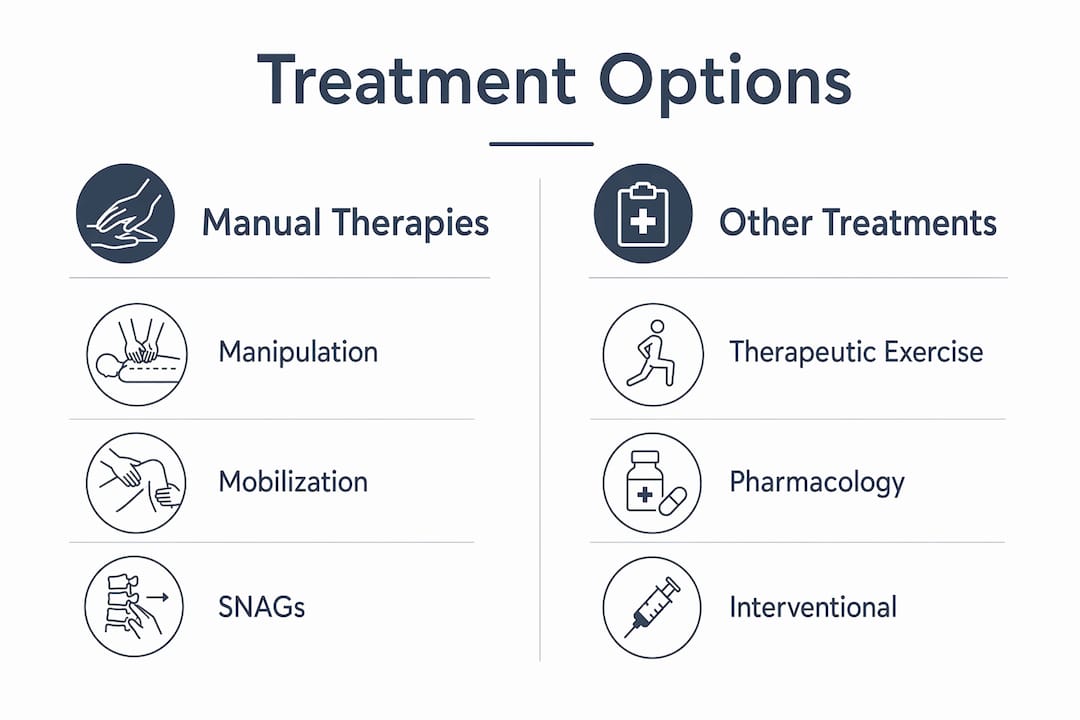
Manipulation uses high-velocity, low-amplitude thrusts. SNAGs use graded, lower-velocity joint mobilization targeting C1–C2 mobility combined with soft-tissue work. Both require a skilled clinician. The mechanistic basis involves stimulation of spinal inhibitory systems and descending pain modulation pathways, not just mechanical realignment.
Safety note:
CSM effectiveness and safety depend heavily on clinician training. For most CGH presentations, SNAGs and mobilization carry a more favorable safety profile and are a reasonable starting point.
What you can do today for immediate symptom relief?
These measures reduce pain now. They are not a substitute for targeted rehab, but they help you function while you arrange proper care.
Do these:
- Sit tall with ears over shoulders. A single posture correction cue can reduce suboccipital compression within minutes.
- Perform 10 slow cervical retractions (chin tucks): glide the head straight back, hold 3 seconds, release.
- Apply heat to the back of the neck for 15 minutes every 2 hours to ease muscle tension and improve local circulation.
- Use an ice pack on the base of the skull or forehead for 15 minutes if inflammation or throbbing is present.
- NSAIDs (ibuprofen) or acetaminophen can reduce acute pain; follow label dosing and consult a pharmacist if you take other medications.
- Trigger point self-massage at the suboccipital ridge can release localized muscle knots contributing to referred pain.
Avoid these:
- Self-manipulation or aggressive neck thrusting. High-velocity self-thrusts carry vascular risk and can worsen joint irritation.
- Prolonged phone-down posture. Every 20 minutes, raise the screen to eye level and retract the chin.
- Sleeping prone (face down). A cervical-support pillow in a side-lying or supine position keeps the spine neutral overnight.
Pro Tip:
Set a phone alarm every 30 minutes during desk work. Stand, retract your chin 5 times, and roll your shoulders back. That microbreak costs 20 seconds and prevents the cumulative load that builds into a headache by afternoon.
Your 6-week home program for Posture Correction and Headache Reduction

A progressive daily program targeting forward head posture is the backbone of long-term cervicogenic headache relief.
Here is a practical structure.
Core Exercises (with brief descriptions):
- Cervical retractions (chin tucks): Glide head straight back, not down. 3 sets of 10 reps daily.
- Deep cervical flexor activation: Lying supine, gently nod the chin without lifting the head. Builds endurance in the stabilizers that hold the head over the spine.
- Suboccipital gentle stretch: Tuck chin, then add a slight forward nod to lengthen the base-of-skull muscles. Hold 20–30 seconds.
- Levator scapulae and scalene release: Tilt ear to shoulder, add slight rotation away, hold 30 seconds per side.
- Scapular rows: Resistance band or cable rows with a focus on retracting the shoulder blades. 3 sets of 12.
- Thoracic mobility drills: Foam roller extension over mid-back for 60 seconds to restore the thoracic curve that forward head posture flattens.
Weekly progression:
- Week 1: Posture awareness and mobility only. Retractions, suboccipital stretches, thoracic foam rolling. No loading.
- Weeks 2–4: Add deep cervical flexor activation and scapular rows at low resistance. Focus on endurance, not strength.
- Weeks 5–6: Increase functional integration. Practice posture cues during work tasks, add resistance to rows, and formalize ergonomic changes.
Ergonomic Fixes that Matter:
- Monitor top at or just below eye level
- Keyboard positioned so elbows stay at 90 degrees
- Phone held at face height, not lap height
- Chair lumbar support maintaining a slight forward pelvic tilt
- Microbreak every 30 minutes
Pro Tip:
If exercises trigger a headache spike in the first week, reduce intensity rather than stopping entirely. A brief flare is common and expected; persistent worsening beyond 48 hours is a signal to check in with your PT.
When Conservative Care isn’t Enough? Interventional Options in the U.S.
If a well-structured PT program over 6–8 weeks hasn’t produced measurable improvement, escalation to interventional care is reasonable.
The Main Options:
- Diagnostic nerve blocks: Anesthetic injected near the target cervical structure. Pain relief confirms the source and identifies candidates for further procedures.
- Cervical epidural steroid injections (CESI): Reduce inflammation around irritated nerve roots. Useful for moderate-to-severe pain with a radicular component.
- Radiofrequency ablation (RFA): Uses heat to interrupt pain signals from confirmed facet-mediated sources. Provides longer-lasting relief for appropriately selected cases.
- Surgery: Last resort, reserved for structural pathology (disc herniation, instability) not responsive to all other approaches.
Radiofrequency ablation and deep cervical plexus blocks are best reserved for cases where diagnostic blocks confirm the pain source. Proceeding without that confirmation reduces the chance of meaningful relief and adds procedural risk.
Risks across interventional procedures include temporary post-injection soreness, infection (rare), and, for cervical procedures, rare but serious vascular or neurologic complications. Choose a board-certified pain specialist with specific experience in cervical procedures.
Evidence from a review of interventional options places acupuncture, CESI, and manual therapy among the supported non-surgical options, with RFA reserved for refractory cases.
How to Choose a Qualified Clinician for Cervicogenic Headache Care
Start with a licensed physical therapist who has specific training in cervical manual techniques. If diagnostics or injections are needed, a physiatrist, neurologist, or pain specialist enters the picture.
Clinician checklist:
- State licensure current and verifiable
- Documented training in cervical manual therapy (SNAGs, mobilization, safe manipulation protocols)
- Familiarity with the cervical flexion-rotation test for CGH diagnosis
- Willingness to coordinate with other specialists when needed
Questions to Ask at the First Visit:
- What outcome measures will you use to track my progress?
- Do you use SNAGs or mobilization before considering high-velocity manipulation?
- At what point would you refer me to a pain specialist or physiatrist?
- What does a typical 6-week plan look like for someone with my presentation?
Signs of quality care include measurable progress tracking from session one, a conservative-first approach, and clear criteria for when to escalate. A clinician who jumps straight to high-velocity manipulation without a thorough assessment is a red flag. Understanding how manual therapy realigns the cervical spine helps you ask better questions and evaluate what your clinician is actually doing.
What a Realistic 6-Week Rehabilitation Timeline Looks Like
Many people see measurable improvement in pain and function within 4–6 weeks of structured PT. At 12 months after a sustained program, 72% of participants had substantial headache frequency reduction.
| Week | Goals | Activities | Progress Markers |
|---|---|---|---|
| 1–2 | Reduce acute pain, restore basic ROM | Manual therapy, posture cues, gentle mobility | Pain VAS decrease, improved chin-tuck range |
| 3–4 | Build endurance, reduce headache frequency | Deep flexor activation, scapular rows, ergonomic setup | Headache days per week trending down |
| 5–6 | Functional integration, independence | Progressive loading, workstation audit, self-management plan | NDI score improvement, sustained posture habits |
| 12 months | Durable reduction | Home program maintenance, periodic PT check-ins | Substantial headache frequency reduction (72% of participants) |
Early symptom variability is normal. A temporary flare in weeks 1–2 does not mean the program is failing. If there is no measurable improvement by week 4–6, or if new neurologic signs appear, the plan needs revision and possibly specialist referral.
Potential Side Effects and Risks of Treatments
Every treatment in this guide carries some risk. Knowing them helps you make informed decisions.
Manual Therapy:
The most common side effects are temporary soreness and stiffness lasting 24–48 hours after a session. High-velocity cervical manipulation carries a rare but documented risk of vertebral artery injury.
Harvard Health guidance specifically recommends caution with high-velocity cervical thrusts, favoring gentler mobilization for most CGH presentations. SNAGs and lower-velocity mobilization have a substantially more favorable safety profile.
Interventional Procedures:
Nerve blocks and CESI carry risks of temporary pain increase, infection, and, rarely, dural puncture or vascular injury. RFA can cause temporary numbness or skin sensitivity at the treatment site. All cervical procedures require an experienced specialist in a clinical setting.
Exercise therapy:
Poorly progressed exercise can trigger symptom flares, particularly in the first two weeks. Gradual loading and clinician oversight reduce this risk considerably.
OTC Medications:
Long-term NSAID use carries gastrointestinal and cardiovascular risks. Acetaminophen in excess of recommended doses causes liver stress. Both are appropriate for short-term acute management, not ongoing daily use.
Does Diagnostic Imaging actually Change how Cervicogenic Headaches are Managed?
Imaging is useful in specific situations but is not required for most straightforward CGH presentations.
A clinical examination, including the cervical flexion-rotation test and response to manual assessment, often provides more diagnostic information than an MRI for typical cases.
When imaging adds value: ruling out structural pathology (disc herniation, instability, fracture, tumor) when red flags are present; guiding interventional procedures; and clarifying the anatomy before surgical consultation.
X-rays can reveal segmental instability or degenerative changes at C1–C3. MRI is preferred when soft-tissue or neural involvement is suspected.
The key point is that a normal MRI does not rule out CGH. The pain source is often functional joint dysfunction that imaging cannot capture. Conversely, degenerative findings on imaging are common in adults without headache and should not automatically drive treatment decisions.
Complementary Therapies with Real Evidence: Acupuncture and Biofeedback
Acupuncture has the strongest complementary evidence for CGH. A review of interventional and non-pharmacological options lists it among supported treatments, and it appears in multiple evidence summaries alongside manual therapy and CESI.
The proposed mechanism involves local anti-inflammatory effects and modulation of pain signaling at the cervical level. Acupuncture’s effect on cervical inflammation makes it a reasonable adjunct when manual therapy alone produces incomplete relief.
Biofeedback targets the stress and muscle-tension component of CGH. Surface EMG biofeedback trains patients to recognize and reduce trapezius and suboccipital muscle activation patterns that contribute to headache.
It works best as part of a broader program that includes posture correction and stress management, not as a standalone fix.
Dry needling, massage, and stress-reduction practices (diaphragmatic breathing, progressive muscle relaxation) round out the complementary options with at least moderate supporting evidence. None of these replace PT-first care, but they can meaningfully reduce symptom burden when layered into a structured program.
Key Takeaways
Physical therapy combining manual therapy and therapeutic exercise is the most evidence-supported first step for cervicogenic headache relief tied to forward head posture.
| Point | Details |
|---|---|
| PT-first is the standard | A 6-week program produced substantial headache frequency reduction in 72% of participants at 12-month follow-up. |
| CSM and SNAGs lead the evidence | The 2025 network meta-analysis gave CSM a SUCRA score of 98.9% for short-term pain relief; SNAGs showed durable long-term gains. |
| Diagnosis before treatment | Cervicogenic headaches are frequently misidentified as migraines; accurate diagnosis determines whether neck-based interventions will work. |
| Escalate when PT plateaus | Diagnostic nerve blocks, CESI, and radiofrequency ablation are the next steps after structured conservative care fails. |
| Bestforwardheadposturefix resources | Bestforwardheadposturefix provides structured posture programs, exercise guides, and evidence summaries to support a PT-first approach at home. |
Why posture correction belongs at the center of this conversation?
Most CGH guides focus on the headache and treat the neck as a secondary detail. That framing gets the problem backward. For people with forward head posture, the neck is the problem.
The headache is a symptom of a mechanical issue that has been building for months or years, usually driven by screen time, desk posture, and the slow creep of the head forward relative to the shoulders.
The research supports this framing. The interventions with the strongest long-term outcomes in the 2025 network meta-analysis are the ones that address cervical joint mechanics directly: SNAGs, mobilization, and exercise.
Medications and passive treatments manage symptoms. Posture correction and targeted rehab address the source.
There is also a practical argument. Interventional procedures like RFA provide real relief for the right patients, but they require confirmed diagnosis, specialist access, and carry procedural risk.
A structured home program costs almost nothing and, done consistently, produces outcomes that rival more invasive approaches for many people. The 6-week timeline is not arbitrary. It reflects how long it takes for cervical stabilizers to build meaningful endurance and for postural habits to become automatic.
The honest caveat: posture correction alone will not resolve CGH in every case. Some presentations involve structural pathology, significant joint degeneration, or pain that is too severe for exercise-first management.
That is exactly why this guide emphasizes early clinical evaluation and clear escalation criteria. The goal is not to replace medical care. It is to make sure you arrive at that care with the right information and the right questions.
Bestforwardheadposturefix: structured resources for your recovery
Cervicogenic headache relief built around posture correction requires more than a single article. Bestforwardheadposturefix offers the structured educational resources that make a PT-first approach actually stick: detailed exercise libraries, ergonomics checklists, manual-therapy explainers, and a step-by-step 6-week posture program grounded in the same clinical evidence covered here.

The site is built specifically for people dealing with forward head posture and neck-origin headaches. You get clear guidance on which exercises to start with, how to progress them without triggering a flare, and when to escalate to a clinician.
Visit Bestforwardheadposturefix to access the full program library and download the 6-week sample plan. Bring it to your first PT appointment as a starting point for your treatment discussion.
Annotated sources and further reading
The claims in this guide draw on the following clinical sources. Bringing summaries of these to your clinician visit supports shared decision-making.
-
Cleveland Clinic: Cervicogenic Headache — Cleveland Clinic CGH page. Covers diagnosis, PT-first treatment, and the 72% long-term outcome figure. Strong starting point for understanding what to expect from a structured program.
-
Frontiers in Neurology 2025 Network Meta-Analysis — Frontiers systematic review. Comparative efficacy of CSM, SNAGs, mobilization, exercise, and massage. The most current head-to-head evidence available.
-
Harvard Health: A Headache That Starts in Your Neck — Harvard Health CGH article. Diagnosis guidance, caution on high-velocity manipulation, and specialist referral recommendations.
-
American Migraine Foundation: Cervicogenic Headache — AMF CGH resource. Explains how nerve blocks serve both diagnostic and treatment purposes; outlines the full provider team.
-
StatPearls / NCBI Bookshelf: Cervicogenic Headache — StatPearls CGH entry. Mechanistic basis for manual therapy, including spinal inhibitory systems and descending pain modulation.
-
PubMed Central: Diagnostic Cervical Nerve Blocks — PMC nerve blocks article. Details the dual diagnostic and therapeutic role of nerve blocks and their use in identifying RFA candidates.
-
Headache Medicine: From Acupuncture to Radiofrequency Ablation — Headache Medicine review. Evidence levels across non-surgical and interventional options, including acupuncture, CESI, and RFA.
This article is general educational information, not medical advice. Confirm your diagnosis and treatment plan with a licensed clinician who can evaluate your specific situation.