Still wondering Isometric Neck Exercises for Forward Head Posture?
Start with a chin-tuck isometric hold right now. Sit tall, gently draw your chin straight back (not down), press your fingertips lightly against your forehead, and hold for 5 seconds without letting your head move.
That single move targets the deep cervical flexors, the small stabilizing muscles that forward head posture weakens most. Do it multiple times per direction throughout your workday, and you have the foundation of a real neck-strengthening program.
The four-direction micro-routine to start today:
- Chin-tuck/flexion hold: Fingertips on forehead, press gently back, hold 5 seconds × 6 reps
- Extension hold: Palm on back of skull, press gently forward, hold 5 seconds × 6 reps
- Right lateral hold: Right palm above right ear, press head into hand, hold 5 seconds × 6 reps
- Left lateral hold: Left palm above left ear, press head into hand, hold 5 seconds × 6 reps
Keep effort at a low to moderate level. You are training neuromuscular control, not testing maximum force.
Table of Contents
- Why do isometric neck exercises improve forward head posture?
- The six core isometric holds: step-by-step cues
- How to program isometric neck work safely
- Two desk routines you can use today
- Safety rules and red flags you need to know
- What timeline should you expect?
- Where does isometric neck work fit in a complete program?
- Key Takeaways
- The case for patience over intensity
- Ready to go deeper with a structured program?
- Useful sources
Why do Isometric Neck Exercises improve Forward Head Posture?
Isometrics improve posture by strengthening stabilizers without repeated joint motion that can irritate cervical tissues.
That distinction matters for anyone whose neck is already stiff or reactive from hours of screen time.
Forward head posture shifts the skull forward of the shoulders, which progressively lengthens and weakens the deep cervical flexors while the posterior neck muscles shorten and tighten.
Low-load isometric work reactivates those deep flexors and rebalances front-to-back muscle control, gradually reducing the forward translation of the head.
The second mechanism is neuromuscular timing. Sub-maximal contractions train the nervous system to fire stabilizing muscles at the right moment, which is exactly what desk workers lose after years of static, slumped postures.
High-force pushing does not accomplish this, and it often provokes spasm instead.
Physiotherapy consensus backs this up: meaningful gains come from control-focused, progressive dosing rather than grinding through maximal effort sets.
The Six Core Isometric Holds: Step-by-Step Cues
These six holds cover every direction your cervical spine needs to stabilize. You need only your hands, a folded towel, or a wall as resistance.
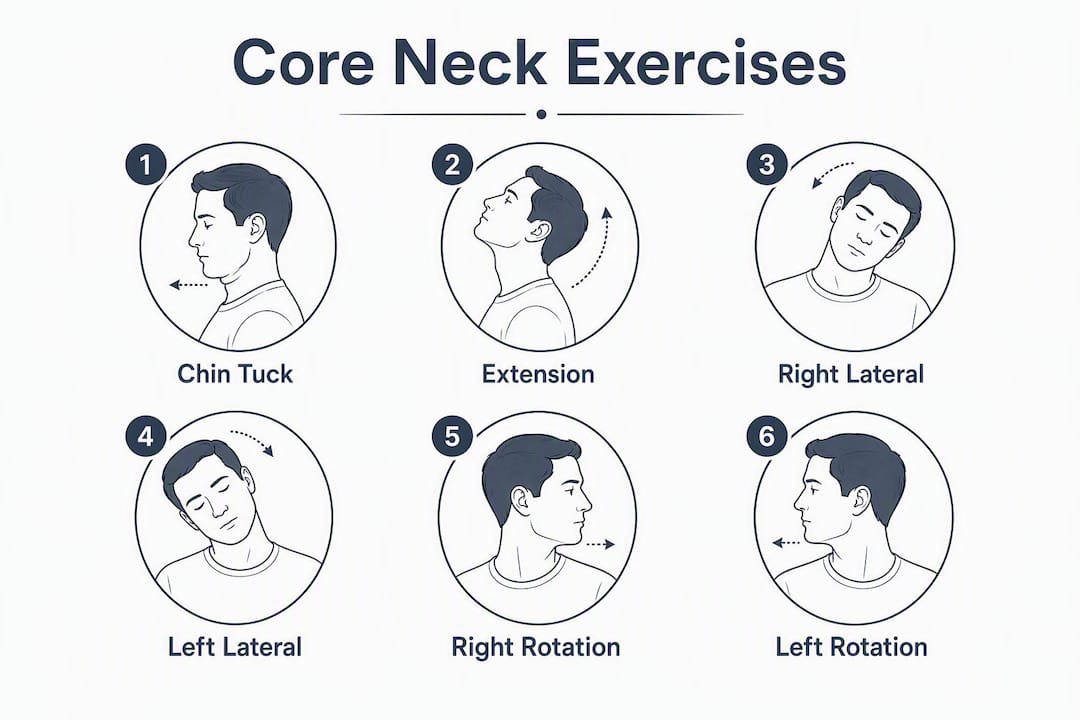
1. Chin-Tuck Isometric (front)
Sit upright, ears over shoulders. Place fingertips on your forehead. Draw your chin straight back, then press your head gently into your fingers. No head movement. Breathe normally throughout.
2. Extension Isometric (back)
Lace your fingers behind your skull. Press your head gently backward into your palms. Keep your chin level. Feel the back of your neck engage without arching your lower back.
3. Right Lateral Isometric
Place your right palm flat above your right ear. Press your head into your hand. Your shoulder stays down. No tilt occurs.

4. Left Lateral Isometric
Mirror the right side. Left palm above left ear, same rules.
5. Right Rotation Isometric
Place your right palm against your right temple. Attempt to rotate your head right while your hand resists. Zero head movement.
6. Left Rotation Isometric
Left palm against left temple, attempt to rotate left, resist with the hand.
| Exercise | Beginner hold | Beginner reps | Progress hold | Progress reps |
|---|---|---|---|---|
| Chin-tuck (front) | 5 sec | 6 | 10 sec | 8 |
| Extension (back) | 5 sec | 6 | 10 sec | 8 |
| Right lateral | 5 sec | 6 | 10 sec | 8 |
| Left lateral | 5 sec | 6 | 10 sec | 8 |
| Right rotation | 5 sec | 5 | 8 sec | 6 |
| Left rotation | 5 sec | 5 | 8 sec | 6 |
Modification for Very Irritable Necks:
Perform the chin-nod supine (lying on your back) before adding resistance.
A wall tap, where you press the back of your head lightly against a wall, works well as a first step toward the extension hold. These variations require no equipment and can be done anywhere.
Pro Tip:
Sub-maximal effort and normal breathing are not optional. Holding your breath spikes intra-abdominal pressure and recruits the wrong muscles. If you cannot breathe freely during a hold, reduce the effort to maintain normal breathing.
How to Program Isometric Neck Work Safely?
Lead with this rule: increase hold time and reps before you increase effort. Neuromuscular control comes first; force comes later, if at all.
Frequent small doses outperform infrequent intense sessions for motor-control retraining. A few holds every hour beats one long session at the end of the day.
Three-Stage Progression:
Begin with short hold durations and low repetitions, gradually increasing hold time and reps over weeks while maintaining moderate effort levels.
Progress through stages by increasing hold duration, repetitions, and sets over time with consistent daily practice.
Safety Cautions:
- Never hold your breath during a contraction.
- Stop if any hold produces sharp, shooting, or radiating pain.
- Over-bracing (gripping at 8–10/10 effort) is the most common beginner error; physiotherapy guidance consistently flags it as counterproductive.
- If stiffness increases after a session, reduce hold time by half before progressing again.
Two Desk Routines You can use Today
Both routines use the six holds above. Pick the one that fits your schedule.
3-Minute Micro-Break (Hourly)
- Chin-tuck hold: 5 sec × 4 reps (40 sec)
- Extension hold: 5 sec × 4 reps (40 sec)
- Right lateral: 5 sec × 3 reps (25 sec)
- Left lateral: 5 sec × 3 reps (25 sec)
- Rest 10 sec between directions
Total: approximately 3 minutes. Set a recurring phone alarm or use your computer’s clock as the trigger.
10-Minute Focused Session (Once or Twice Daily)
- All six isometric holds: 5–8 sec × 6 reps each (roughly 6 minutes)
- Scapular retraction: squeeze shoulder blades together, hold 5 sec × 10 reps (2 minutes)
- Thoracic extension over chair back: 30-second gentle hold × 2 (1 minute)
- Standing break and reset: 1 minute
Pro Tip:
Pair the 3-minute routine with something you already do hourly, like refilling your water or checking messages. Habit-stacking beats willpower every time.
Short, frequent doses build motor control faster than single long sessions. That is not a motivational claim; it is how neuromuscular retraining works.
Safety Rules and Red Flags You Need to Know
Stop immediately and seek clinical review if you experience any of the following:
- Sharp or radiating pain into the arm, shoulder, or hand during or after a hold
- New numbness or tingling in the fingers or arm
- Dizziness, visual changes, or nausea during neck movements
- Progressive arm weakness that was not present before starting
Common Beginner Mistakes and Quick Fixes:
- Over-bracing: Effort creeps above moderate levels. Reduce to 3–5/10 and focus on control, not force.
- Head movement during the hold: The head must stay still. If it moves, reduce resistance.
- Shoulder shrugging: Keep shoulders relaxed and down throughout every hold.
- Breath-holding: Breathe normally. If you cannot, the effort is too high.
Mild muscle soreness in the first few days is normal as your neck relearns coordination. What is not normal: sharp pain, worsening stiffness the morning after, or any neurological symptom.
NHS guidance recommends that pain should not worsen the morning after exercising. If it does, reduce load before adding any volume.
For persistent or worsening symptoms, physiotherapy assessment is the right next step.
What Timeline should You Expect?
Many people notice better neck control and less stiffness within 4–6 weeks of consistent practice.
Visible postural change typically takes 8–12 weeks or longer, and only when isometrics are combined with upper-back work and ergonomic adjustments.
- Hours to days: Reduced stiffness after each session; improved awareness of head position.
- Weeks 2–6: Better endurance during holds; less fatigue at the desk; improved neuromuscular timing.
- Weeks 6–12: Measurable reduction in forward head translation when combined with scapular strengthening and workstation changes.
- Beyond 12 weeks: Sustained improvement requires habit integration, not just exercise repetition.
Individual variability is real.
Factors like sleep, stress, screen time, and pre-existing cervical changes all affect the rate of progress.
If symptoms are not improving after 6–8 weeks of consistent work, reassess your neck alignment and consider professional input.
Where does Isometric Neck Work fit in a Complete Program?
Isometrics are the control-building piece of a three-part plan. The other two parts are scapular and upper-back strengthening, and workstation ergonomics. Without all three, progress stalls.
- Scapular retraction sets: Weak mid-trapezius and rhomboids let the shoulders round forward, which pulls the head with them. Combining neck control work with scapular strengthening produces better postural outcomes than either alone.
- Thoracic mobility: A stiff upper back forces the neck to compensate. Add thoracic extension over a chair back or foam roller 2–3 times per week.
- Workstation adjustments: Screen at eye level, chair supporting lumbar curve, external keyboard if using a laptop. These reduce the postural load your neck muscles are fighting against all day.
- Complementary stretches: Neck stretches for forward head posture pair well with isometrics as a warm-up or cooldown.
Neck strain is not always desk-related. Caregiving postures, including feeding positions, create similar forward-load patterns.
Neck strain from sustained caregiving positions responds to the same isometric and ergonomic principles.
Key Takeaways
Isometric neck exercises build deep cervical flexor control most effectively at sub-maximal effort (3–5/10), performed in short sets every hour rather than one long daily session.
| Point | Details |
|---|---|
| Sub-maximal effort | Keep contractions at 3–5/10 intensity; higher force increases spasm risk, not control. |
| Hourly micro-dosing | Short sets every hour build motor control faster than one intense daily session. |
| Six-direction coverage | Train all six directions: front, back, right/left lateral, right/left rotation. |
| Integrate upper-back work | Pair isometrics with scapular retraction and thoracic mobility for lasting postural change. |
| Bestforwardheadposturefix | Provides science-backed guides, progressive 12-week programs, and habit-change support for forward head posture correction. |
The case for Patience over Intensity
Most people who start neck exercises push too hard too fast.
They feel the muscles working, assume more effort means faster results, and end up with increased stiffness by day three. Then they quit.
The research behind isometric neck work points in the opposite direction.
Control and timing improve with moderate, repeated activation, not with maximal grinding. A 5-second hold at 4/10 effort, done six times an hour, does more for forward head posture than a single brutal set ever will.
What gets overlooked is that forward head posture is largely a motor-control problem, not a strength deficit.
The deep cervical flexors are not simply weak; they have stopped firing at the right time. Isometrics at sub-maximal intensity are one of the few tools that directly retrain that timing.
Combine that with scapular work and a screen at eye level, and you have a program that addresses the actual cause rather than just the symptom.
The other thing worth saying: consistency over weeks matters far more than perfection in any single session.
Miss a day, reduce load when your neck is reactive, and keep going. That is what sustainable posture correction looks like.
Ready to go Deeper with a Structured Program?
Bestforwardheadposturefix gives you everything in one place: printable 3-minute and 10-minute desk routines, a progressive 12-week isometric and upper-back program, and a full exercise library covering scapular strengthening, thoracic mobility, and habit-change strategies.

The guides are built on the same physiotherapy-aligned principles covered here, structured so you can move from beginner holds to a full posture-correction program without guessing what comes next.
Visit Bestforwardheadposturefix to access the complete resource library and start your structured program today.
Useful Sources
The following clinical and government sources informed the exercise cues, dosage guidance, and safety recommendations in this article:
- PubMed: Isometric neck exercise and cervical stabilization
- PubMed: Sub-maximal isometric intensity for neck rehabilitation
- PMC: Physiotherapy guidance on neck motor control
- NCBI Bookshelf: Exercise dosing and neuromuscular retraining
- NHS Inform: Exercises for neck problems
- Spine-Health: Neck strengthening exercises
- Physical-Therapy.us: Isometric neck exercise guide
This article is for general educational purposes only and is not a substitute for professional medical or physiotherapy advice.
If you have existing neck injury, neurological symptoms, or are unsure whether these exercises are appropriate for your situation, consult a licensed clinician before starting.