Most cycling neck pain comes down to one thing: your handlebars are too low or too far away, and your neck’s small extensor muscles are doing endurance work they were never built for. The fix is almost never one thing alone. It’s a combination of fit adjustments you can test on a single ride and neck endurance work you build over two to four weeks.
Here’s what to try before your next ride:
- Raise your bars 10 to 20 millimeters using spacers you already have, or flip your stem if it’s slammed. Check within one ride.
- Soften your elbows and shift hand position every 10 to 15 minutes on the hoods, tops, or drops. Check within 15 minutes.
- Shorten your reach slightly (a shorter stem or bars rotated back a few degrees) if raising bars alone doesn’t cut it. Check over 2 to 4 weeks of riding.
Neck pain from cycling is common enough that it’s barely considered unusual. One widely cited estimate puts non-traumatic riding injuries, neck and back pain included, at up to 85% of cyclists at some point. That’s not a fringe complaint. It’s closer to a universal cycling tax that most riders just accept instead of fixing.
Key Takeaways
Cycling neck pain is usually a fixable combination of a too-aggressive bike fit and pre-fatigued neck muscles carried over from daily desk posture, and both need addressing for lasting relief.
| Point | Details |
|---|---|
| Test bar height first | Add 10 to 20 millimeters of spacer height and ride 20 minutes to check for improvement on your next ride. |
| Rotate hand positions | Shift between hoods, tops, and drops every 10 to 15 minutes to vary cervical extension angle. |
| Fix your desk setup | Raise your monitor to eye level and set an hourly posture check to reduce pre-ride neck fatigue. |
| Start chin-tuck holds | Do 10 reps of 5-second holds, 3 to 5 times per week, to build deep neck flexor endurance. |
| Watch for red flags | Numbness, shooting arm pain, or progressive weakness means see a physio or doctor, not another fit tweak. |
| Explore root-cause guides | Bestforwardheadposturefix offers structured posture-correction education for the forward head posture that often preloads cycling neck pain. |
Where to read more on this
These sources were chosen because they combine clinical interviews with practical, testable guidance rather than generic stretching advice. University of Utah Health’s Scope article is useful for its clinician-backed framing of desk posture and fit. Roadman Cycling’s prevention guide gives the clearest actionable numbers for bar height changes. Avid Sports Medicine’s breakdown is worth reading for its case against relying on stretching alone. Chain Reaction Physical Therapy’s fit-focused piece is the sharpest resource on checking eyeline and knee angle before touching your cockpit. And Bicycling’s exercise guide offers the most complete, rider-tested list of mobility and strength drills.
This article is general information, not a substitute for advice from a qualified doctor. Consult a qualified healthcare professional about your own circumstances before acting on anything here.
Table of Contents
- What Causes Neck Pain From Cycling?
- How Do You Fix Cycling Neck Pain on Your Next Ride?
- What Bike Fit Changes Reduce Neck Strain?
- What Exercises Help Cycling Neck Pain?
- Why Does Desk Posture Cause Neck Pain When Cycling?
- When Should You See a Doctor for Neck Pain From Cycling?
- How Bestforwardheadposturefix Helps You Fix the Root Cause
- Sources
What Causes Neck Pain From Cycling?
Your neck isn’t built to hold an extended, chin-up position for two hours at a stretch, and that’s exactly what a drop-bar riding posture demands. When your torso flexes forward at the hips and thoracic spine, your neck has to extend backward to keep your eyes on the road. That combination, thoracic flexion paired with cervical extension, puts sustained load on a handful of small muscles at the base of your skull: the suboccipitals, upper trapezius, and splenius group. They’re built for quick postural corrections, not for holding a fixed angle against gravity for 90 minutes.
The math is not in your favor to begin with. Your head weighs somewhere between 10 and 12 pounds on its own. Tilt it back to look up the road while your torso is already bent forward, and the effective leverage on those neck muscles multiplies well beyond that resting weight. Fast Talk Laboratories frames it as an endurance problem more than an injury problem: the muscles aren’t torn, they’re just outmatched by the demand you’re placing on them, ride after ride.
| Factor | Typical Range | What It Means |
|---|---|---|
| Head weight | 10–12 lbs | Leverage increases sharply with cervical extension angle |
| Non-traumatic injury prevalence | Up to 85% of cyclists | Neck and back complaints are the norm, not the exception |
| Time-to-onset | 20 minutes into a ride | Pain often starts once desk fatigue meets riding position |
| Effective fit fix window | 1 ride to 4 weeks | Bar height changes work fast; strength changes take longer |
A few risk factors stack on top of the basic mechanics. Forward head posture from years of desk work or phone use means your neck extensors are already working overtime before you clip in. Poor thoracic mobility forces your neck to compensate for a stiff upper back that can’t round enough on its own. An aggressive reach and drop, common on race-oriented frames, pushes the extension angle further than most non-racers need. And a heavy or forward-tilted helmet adds rotational torque right where you can least afford it. Riders who spend eight hours a day hunched over a keyboard show up to their evening ride with neck extensors that are already pre-fatigued, according to clinicians at University of Utah Health, which is why the same bike fit can feel fine on a rest day and brutal after a long workday.
How Do You Fix Cycling Neck Pain on Your Next Ride?
You can diagnose most of this yourself with a single ride, broken into three timed stages. Don’t change everything at once. Change one variable, ride long enough to notice a difference, then decide.
- Start with bar height. Add 10 to 20 millimeters of spacer height under your stem, or flip the stem if it’s currently angled down. Ride at least 20 minutes at your normal effort and note when neck discomfort starts compared to your usual onset time.
- Soften your elbows. A locked elbow transmits every bit of road vibration straight into your shoulders and neck. Bend them slightly, almost like a boxer’s guard, and hold that for 10 minutes. If your shoulders drop and your neck feels less locked, that’s your answer.
- Rotate through hand positions. Move between the tops, hoods, and drops every 10 to 15 minutes instead of parking on the hoods for the whole ride. Each position changes your cervical extension angle slightly, which gives overworked muscles a break.
- Shorten your stem or bring the bars closer, only if steps one and two didn’t fully resolve things. This is a bigger change, so give it a full ride before judging.
Improvement after step one or two usually shows up immediately, within that same ride. If raising the bars buys you an extra 15 minutes before onset, you’ve confirmed fit is a major driver. If nothing changes even after softening your elbows and rotating hand positions, the problem likely sits more in endurance and mobility than in millimeters of stem length.
Pro Tip: Keep a one-line log after each ride: time-to-onset, what you changed, and how you felt the next morning. A change that helps for one ride but the pain returns worse by the third ride is often a temporary compensation, not a fix. A change that keeps working past ride three or four is the one worth keeping permanently.
What Bike Fit Changes Reduce Neck Strain?
Reach and drop are the two numbers that dictate how far your neck has to extend to keep your eyes level with the road. Reach is the horizontal distance from your saddle to your bars; drop is the vertical distance between saddle height and bar height. Increase either one and you’re asking your neck to compensate for a torso that’s flatter and farther forward than it can comfortably support for a long ride.
You don’t need a laser fit tool to get a rough read on this. Sit on your bike against a wall or have someone take a side photo while you’re in your normal riding position, hands on the hoods. If your eyeline requires you to crane your chin up noticeably to see 20 feet ahead, your drop is likely too aggressive for your current mobility. Clinicians at Chain Reaction Physical Therapy point to a stem that’s too low, a saddle set too high, or reach that’s simply too long as the three most common culprits, and recommend checking eyeline and knee angle before touching cockpit geometry at all.
Bar Stack and Spacers
Adding spacers under your stem is the cheapest, most reversible change available. Most road and gravel bikes tolerate 20 to 40 millimeters of added stack without hurting handling in any way you’d notice on a recreational ride. Start with 10 to 20 millimeters, since that range alone has been shown to meaningfully reduce cervical extension for many riders.
Stem Length
A shorter stem, dropping from a 110mm to a 90mm for example, shortens your reach without touching saddle position. This matters if raising your bars alone left your torso still stretched flat. Swap stems are cheap, and most shops will let you test a demo length before committing.
Saddle Fore-Aft Position
Sliding your saddle slightly forward can shorten effective reach without lowering the front end, which is useful if you don’t want to sacrifice aerodynamics or descending control. Move it in small increments, 5 millimeters at a time, since saddle position also affects knee tracking and power transfer.
Bar Width and Tilt
Wider bars open your chest and can ease shoulder tension that radiates into the neck. Rotating your bars up slightly changes the angle of your wrists and, in turn, how much you have to extend your neck to keep your hands comfortable on the hoods.
For each of these, the test protocol is the same: change one thing, ride at least one full session at normal effort, and give it three to four rides before deciding whether the improvement is real or just a placebo bump from novelty. Fast Talk’s clinical panel is blunt about this: physical exams matter before big changes, because some neck issues are structural and won’t respond to fit tweaks no matter how well-calibrated they are.
What Exercises Help Cycling Neck Pain?
Fit changes buy you comfort today. Strength and mobility work is what keeps that comfort from evaporating the moment you add another hour to your weekend ride. Sports medicine guidance is consistent on this point: pairing cockpit adjustments with targeted training outperforms either approach alone, and stretching by itself tends to be the weakest lever of the three.
- Chin-tuck holds: 10 reps of 5-second holds, 3 to 5 times per week. Pull your chin straight back like you’re avoiding a low doorway, not down toward your chest.
- Thoracic extension over a foam roller: 8 to 10 reps, holding each extension for 2 seconds, daily if your upper back feels stiff.
- Scapular retraction (squeeze and hold): 10 reps of 5-second holds, 3 to 5 times per week, to build the upper-back endurance that keeps your shoulders from collapsing forward on long rides.
- Diaphragmatic breathing drills: 5 minutes daily, focused on expanding your ribcage rather than lifting your shoulders, which reduces the accessory neck muscle tension that builds during shallow, stressed breathing.
Progress by adding a light resistance band to chin tucks once 10 reps feels easy, or by extending hold times on scapular retractions from 5 seconds to 10. Don’t rush load, though. These are small stabilizer muscles, and quick progression tends to cause soreness that mimics the pain you’re trying to fix. Yoga-based mobility work aimed specifically at cyclists’ recovery needs can supplement this routine on rest days, particularly for thoracic rotation and hip flexor length, both of which indirectly affect how much your neck has to compensate on the bike.
Stop and reassess if any exercise reproduces sharp pain, tingling, or numbness rather than the expected mild muscular fatigue. That’s a signal to see a professional rather than push through.
Why Does Desk Posture Cause Neck Pain When Cycling?
Your ride doesn’t start when you clip in. It starts eight hours earlier at your desk. If your monitor sits below eye level or your keyboard forces your shoulders forward, you spend your workday in the same forward head posture that cycling then asks your neck to hold in a different, extended position. The muscles arrive at the ride already partway to fatigue, which shortens your time-to-onset dramatically compared to a rest day.
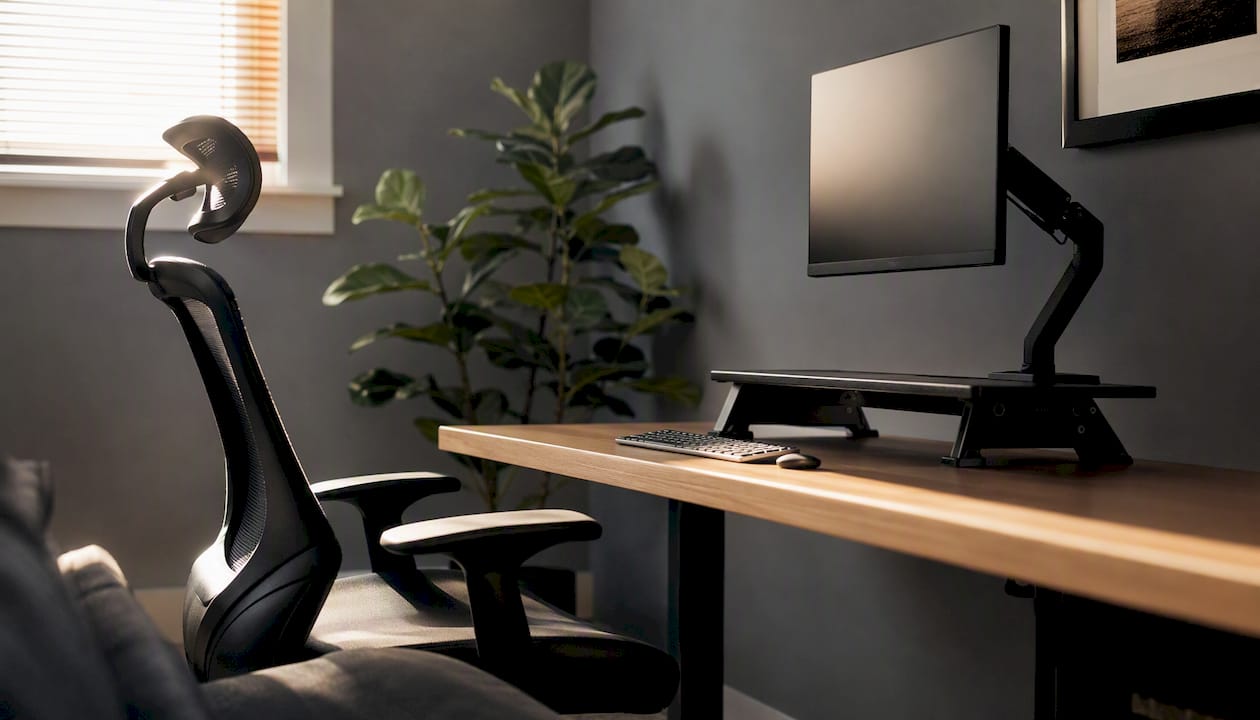
Raise your monitor so the top third of the screen sits at eye level, keep your keyboard close enough that your elbows stay near your sides, and set a timer for every 60 minutes to check whether your chin has crept forward. That single hourly check, informal as it sounds, is often more effective at preventing FHP-related strain than any bike adjustment, because it addresses the muscle fatigue before it ever reaches the bike.
This is why fixing your workstation often produces a faster drop in ride-day neck pain than another round of stem swaps. You’re not fighting a fit problem anymore; you’re fighting a 40-hour-a-week postural habit that a two-hour ride simply can’t outweigh on its own. Riders who build in a midday posture check tend to report a shorter time-to-onset improvement within a week or two, well ahead of what pure fit changes typically deliver on their own.
When Should You See a Doctor for Neck Pain From Cycling?
Most cycling neck pain is muscular, positional, and fixable with the steps above. But certain symptoms mean you should stop experimenting and get evaluated instead of running another one-ride test.
- Numbness or tingling in your hands, arms, or fingers, especially if it follows a specific nerve pathway rather than a general ache.
- Shooting pain down one arm, which can indicate nerve root involvement rather than simple muscle fatigue.
- Progressive weakness in your grip or arm strength that wasn’t there a month ago.
- Persistent night pain or a headache pattern that’s changed in frequency or intensity, particularly if over-the-counter pain relief stops working.
Before your appointment, bring a short log: how long into a ride the pain typically starts, what makes it better or worse, any past neck injuries (including old whiplash, which can predispose you to recurring strain), and whether you’ve changed helmets recently. A physical therapist or sports medicine physician is usually the right first stop for positional or fit-related pain; they’ll often check cervical range of motion, screen for nerve tension, and may refer you for imaging only if red flags are present. Primary care makes more sense if the pain came on suddenly with no clear riding trigger, or if you’re also dealing with headaches, dizziness, or vision changes.
One habit that consistently helps riders
The single change that seems to move the needle fastest isn’t a fit tweak at all. It’s the hourly desk posture check paired with a five-minute chin-tuck routine done before you even touch your bike. Riders who adopt that habit tend to notice their neck pain onset gets pushed later within the first couple of rides, often before any cockpit adjustment has even been tested. That’s the desk-to-bike pipeline in action: fix the input, and the output improves without touching a single spacer.

A rider who spends all week at a laptop and then wonders why 40 minutes into Saturday’s group ride their neck seizes up is usually looking at the wrong variable. The bike fit might be fine. The desk setup, and the eight hours a day it quietly loads onto the same muscles, is often the real lever. Start there, and the fit changes you eventually make tend to stick better because you’re not fighting pre-fatigued muscles anymore. Try the hourly check tomorrow, not next month.
How Bestforwardheadposturefix Helps You Fix the Root Cause
Bestforwardheadposturefix takes the desk-to-bike problem seriously because forward head posture doesn’t start on your bike, it follows you there. The site’s educational guides walk you through the same postural mechanics behind cycling neck pain, but applied to the other 22 hours of your day when you’re not riding, using structured habit-change frameworks instead of one-off stretches.

You’ll find in-depth breakdowns of how posture correction techniques reduce chronic neck strain, plus practical guides on rebuilding the muscle balance that keeps your head stacked over your shoulders instead of drifting forward at your desk and on your bars alike. Start with the Bestforwardheadposturefix homepage to find the guide that matches where your posture problems actually originate, whether that’s hours at a keyboard, an old whiplash injury, or years of a too-aggressive bike fit.
Sources
- Preventing Neck and Back Pain in Cyclists — The Scope (University of Utah Health)
- Cycling Neck Pain — Causes, Fixes & Prevention | Roadman Cycling
- Neck Pain In Cyclists: Why It Happens And How To Fix It | Avid Sports Medicine
- Neck Pain With Cycling and How To Fix It — Chain Reaction Physical Therapy
- 8 Neck Exercises to Ease Pain and Soreness from Cycling — Bicycling